Will AI replace criminal justice and law enforcement teachers, postsecondary?

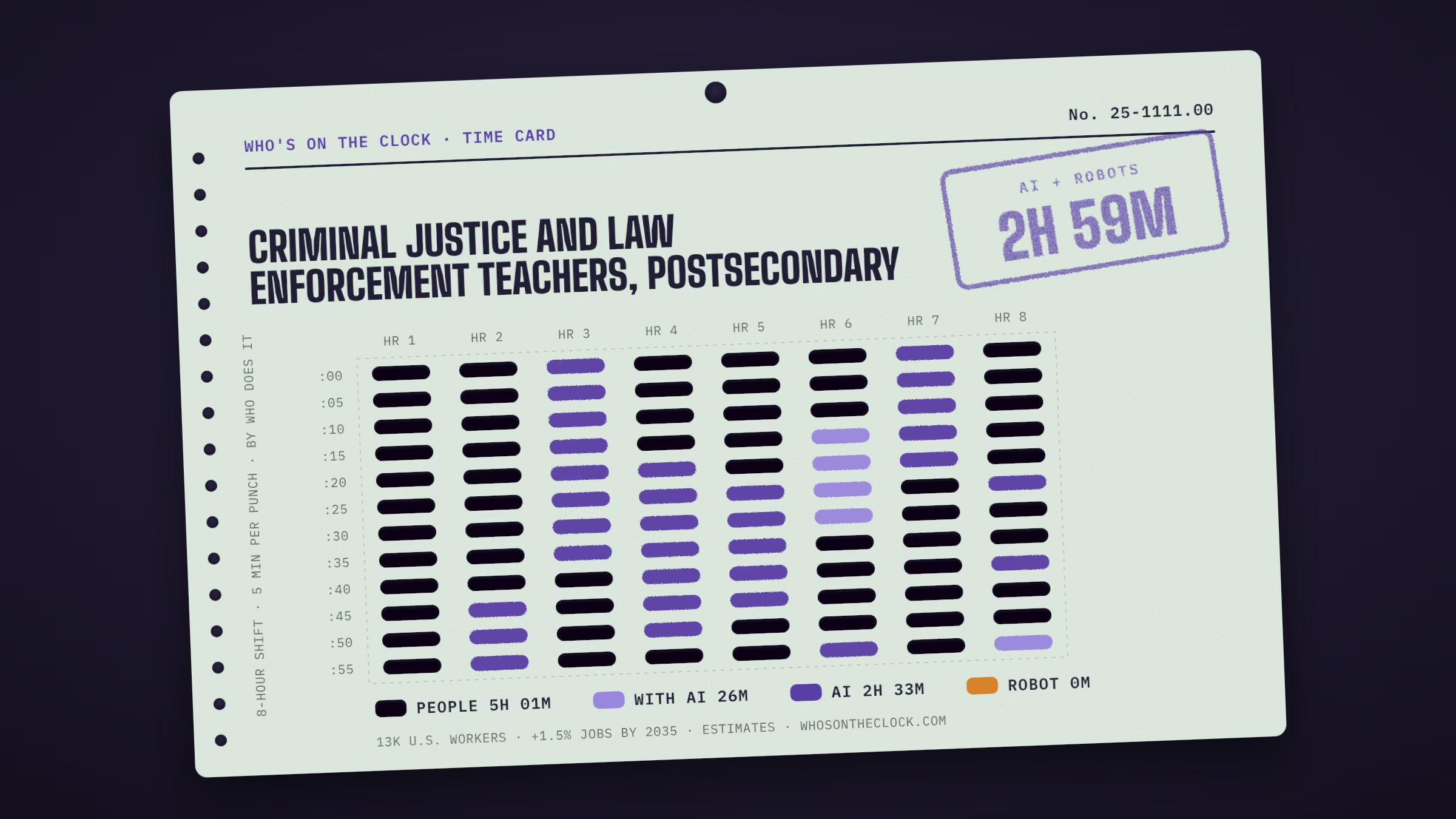
Some tasks are already handled by AI or machines; the rest still needs a person. About 2h 33m of an 8-hour shift goes to tasks that AI or robots largely take over. The breakdown: 26m done by people with AI help, 2h 33m that AI mostly does alone. The other 5h 1m (63%) stays with people. Separately, BLS expects about 1.5% more of these jobs by 2035 (all jobs: +3.5%).

Time card for criminal justice and law enforcement teachers, postsecondary showing a typical 8-hour shift: 5h 1m done by people, 26m done by people with AI, 2h 33m by AI.
Each mark is 5 minutes of a typical shift for criminal justice and law enforcement teachers, postsecondary, colored by who does that task today. Estimates from O*NET tasks and Anthropic Economic Index data. How it's made

Home / Education / Criminal Justice and Law Enforcement Teachers, Postsecondary

Teach courses in criminal justice, corrections, and law enforcement administration. Includes both teachers primarily engaged in teaching and those who do a combination of teaching and research.

Time card

Untick tasks you don't do, or set your own times.
MineTask, by time spentHumanWith AIAIRobot
Prepare and deliver lectures to undergraduate or graduate students on topics such as criminal law, defensive policing, and investigation techniques.1h 46m a shift · No AI or robot evidence found
Evaluate and grade students' class work, assignments, and papers.53m a shift · Observed in AI useTypical AI request: about 3h 59m alone, 42m with AI
Prepare course materials, such as syllabi, homework assignments, and handouts.37m a shift · No AI or robot evidence found
Conduct research in a particular field of knowledge and publish findings in professional journals, books, or electronic media.32m a shift · Observed in AI useTypical AI request: about 8h 34m alone, 31m with AI
Initiate, facilitate, and moderate classroom discussions.26m a shift · No AI or robot evidence found
Compile, administer, and grade examinations, or assign this work to others.26m a shift · Observed in AI useTypical AI request: about 8h 15m alone, 25m with AI
Maintain regularly scheduled office hours to advise and assist students.26m a shift · No AI or robot evidence found
Keep abreast of developments in the field by reading current literature, talking with colleagues, and participating in professional conferences.21m a shift · Observed in AI use
Serve on academic or administrative committees that deal with institutional policies, departmental matters, and academic issues.21m a shift · No AI or robot evidence found
Plan, evaluate, and revise curricula, course content, course materials, and methods of instruction.16m a shift · Observed in AI useTypical AI request: about 10h 7m alone, 1h 7m with AI
Advise students on academic and vocational curricula and on career issues.16m a shift · Observed in AI useTypical AI request: about 4h 19m alone, 51m with AI
Collaborate with colleagues to address teaching and research issues.16m a shift · No AI or robot evidence found
Perform administrative duties, such as serving as department head.16m a shift · No AI or robot evidence found
Maintain student attendance records, grades, and other required records.11m a shift · No AI or robot evidence found
Participate in campus and community events.11m a shift · No AI or robot evidence found
Supervise undergraduate or graduate teaching, internship, and research work.11m a shift · No AI or robot evidence found
Participate in student recruitment, registration, and placement activities.5m a shift · Observed in AI use
Select and obtain materials and supplies, such as textbooks.5m a shift · No AI or robot evidence found
Write letters of recommendation for students.5m a shift · No AI or robot evidence found
Compile bibliographies of specialized materials for outside reading assignments.5m a shift · Observed in AI use
Act as advisers to student organizations.5m a shift · No AI or robot evidence found
Write grant proposals to procure external research funding.5m a shift · No AI or robot evidence found
Provide professional consulting services to government or industry.5m a shift · Observed in AI use

On the floor

No company news tracked for this job yet. New stories are added as they happen.

Ask the clock

Will AI replace criminal justice and law enforcement teachers, postsecondary?

Some tasks are already handled by AI or machines; the rest still needs a person. About 2h 33m of an 8-hour shift goes to tasks that AI or robots largely take over. The breakdown: 26m done by people with AI help, 2h 33m that AI mostly does alone. The other 5h 1m (63%) stays with people. Separately, BLS expects about 1.5% more of these jobs by 2035 (all jobs: +3.5%).

What can AI already do for criminal justice and law enforcement teachers, postsecondary?

AI shows up regularly in 9 of 23 tasks, about 2h 59m of a typical shift. The biggest ones:

  • Evaluate and grade students' class work, assignments, and papers. (53m a shift, AI mostly does it alone)
  • Conduct research in a particular field of knowledge and publish findings in professional journals, books, or electronic media. (32m a shift, AI mostly does it alone)
  • Compile, administer, and grade examinations, or assign this work to others. (26m a shift, AI mostly does it alone)
  • Plan, evaluate, and revise curricula, course content, course materials, and methods of instruction. (16m a shift, AI mostly does it alone)
  • Advise students on academic and vocational curricula and on career issues. (16m a shift, AI mostly does it alone)
What still needs a person?

5h 1m of a typical shift, or 63%, goes to tasks with no AI or robot evidence yet. No AI usage or robot deployment has shown up for these so far. The biggest:

  • Prepare and deliver lectures to undergraduate or graduate students on topics such as criminal law, defensive policing, and investigation techniques. (1h 46m a shift)
  • Prepare course materials, such as syllabi, homework assignments, and handouts. (37m a shift)
  • Initiate, facilitate, and moderate classroom discussions. (26m a shift)
  • Maintain regularly scheduled office hours to advise and assist students. (26m a shift)
  • Serve on academic or administrative committees that deal with institutional policies, departmental matters, and academic issues. (21m a shift)
Why is that work hard to automate?

Much of it comes down to where and how the work happens. In-person, hands-on and high-stakes work is where AI and robots have made the least headway so far. In the official O*NET survey of people in this job:

  • 75% say dealing with the public is very or extremely important
  • 63% talk face to face with others every day
  • 52% work at arm's length or closer to other people
How much time does AI save on these tasks?

For the 5 tasks in this job where AI shows up and timing data exists, a typical request takes about 8h 15m for a person alone and about 42m with AI. These are Claude's own estimates from real conversations in April and May 2026 (Anthropic Economic Index). They describe single requests, not whole workdays, and time saved on a task doesn't mean jobs are cut. The biggest gaps:

  • Plan, evaluate, and revise curricula, course content, course materials, and methods of instruction (about 10h 7m alone, 1h 7m with AI)
  • Conduct research in a particular field of knowledge and publish findings in professional journals, books, or electronic media (about 8h 34m alone, 31m with AI)
  • Compile, administer, and grade examinations, or assign this work to others (about 8h 15m alone, 25m with AI)
Are employers still hiring criminal justice and law enforcement teachers, postsecondary?

On Indeed, job postings in the Education & Instruction sector are at 107% of their February 2020 level (all U.S. postings: 104%), down 9.5% from a year earlier, as of Oct 9, 2026. BLS separately expects about 1,100 openings a year in this job through 2035. Across all U.S. postings, 7.3% now mention AI skills. Sector postings cover more than this one job and move for many reasons besides AI.

How much do criminal justice and law enforcement teachers, postsecondary make?

The median pay is about $76,590 a year, 50% above the median for all U.S. jobs ($50,980). Most people in this job earn between $45,000 and $140,240 a year; that range covers the middle 80%. Pay figures are from BLS, May 2025, and vary a lot by state and employer. Pick a state to compare:

Is this job growing or shrinking?

BLS projects growth of 1.5% from 2025 to 2035, compared with 3.5% growth for all jobs. That's about 16,000 jobs in 2035. It expects about 1,100 openings a year, mostly from people retiring or changing careers. These projections don't single out AI as a cause.

How many criminal justice and law enforcement teachers, postsecondary are there in the U.S.?

About 13,000 people in the U.S., roughly 0.01% of all workers (BLS, May 2025). That makes it the 619th largest of the 796 jobs on this site. BLS expects about 16,000 in 2035.

What training do criminal justice and law enforcement teachers, postsecondary need?

The most common requirement is a master's degree: about 39% of people in the job said so in the official O*NET survey. O*NET rates the job at level 5 of 5 for preparation, which usually means: graduate degree. Requirements vary by state and employer, especially for licensed work.

What should I learn to stay ahead of AI?

These come from the job's official skill ratings and from the tasks that AI and robots touch least today. Building them keeps you strong in the parts of the work that still need a person:

  • Skills that matter more here than in most jobs: Speaking, Learning Strategies, Instructing, Active Learning
  • Get strong at the parts of the job that stay with people (listed above), which take 5h 1m of a typical shift
  • Tools employers list: Google Docs, Microsoft Access, Microsoft Excel, Microsoft Office software, Microsoft Outlook
  • Learn to use AI well on the tasks where it already shows up in this job (listed above)
What other jobs could criminal justice and law enforcement teachers, postsecondary move into?

These use similar skills. Matches come from 109 official ratings of skills, knowledge and work activities, and each needs the same or less preparation unless the official list relates the jobs directly:

  • Postsecondary Law Teachers (4h 25m touched, $129k median pay)
  • Family and Consumer Sciences Teachers, Postsecondary (2h 58m touched, $76k median pay)
  • Postsecondary Business Teachers (3h 20m touched, $99k median pay)
  • Postsecondary Sociology Teachers (3h 33m touched, $84k median pay)
  • Postsecondary Library Science Teachers (3h 42m touched, $80k median pay)
How solid are these numbers?

Each task carries its own evidence label. For this job: 9 observed in real AI use, 14 with no AI or robot evidence found. The minutes per task are estimates, not measured hours, and "no evidence" doesn't prove a task is safe.

Tools in demand

  • Google Docs
  • Microsoft Access
  • Microsoft Excel
  • Microsoft Office software
  • Microsoft Outlook
  • Microsoft PowerPoint
  • Microsoft Word

Also called

Adjunct Criminal Justice Instructor, Adjunct Instructor, Adjunct Professor, Assistant Professor, Associate Professor, College Faculty Member, College Professor, Criminal Justice Adjunct Instructor, Criminal Justice Assistant Professor, Criminal Justice Associate Instructor, Criminal Justice Faculty Member, Criminal Justice Instructor, Criminal Justice Professor, Criminal Justice Specialist