Will AI replace quality control analysts?

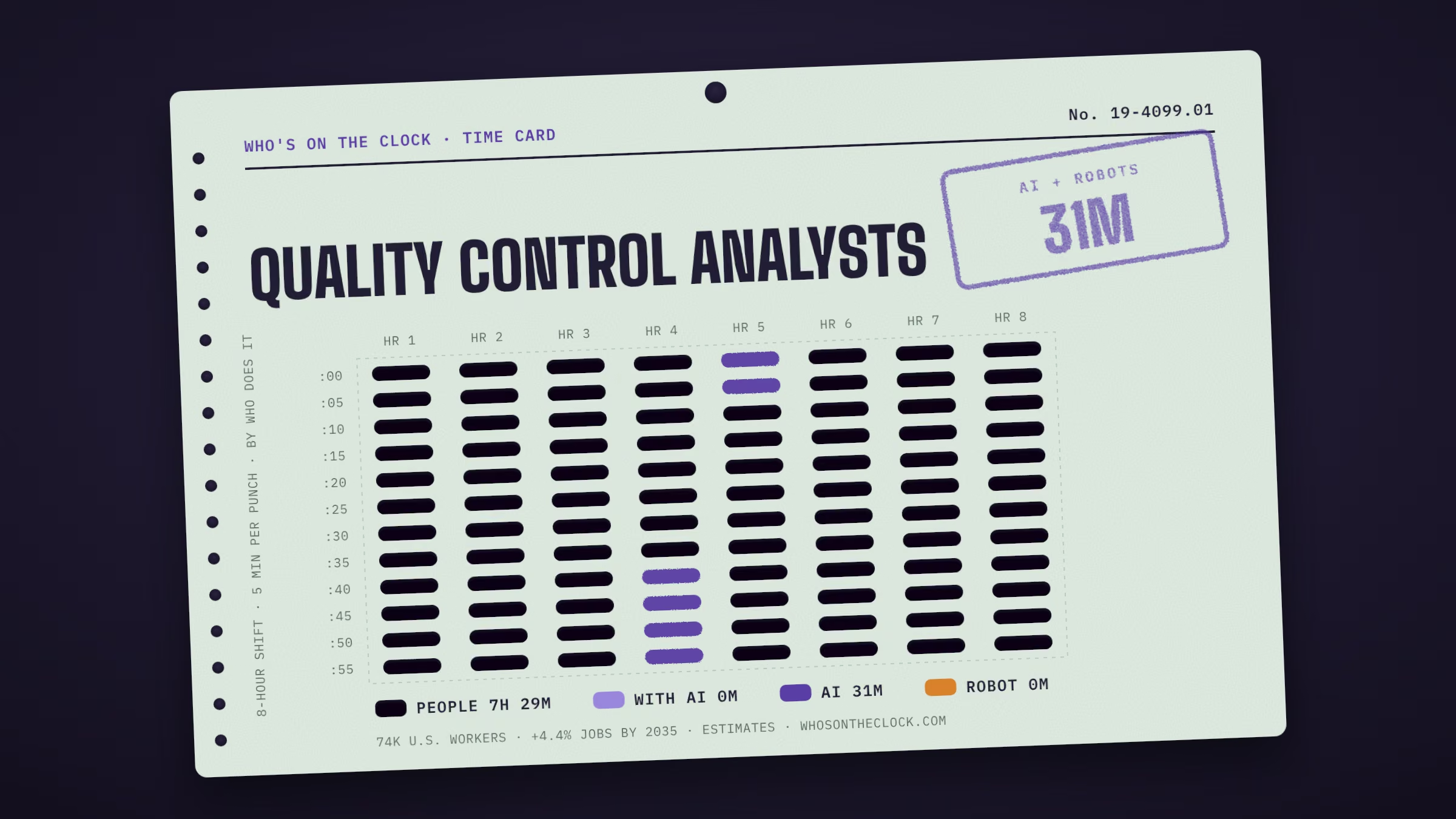
Not replace, but it is changing the job. About 31m of an 8-hour shift goes to tasks touched by AI working on its own. The other 7h 29m (94%) stays with people. Separately, BLS expects about 4.4% more of these jobs by 2035 (all jobs: +3.5%).

Time card for quality control analysts showing a typical 8-hour shift: 7h 29m done by people, 31m by AI.
Each mark is 5 minutes of a typical shift for quality control analysts, colored by who does that task today. Estimates from O*NET tasks and Anthropic Economic Index data. How it's made

Home / Science / Quality Control Analysts

Conduct tests to determine quality of raw materials, bulk intermediate and finished products. May conduct stability sample tests.

Time card

Untick tasks you don't do, or set your own times.
MineTask, by time spentHumanWith AIAIRobot
Conduct routine and non-routine analyses of in-process materials, raw materials, environmental samples, finished goods, or stability samples.2h 23m a shift · Robots only in factory cells
Complete documentation needed to support testing procedures, including data capture forms, equipment logbooks, or inventory forms.44m a shift · No AI or robot evidence found
Interpret test results, compare them to established specifications and control limits, and make recommendations on appropriateness of data for release.31m a shift · No AI or robot evidence found
Compile laboratory test data and perform appropriate analyses.31m a shift · Observed in AI useTypical AI request: about 3h 47m alone, 39m with AI
Calibrate, validate, or maintain laboratory equipment.25m a shift · Robots only in factory cells
Write technical reports or documentation, such as deviation reports, testing protocols, and trend analyses.19m a shift · No AI or robot evidence found
Ensure that lab cleanliness and safety standards are maintained.12m a shift · Robots only in factory cells
Perform visual inspections of finished products.12m a shift · Robots only in factory cells
Identify and troubleshoot equipment problems.12m a shift · No AI or robot evidence found
Investigate or report questionable test results.12m a shift · No AI or robot evidence found
Monitor testing procedures to ensure that all tests are performed according to established item specifications, standard test methods, or protocols.12m a shift · No AI or robot evidence found
Identify quality problems and recommend solutions.12m a shift · No AI or robot evidence found
Participate in out-of-specification and failure investigations and recommend corrective actions.12m a shift · No AI or robot evidence found
Receive and inspect raw materials.12m a shift · Robots only in factory cells
Serve as a technical liaison between quality control and other departments, vendors, or contractors.12m a shift · No AI or robot evidence found
Perform validations or transfers of analytical methods in accordance with applicable policies or guidelines.12m a shift · Robots only in factory cells
Train other analysts to perform laboratory procedures and assays.6m a shift · No AI or robot evidence found
Supply quality control data necessary for regulatory submissions.6m a shift · No AI or robot evidence found
Write or revise standard quality control operating procedures.6m a shift · No AI or robot evidence found
Participate in internal assessments and audits as required.6m a shift · No AI or robot evidence found
Evaluate analytical methods and procedures to determine how they might be improved.6m a shift · No AI or robot evidence found
Prepare or review required method transfer documentation including technical transfer protocols or reports.6m a shift · No AI or robot evidence found
Review data from contract laboratories to ensure accuracy and regulatory compliance.6m a shift · No AI or robot evidence found
Develop and qualify new testing methods.6m a shift · Robots only in factory cells
Coordinate testing with contract laboratories and vendors.6m a shift · No AI or robot evidence found
Evaluate new technologies and methods to make recommendations regarding their use.6m a shift · No AI or robot evidence found

On the floor

No company news tracked for this job yet. New stories are added as they happen.

Ask the clock

Will AI replace quality control analysts?

Not replace, but it is changing the job. About 31m of an 8-hour shift goes to tasks touched by AI working on its own. The other 7h 29m (94%) stays with people. Separately, BLS expects about 4.4% more of these jobs by 2035 (all jobs: +3.5%).

What parts of the job can AI already do?

AI shows up regularly in 1 of 26 tasks, about 31m of a typical shift. The biggest ones:

  • Compile laboratory test data and perform appropriate analyses. (31m a shift, AI mostly does it alone)
Can a robot do this job?

Not in workplaces like this one, based on a 2026 review of robot deployments. 7 more tasks have only been done in factory setups built around the machine, so they stay with people here. For 1 physical task, no robot has shown it can do the work yet.

What parts of the job are still done by people?

7h 29m of a typical shift, or 94%, goes to tasks with no AI or robot evidence yet. No AI usage or robot deployment has shown up for these so far. The biggest:

  • Conduct routine and non-routine analyses of in-process materials, raw materials, environmental samples, finished goods, or stability samples. (2h 23m a shift)
  • Complete documentation needed to support testing procedures, including data capture forms, equipment logbooks, or inventory forms. (44m a shift)
  • Interpret test results, compare them to established specifications and control limits, and make recommendations on appropriateness of data for release. (31m a shift)
  • Calibrate, validate, or maintain laboratory equipment. (25m a shift)
  • Write technical reports or documentation, such as deviation reports, testing protocols, and trend analyses. (19m a shift)
Why does a person still do this work?

Part of the answer is the setting, not just the tasks. Work that is in person, hands on or high stakes is where AI and robots have made the least headway so far. In the official O*NET survey of people in this job:

  • 81% use their hands on tools, objects or controls more than half the time
  • 72% talk face to face with others every day
  • 58% say a mistake would be very or extremely serious
How much time does AI save on this job's tasks?

For the 1 task in this job where AI shows up and timing data exists, a typical request takes about 3h 47m for a person alone and about 39m with AI. These are Claude's own estimates from real conversations in April and May 2026 (Anthropic Economic Index). They describe single requests, not whole workdays, and time saved on a task doesn't mean jobs are cut. The biggest gaps:

  • Compile laboratory test data and perform appropriate analyses (about 3h 47m alone, 39m with AI)
Are employers still hiring for this job?

On Indeed, job postings in the Scientific Research & Development sector are at 84% of their February 2020 level (all U.S. postings: 104%), up 19.9% from a year earlier, as of Oct 9, 2026. BLS separately expects about 11,000 openings a year in this job through 2035. Across all U.S. postings, 7.3% now mention AI skills. Sector postings cover more than this one job and move for many reasons besides AI.

How much do quality control analysts make?

The median pay is about $62,280 a year ($29.94 an hour), 22% above the median for all U.S. jobs ($50,980). Most people in this job earn between $39,000 and $102,690 a year; that range covers the middle 80%. Pay figures are from BLS, May 2025, and vary a lot by state and employer. Pick a state to compare:

Is this job growing or shrinking?

BLS projects growth of 4.4% from 2025 to 2035, compared with 3.5% growth for all jobs. That's about 93,000 jobs in 2035. It expects about 11,000 openings a year, mostly from people retiring or changing careers. These projections don't single out AI as a cause.

How many people do this job?

About 74,000 people in the U.S., roughly 0.05% of all workers (BLS, May 2025). That makes it the 317th largest of the 796 jobs on this site. BLS expects about 93,000 in 2035.

What do you need to become one?

The most common requirement is a high school diploma: about 38% of people in the job said so in the official O*NET survey. O*NET rates the job at level 3 of 5 for preparation, which usually means: vocational school or associate's degree. Requirements vary by state and employer, especially for licensed work.

What should I learn to stay ahead?

These come from the job's official skill ratings and from the tasks that AI and robots touch least today. Building them keeps you strong in the parts of the work that still need a person:

  • Skills that matter more here than in most jobs: Quality Control Analysis, Troubleshooting, Monitoring, Operations Monitoring
  • Get strong at the parts of the job that stay with people (listed above), which take 7h 29m of a typical shift
  • Tools employers list: SAP software, Microsoft Word, Microsoft PowerPoint, Microsoft Outlook, Microsoft Office software
  • Learn to use AI well on the tasks where it already shows up in this job (listed above)
What similar jobs could I move into?

These use similar skills. Matches come from 109 official ratings of skills, knowledge and work activities, and each needs the same or less preparation unless the official list relates the jobs directly:

  • Chemical Technicians (4h 53m touched, $60k median pay)
How solid are these numbers?

Each task carries its own evidence label. For this job: 1 observed in real AI use, 25 with no AI or robot evidence found. The minutes per task are estimates, not measured hours, and "no evidence" doesn't prove a task is safe.

Tools in demand

  • SAP software
  • Microsoft Word
  • Microsoft PowerPoint
  • Microsoft Outlook
  • Microsoft Office software
  • Microsoft Excel
  • Adobe Acrobat
  • Atlassian JIRA

Also called

Chemistry Quality Control Analyst (Chemistry QC Analyst), Chemistry Quality Control Technician (Chemistry QC Technician), Data Quality Analyst, IT Quality Control Analyst (Information Technology Quality Control Analyst), Lab Analyst, Lab Technician (Lab Tech), Laboratory Analyst, Laboratory Technician (Lab Tech), Microbiology Lab Analyst, Microbiology Quality Control Technician (Microbiology QC Tech), Performance Quality Auditor, QA Analyst (Quality Assurance Analyst), QA Associate (Quality Assurance Associate), QA Auditor (Quality Assurance Auditor)