Will AI replace traffic technicians?

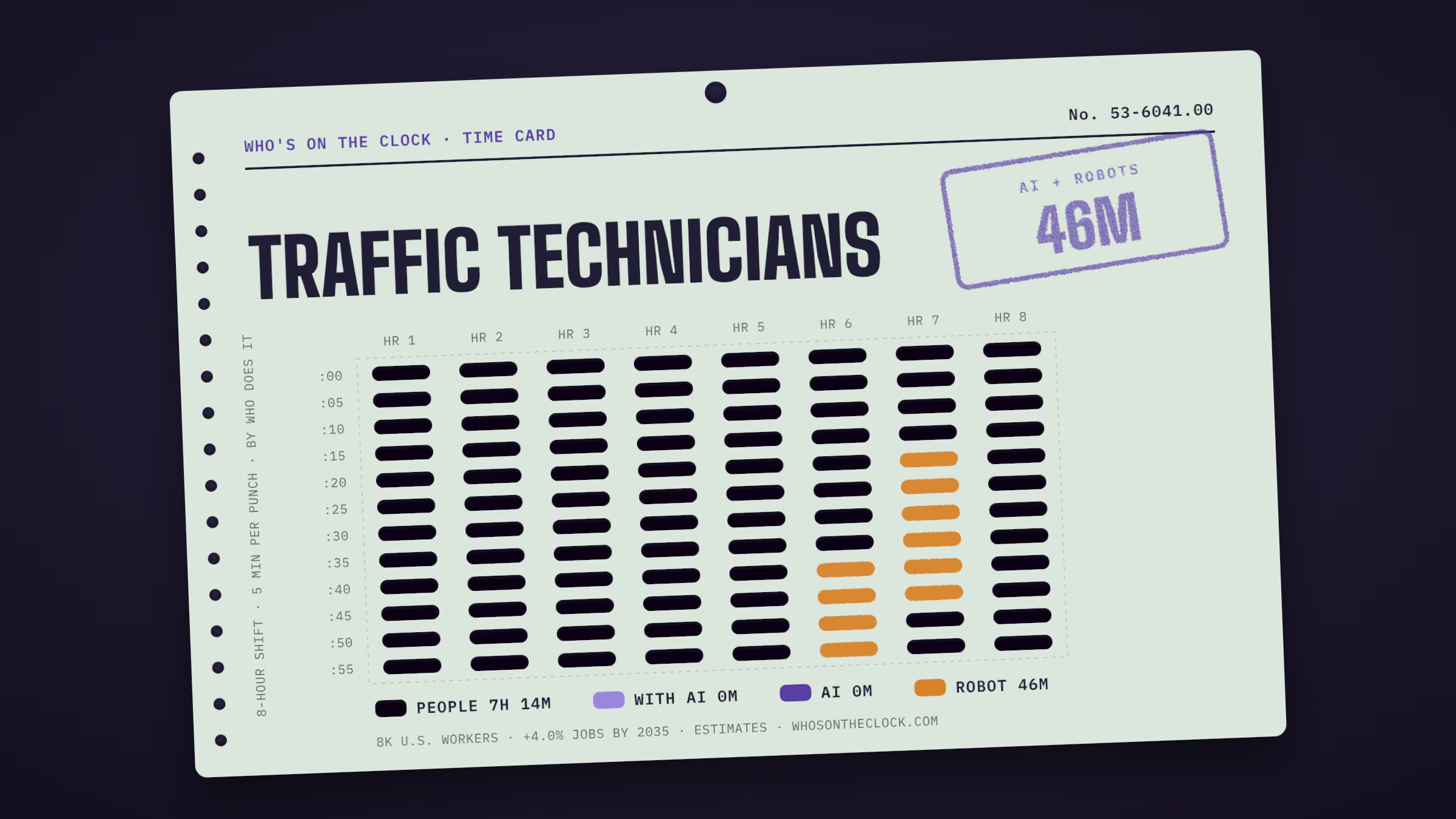
Not replace, but it is changing the job. About 46m of an 8-hour shift goes to tasks touched by robots. The other 7h 14m (91%) stays with people. Separately, BLS expects about 4% more of these jobs by 2035 (all jobs: +3.5%).

Time card for traffic technicians showing a typical 8-hour shift: 7h 14m done by people, 46m by robots.
Each mark is 5 minutes of a typical shift for traffic technicians, colored by who does that task today. Estimates from O*NET tasks and Anthropic Economic Index data. How it's made

Home / Transportation & warehouse / Traffic Technicians

Conduct field studies to determine traffic volume, speed, effectiveness of signals, adequacy of lighting, and other factors influencing traffic conditions, under direction of traffic engineer.

Time card

Untick tasks you don't do, or set your own times.
MineTask, by time spentHumanWith AIAIRobot
Interact with the public to answer traffic-related questions, respond to complaints or requests, or discuss traffic control ordinances, plans, policies, or procedures.32m a shift · No AI or robot evidence found
Analyze data related to traffic flow, accident rates, or proposed development to determine the most efficient methods to expedite traffic flow.32m a shift · No AI or robot evidence found
Gather and compile data from hand count sheets, machine count tapes, or radar speed checks and code data for computer input.32m a shift · No AI or robot evidence found
Operate counters and record data to assess the volume, type, and movement of vehicular or pedestrian traffic at specified times.32m a shift · No AI or robot evidence found
Prepare work orders for repair, maintenance, or changes in traffic systems.26m a shift · No AI or robot evidence found
Plan, design, and improve components of traffic control systems to accommodate current or projected traffic and to increase usability and efficiency.26m a shift · No AI or robot evidence found
Compute time settings for traffic signals or speed restrictions, using standard formulas.26m a shift · No AI or robot evidence found
Prepare drawings of proposed signal installations or other control devices, using drafting instruments or computer-automated drafting equipment.26m a shift · No AI or robot evidence found
Place and secure automatic counters, using power tools, and retrieve counters after counting periods end.26m a shift · No AI or robot evidence found
Review traffic control or barricade plans to issue permits for parades or other special events or for construction work that affects rights of way, providing assistance with plan preparation or revision, as necessary.26m a shift · No AI or robot evidence found
Visit development or work sites to determine projects' effect on traffic and the adequacy of traffic control and safety plans or to suggest traffic control measures.26m a shift · No AI or robot evidence found
Prepare graphs, charts, diagrams, or other aids to illustrate observations or conclusions.19m a shift · No AI or robot evidence found
Study factors affecting traffic conditions, such as lighting or sign and marking visibility, to assess their effectiveness.19m a shift · Robots only in factory cells
Measure and record the speed of vehicular traffic, using electrical timing devices or radar equipment.19m a shift · Robots deployed · e.g. ReADI autonomous dock-drone network (AI View Group, on FlytBase, DJI M300/M30T + VTOL)
Monitor street or utility projects for compliance to traffic control permit conditions.19m a shift · Robots only in factory cells
Study traffic delays by noting times of delays, the numbers of vehicles affected, and vehicle speed through the delay area.13m a shift · Robots deployed · e.g. ReADI (AI View Group docked drones on FlytBase, DJI M300/M30T + VTOL)
Lay out pavement markings for striping crews.13m a shift · Robots deployed · e.g. TinyMobileRobots TinySurveyor Terra
Provide technical supervision regarding traffic control devices to other traffic technicians or laborers.13m a shift · No AI or robot evidence found
Maintain or make minor adjustments or field repairs to equipment used in surveys, including the replacement of parts on traffic data gathering devices.13m a shift · Robots only in factory cells
Establish procedures for street closures or for repair or construction projects.13m a shift · No AI or robot evidence found
Provide traffic information, such as road conditions, to the public.13m a shift · No AI or robot evidence found
Time stoplights or other delays, using stopwatches.6m a shift · No AI or robot evidence found
Develop plans or long-range strategies for providing adequate parking space.6m a shift · No AI or robot evidence found

On the floor

No company news tracked for this job yet. New stories are added as they happen.

Ask the clock

Will AI replace traffic technicians?

Not replace, but it is changing the job. About 46m of an 8-hour shift goes to tasks touched by robots. The other 7h 14m (91%) stays with people. Separately, BLS expects about 4% more of these jobs by 2035 (all jobs: +3.5%).

What parts of the job can AI already do?

None of this job's tasks show regular AI use yet. That can mean the work is hands-on or in person, or simply that it rarely comes up in AI usage data.

Can a robot do this job?

For some tasks, yes. Robots have done 3 of this job's tasks in workplaces like this one, about 46m of a typical shift. 3 more tasks have only been done in factory setups built around the machine, so they stay with people here. For 2 physical tasks, no robot has shown it can do the work yet.

  • Measure and record the speed of vehicular traffic, using electrical timing devices or radar equipment. (19m a shift; e.g. ReADI autonomous dock-drone network (AI View Group, on FlytBase, DJI M300/M30T + VTOL), in use)
  • Study traffic delays by noting times of delays, the numbers of vehicles affected, and vehicle speed through the delay area. (13m a shift; e.g. ReADI (AI View Group docked drones on FlytBase, DJI M300/M30T + VTOL), in use)
  • Lay out pavement markings for striping crews. (13m a shift; e.g. TinyMobileRobots TinySurveyor Terra, in use)
What parts of the job are still done by people?

7h 14m of a typical shift, or 91%, goes to tasks with no AI or robot evidence yet. No AI usage or robot deployment has shown up for these so far. The biggest:

  • Interact with the public to answer traffic-related questions, respond to complaints or requests, or discuss traffic control ordinances, plans, policies, or procedures. (32m a shift)
  • Analyze data related to traffic flow, accident rates, or proposed development to determine the most efficient methods to expedite traffic flow. (32m a shift)
  • Gather and compile data from hand count sheets, machine count tapes, or radar speed checks and code data for computer input. (32m a shift)
  • Operate counters and record data to assess the volume, type, and movement of vehicular or pedestrian traffic at specified times. (32m a shift)
  • Prepare work orders for repair, maintenance, or changes in traffic systems. (26m a shift)
How much do traffic technicians make?

The median pay is about $59,090 a year ($28.41 an hour), 16% above the median for all U.S. jobs ($50,980). Most people in this job earn between $39,090 and $85,130 a year; that range covers the middle 80%. Pay figures are from BLS, May 2025, and vary a lot by state and employer.

Is this job growing or shrinking?

BLS projects growth of 4% from 2025 to 2035, compared with 3.5% growth for all jobs. That's about 8,400 jobs in 2035. It expects about 900 openings a year, mostly from people retiring or changing careers. These projections don't single out AI as a cause.

How many people do this job?

About 7,860 people in the U.S., roughly 0.01% of all workers (BLS, May 2025). That makes it the 697th largest of the 796 jobs on this site. BLS expects about 8,400 in 2035.

What do you need to become one?

The most common requirement is a high school diploma: about 43% of people in the job said so in the official O*NET survey. O*NET rates the job at level 3 of 5 for preparation, which usually means: vocational school or associate's degree. Requirements vary by state and employer, especially for licensed work.

What should I learn to stay ahead?

These come from the job's official skill ratings and from the tasks that AI and robots touch least today. Building them keeps you strong in the parts of the work that still need a person:

  • Skills that matter more here than in most jobs: Management of Personnel Resources, Systems Evaluation, Systems Analysis, Complex Problem Solving
  • Get strong at the parts of the job that stay with people (listed above), which take 7h 14m of a typical shift
  • Tools employers list: Microsoft Office software, Microsoft Excel, Autodesk AutoCAD, Bentley MicroStation, C++
What similar jobs could I move into?

These use similar skills. Matches come from 109 official ratings of skills, knowledge and work activities, and each needs the same or less preparation unless the official list relates the jobs directly:

  • Civil Engineering Technologists and Technicians (1h 23m touched, $65k median pay)
How solid are these numbers?

Each task carries its own evidence label. For this job: 3 with robots in real deployments, 20 with no AI or robot evidence found. The minutes per task are estimates, not measured hours, and "no evidence" doesn't prove a task is safe.

Tools in demand

  • Microsoft Office software
  • Microsoft Excel
  • Autodesk AutoCAD
  • Bentley MicroStation
  • C++
  • ESRI ArcGIS software
  • Microsoft Access
  • Microsoft Outlook

Also called

Collection Technician, Field Traffic Investigator, Highway Traffic Control Technician, Pavement Engineer, Permit Technician, Radar Signal Processing Engineers, Sign Technician, Street Light Technician, Survey Field Technician, Traffic Analyst, Traffic Control Laborer, Traffic Control Specialist, Traffic Control Technician, Traffic Engineering Technician