Will AI replace automotive glass installers and repairers?

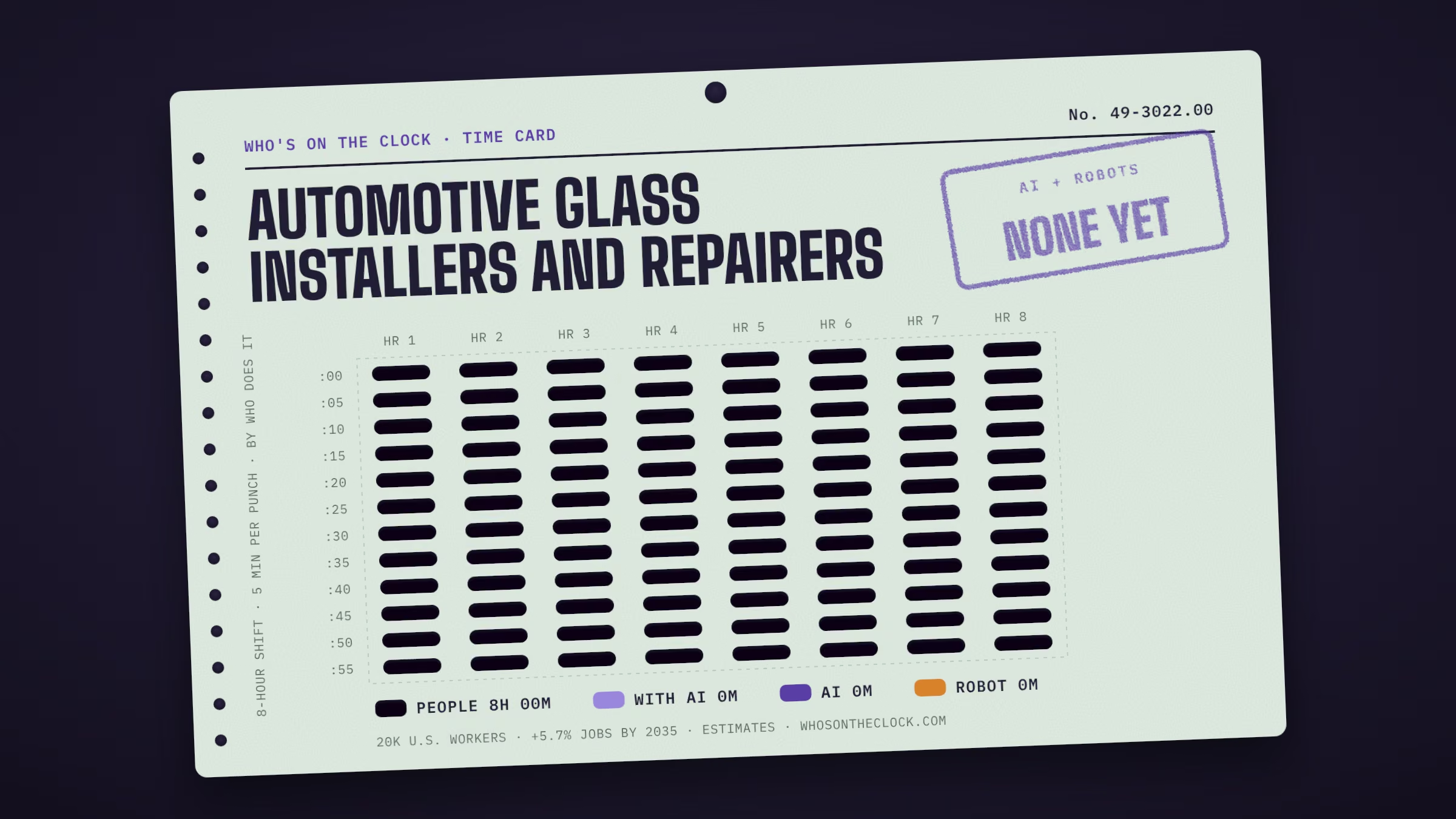
Not on current evidence. Less than 30 minutes of a typical shift goes to tasks that AI or robots are doing today. The other 8h (100%) stays with people. Separately, BLS expects about 5.7% more of these jobs by 2035 (all jobs: +3.5%).

Time card for automotive glass installers and repairers showing a typical 8-hour shift: 8h done by people.
Each mark is 5 minutes of a typical shift for automotive glass installers and repairers, colored by who does that task today. Estimates from O*NET tasks and Anthropic Economic Index data. How it's made

Home / Repair & maintenance / Automotive Glass Installers and Repairers

Replace or repair broken windshields and window glass in motor vehicles.

Time card

Untick tasks you don't do, or set your own times.
MineTask, by time spentHumanWith AIAIRobot
Install replacement glass in vehicles.1h 20m a shift · Robots only in factory cells
Remove broken or damaged glass windshields or window glass from motor vehicles, using hand tools to remove screws from frames holding glass.53m a shift · No AI or robot evidence found
Apply a bead of urethane around the perimeter of each pinchweld and dress the remaining urethane on the pinchwelds so that it is of uniform level and thickness.40m a shift · Robots only in factory cells
Replace all moldings, clips, windshield wipers, or other parts that were removed prior to glass replacement or repair.40m a shift · Robots only in factory cells
Remove moldings, clips, windshield wipers, screws, bolts, and inside A-pillar moldings and lower headliners in preparation for installation or repair work.40m a shift · No AI or robot evidence found
Install, repair, or replace safety glass and related materials, such as back glass heating elements, on vehicles or equipment.40m a shift · No AI or robot evidence found
Remove all dirt, foreign matter, and loose glass from damaged areas, apply primer along windshield or window edges, and allow primer to dry.33m a shift · Robots only in factory cells
Obtain windshields or windows for specific automobile makes and models from stock and examine them for defects prior to installation.33m a shift · Robots only in factory cells
Select appropriate tools, safety equipment, and parts, according to job requirements.27m a shift · Robots only in factory cells
Allow all glass parts installed with urethane ample time to cure, taking temperature and humidity into account.20m a shift · No AI or robot evidence found
Prime all scratches on pinchwelds with primer and allow to dry.13m a shift · Robots only in factory cells
Check for and remove moisture or contamination in damaged areas and keep areas dry until repairs are complete.13m a shift · No AI or robot evidence found
Replace or adjust motorized or manual window-raising mechanisms.13m a shift · No AI or robot evidence found
Install rubber channeling strips around edges of glass or frames to weatherproof windows or to prevent rattling.13m a shift · Robots only in factory cells
Cool or warm glass in the event of temperature extremes.7m a shift · Robots only in factory cells
Install new foam dams on pinchwelds, if required.7m a shift · Robots only in factory cells
Cut flat safety glass according to specified patterns or perform precision pattern making and glass cutting to custom fit replacement windows.7m a shift · Robots only in factory cells
Hold cut or uneven edges of glass against automated abrasive belts to shape or smooth edges.time not estimated · Robots only in factory cells

On the floor

No company news tracked for this job yet. New stories are added as they happen.

Ask the clock

Will AI replace automotive glass installers and repairers?

Not on current evidence. Less than 30 minutes of a typical shift goes to tasks that AI or robots are doing today. The other 8h (100%) stays with people. Separately, BLS expects about 5.7% more of these jobs by 2035 (all jobs: +3.5%).

What can AI already do for automotive glass installers and repairers?

None of this job's tasks show regular AI use yet. That can mean the work is hands-on or in person, or simply that it rarely comes up in AI usage data.

Where do robots fit in?

Not in workplaces like this one, based on a 2026 review of robot deployments. 12 more tasks have only been done in factory setups built around the machine, so they stay with people here. For 5 physical tasks, no robot has shown it can do the work yet.

What still needs a person?

8h of a typical shift, or 100%, goes to tasks with no AI or robot evidence yet. No AI usage or robot deployment has shown up for these so far. The biggest:

  • Install replacement glass in vehicles. (1h 20m a shift)
  • Remove broken or damaged glass windshields or window glass from motor vehicles, using hand tools to remove screws from frames holding glass. (53m a shift)
  • Apply a bead of urethane around the perimeter of each pinchweld and dress the remaining urethane on the pinchwelds so that it is of uniform level and thickness. (40m a shift)
  • Replace all moldings, clips, windshield wipers, or other parts that were removed prior to glass replacement or repair. (40m a shift)
  • Remove moldings, clips, windshield wipers, screws, bolts, and inside A-pillar moldings and lower headliners in preparation for installation or repair work. (40m a shift)
Why is that work hard to automate?

Much of it comes down to where and how the work happens. In-person, hands-on and high-stakes work is where AI and robots have made the least headway so far. In the official O*NET survey of people in this job:

  • 95% talk face to face with others every day
  • 84% work outdoors in all weather every day
  • 66% say dealing with the public is very or extremely important
Are employers still hiring automotive glass installers and repairers?

On Indeed, job postings in the Installation & Maintenance sector are at 118% of their February 2020 level (all U.S. postings: 104%), up 4.1% from a year earlier, as of Oct 9, 2026. BLS separately expects about 1,300 openings a year in this job through 2035. Across all U.S. postings, 7.3% now mention AI skills. Sector postings cover more than this one job and move for many reasons besides AI.

How much do automotive glass installers and repairers make?

The median pay is about $47,630 a year ($22.90 an hour), 7% below the median for all U.S. jobs ($50,980). Most people in this job earn between $35,390 and $70,650 a year; that range covers the middle 80%. Pay figures are from BLS, May 2025, and vary a lot by state and employer. Pick a state to compare:

Is this job growing or shrinking?

BLS projects growth of 5.7% from 2025 to 2035, compared with 3.5% growth for all jobs. That's about 24,000 jobs in 2035. It expects about 1,300 openings a year, mostly from people retiring or changing careers. These projections don't single out AI as a cause.

How many automotive glass installers and repairers are there in the U.S.?

About 20,000 people in the U.S., roughly 0.01% of all workers (BLS, May 2025). That makes it the 547th largest of the 796 jobs on this site. BLS expects about 24,000 in 2035.

What training do automotive glass installers and repairers need?

The most common requirement is a high school diploma: about 90% of people in the job said so in the official O*NET survey. O*NET rates the job at level 2 of 5 for preparation, which usually means: high school diploma, some training. Requirements vary by state and employer, especially for licensed work.

What should I learn to stay ahead of AI?

These come from the job's official skill ratings and from the tasks that AI and robots touch least today. Building them keeps you strong in the parts of the work that still need a person:

  • Skills that matter more here than in most jobs: Installation, Equipment Selection, Speaking
  • Get strong at the parts of the job that stay with people (listed above), which take 8h of a typical shift
  • Tools employers list: Microsoft Windows, Workday software
What other jobs could automotive glass installers and repairers move into?

These use similar skills. Matches come from 109 official ratings of skills, knowledge and work activities, and each needs the same or less preparation unless the official list relates the jobs directly:

  • Coin, Vending, and Amusement Machine Servicers and Repairers (0m touched, $47k median pay)
  • Molders, Shapers, and Casters (6m touched, $46k median pay)
How solid are these numbers?

Each task carries its own evidence label. For this job: 18 with no AI or robot evidence found. The minutes per task are estimates, not measured hours, and "no evidence" doesn't prove a task is safe.

Tools in demand

  • Microsoft Windows
  • Workday software

Also called

Auto Glass Repair Specialist (Automotive Glass Repair Specialist), Auto Services Glass Installer (Automotive Services Glass Installer), Auto Technician, Automobile Installer, Automotive Glass Installer (Auto Glass Installer), Automotive Glass Mechanic (Auto Glass Mechanic), Automotive Glass Specialist (Auto Glass Specialist), Automotive Glass Technician (Auto Glass Technician), Automotive Glazier (Auto Glazier), Automotive Technician, Automotive Tinter, Automotive Window Tinter, Direct Installer, Glass Fitter