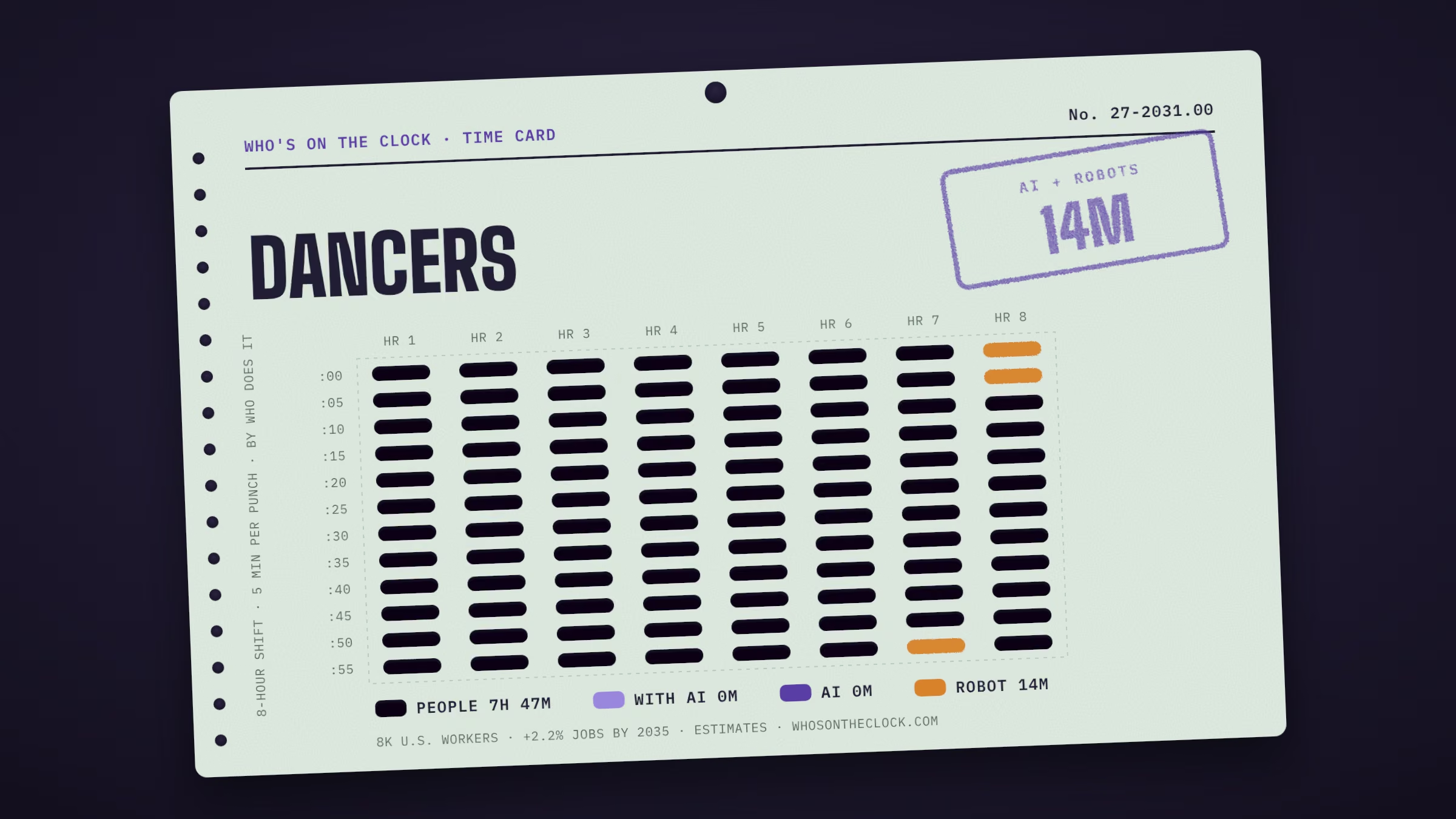
Not on current evidence. Less than 30 minutes of a typical shift goes to tasks that AI or robots are doing today. The other 7h 47m (97%) stays with people. Separately, BLS expects about 2.2% more of these jobs by 2035 (all jobs: +3.5%).
⤢ Full sizeEach mark is 5 minutes of a typical shift for dancers, colored by who does that task today. Estimates from O*NET tasks and Anthropic Economic Index data. How it's made
Perform dances. May perform on stage, for broadcasting, or for video recording.
Time card
Untick tasks you don't do, or set your own times.
Mine
Task, by time spent
Human
With AI
AI
Robot
Train, exercise, and attend dance classes to maintain high levels of technical proficiency, physical ability, and physical fitness.1h 48m a shift · No AI or robot evidence found
Study and practice dance moves required in roles.1h 35m a shift · No AI or robot evidence found
Coordinate dancing with that of partners or dance ensembles.1h 14m a shift · No AI or robot evidence found
Perform classical, modern, or acrobatic dances in productions, expressing stories, rhythm, and sound with their bodies.47m a shift · No AI or robot evidence found
Teach dance students.41m a shift · No AI or robot evidence found
Collaborate with choreographers to refine or modify dance steps.27m a shift · No AI or robot evidence found
Attend costume fittings, photography sessions, and makeup calls associated with dance performances.20m a shift · No AI or robot evidence found
Audition for dance roles or for membership in dance companies.14m a shift · No AI or robot evidence found
Devise and choreograph dance for self or others.14m a shift · No AI or robot evidence found
Develop self-understanding of physical capabilities and limitations, and choose dance styles accordingly.7m a shift · No AI or robot evidence found
Monitor the field of dance to remain aware of current trends and innovations.7m a shift · No AI or robot evidence found
Prepare pointe shoes, by sewing or other means, for use in rehearsals and performance.7m a shift · No AI or robot evidence found
Perform in productions, singing or acting in addition to dancing, if required.7m a shift · No AI or robot evidence found
On the floor
No company news tracked for this job yet. New stories are added as they happen.
Ask the clock
Will AI replace dancers?
Not on current evidence. Less than 30 minutes of a typical shift goes to tasks that AI or robots are doing today. The other 7h 47m (97%) stays with people. Separately, BLS expects about 2.2% more of these jobs by 2035 (all jobs: +3.5%).
What can AI already do for dancers?
None of this job's tasks show regular AI use yet. That can mean the work is hands-on or in person, or simply that it rarely comes up in AI usage data.
Where do robots fit in?
For some tasks, yes. Robots have done 1 of this job's tasks in workplaces like this one, about 14m of a typical shift. For 10 physical tasks, no robot has shown it can do the work yet.
Harmonize body movements to rhythm of musical accompaniment. (14m a shift; e.g. Unitree H1 humanoid robot ('Fuxi'), Yang BOT program, in use)
What still needs a person?
7h 47m of a typical shift, or 97%, goes to tasks with no AI or robot evidence yet. No AI usage or robot deployment has shown up for these so far. The biggest:
Train, exercise, and attend dance classes to maintain high levels of technical proficiency, physical ability, and physical fitness. (1h 48m a shift)
Study and practice dance moves required in roles. (1h 35m a shift)
Coordinate dancing with that of partners or dance ensembles. (1h 14m a shift)
Perform classical, modern, or acrobatic dances in productions, expressing stories, rhythm, and sound with their bodies. (47m a shift)
Teach dance students. (41m a shift)
Why is that work hard to automate?
Much of it comes down to where and how the work happens. In-person, hands-on and high-stakes work is where AI and robots have made the least headway so far. In the official O*NET survey of people in this job:
100% work at arm's length or closer to other people
85% are in constant contact with other people
83% spend more than half the day on their feet
Are employers still hiring dancers?
On Indeed, job postings in the Arts & Entertainment sector are at 87% of their February 2020 level (all U.S. postings: 104%), up 12.4% from a year earlier, as of Oct 9, 2026. BLS separately expects about 1,600 openings a year in this job through 2035. Across all U.S. postings, 7.3% now mention AI skills. Sector postings cover more than this one job and move for many reasons besides AI.
How much do dancers make?
The median pay is about $51,584 a year ($24.80 an hour), 1% above the median for all U.S. jobs ($50,980). Pay figures are from BLS, May 2025, and vary a lot by state and employer.
Is this job growing or shrinking?
BLS projects growth of 2.2% from 2025 to 2035, compared with 3.5% growth for all jobs. That's about 14,000 jobs in 2035. It expects about 1,600 openings a year, mostly from people retiring or changing careers. These projections don't single out AI as a cause.
How many dancers are there in the U.S.?
About 8,130 people in the U.S., roughly 0.01% of all workers (BLS, May 2025). That makes it the 691st largest of the 796 jobs on this site. BLS expects about 14,000 in 2035.
What training do dancers need?
The most common requirement is a high school diploma: about 45% of people in the job said so in the official O*NET survey. O*NET rates the job at level 3 of 5 for preparation, which usually means: vocational school or associate's degree. Requirements vary by state and employer, especially for licensed work.
What should I learn to stay ahead of AI?
These come from the job's official skill ratings and from the tasks that AI and robots touch least today. Building them keeps you strong in the parts of the work that still need a person:
Skills that matter more here than in most jobs: Coordination, Active Listening, Critical Thinking
Get strong at the parts of the job that stay with people (listed above), which take 7h 47m of a typical shift
Tools employers list: Adobe Photoshop, Facebook, Microsoft Office software, Microsoft Outlook
What other jobs could dancers move into?
These use similar skills. Matches come from 109 official ratings of skills, knowledge and work activities, and each needs the same or less preparation unless the official list relates the jobs directly:
Actors (38m touched, $60k median pay)
Musicians and Singers (9m touched, $99k median pay)
How solid are these numbers?
Each task carries its own evidence label. For this job: 1 with robots in real deployments, 13 with no AI or robot evidence found. The minutes per task are estimates, not measured hours, and "no evidence" doesn't prove a task is safe.
Tools in demand
Adobe Photoshop
Facebook
Microsoft Office software
Microsoft Outlook
Also called
Acrobatic Dancer, Ballerina, Ballet Company Member, Ballet Dancer, Ballet Soloist, Belly Dancer, Burlesque Dancer, Company Dancer, Dance Artist, Dance Performer, Dancer, Discotheque Dancer, Entertainment Dancer, Exotic Dancer