Will AI replace actors?

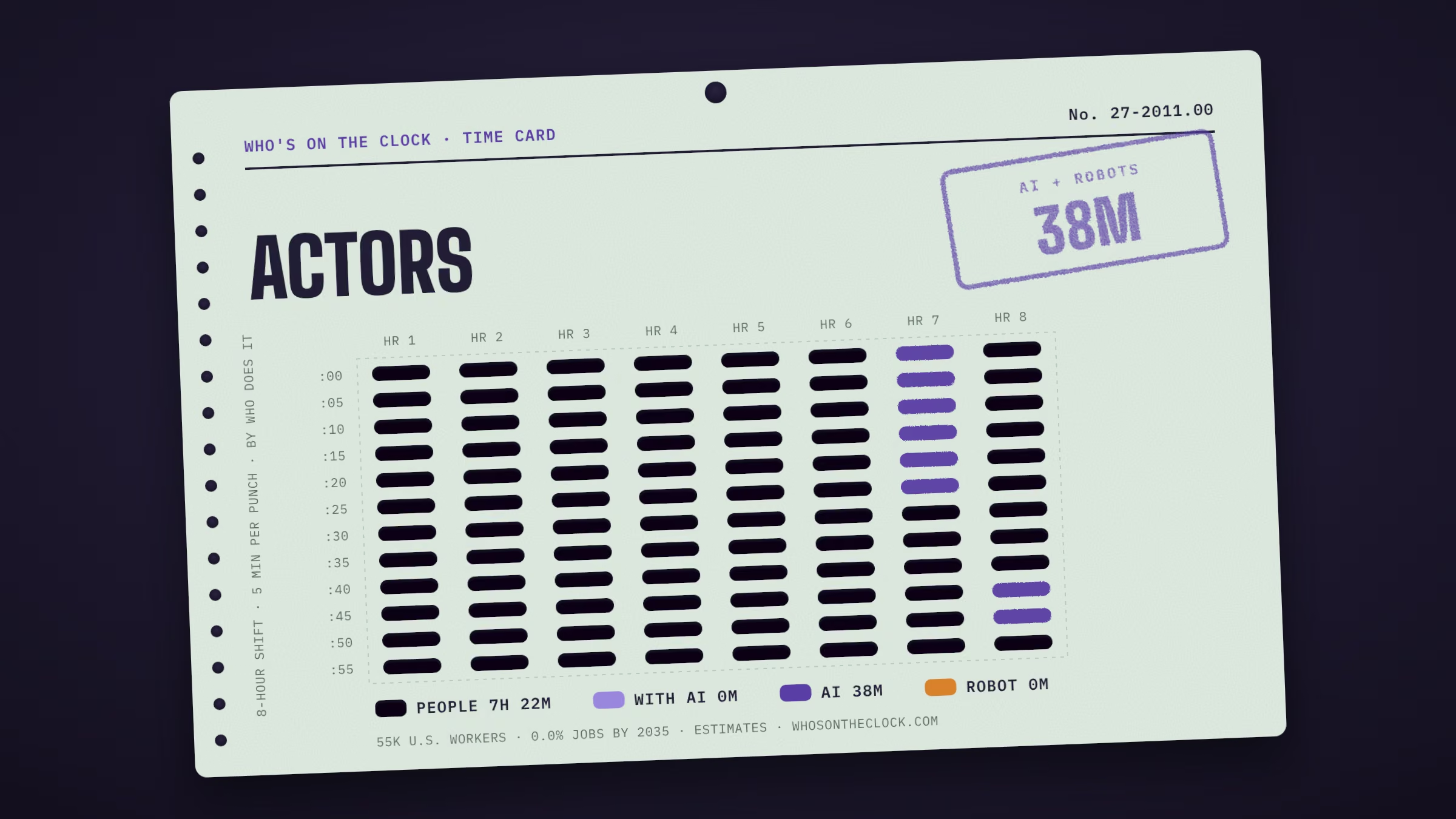
Unlikely, though parts of the work are changing. About 38m of an 8-hour shift goes to tasks touched by AI working on its own. The other 7h 22m (92%) stays with people. Separately, BLS expects about 0% more of these jobs by 2035 (all jobs: +3.5%).

Time card for actors showing a typical 8-hour shift: 7h 22m done by people, 38m by AI.
Each mark is 5 minutes of a typical shift for actors, colored by who does that task today. Estimates from O*NET tasks and Anthropic Economic Index data. How it's made

Home / Arts, media & sports / Actors

Play parts in stage, television, radio, video, or film productions, or other settings for entertainment, information, or instruction. Interpret serious or comic role by speech, gesture, and body movement to entertain or inform audience. May dance and sing.

Time card

Untick tasks you don't do, or set your own times.
MineTask, by time spentHumanWith AIAIRobot
Study and rehearse roles from scripts to interpret, learn and memorize lines, stunts, and cues as directed.1h 41m a shift · No AI or robot evidence found
Portray and interpret roles, using speech, gestures, and body movements, to entertain, inform, or instruct radio, film, television, or live audiences.1h 25m a shift · No AI or robot evidence found
Attend auditions and casting calls to audition for roles.54m a shift · No AI or robot evidence found
Collaborate with other actors as part of an ensemble.46m a shift · No AI or robot evidence found
Work closely with directors, other actors, and playwrights to find the interpretation most suited to the role.46m a shift · No AI or robot evidence found
Perform humorous and serious interpretations of emotions, actions, and situations, using body movements, facial expressions, and gestures.31m a shift · No AI or robot evidence found
Learn about characters in scripts and their relationships to each other to develop role interpretations.31m a shift · Observed in AI use
Sing or dance during dramatic or comedic performances.16m a shift · Robots only in factory cells
Work with other crew members responsible for lighting, costumes, make-up, and props.16m a shift · No AI or robot evidence found
Read from scripts or books to narrate action or to inform or entertain audiences, utilizing few or no stage props.16m a shift · No AI or robot evidence found
Tell jokes, perform comic dances, songs and skits, impersonate mannerisms and voices of others, contort face, and use other devices to amuse audiences.8m a shift · Robots only in factory cells
Promote productions using means such as interviews about plays or movies.8m a shift · No AI or robot evidence found
Prepare and perform action stunts for motion picture, television, or stage productions.8m a shift · No AI or robot evidence found
Write original or adapted material for dramas, comedies, puppet shows, narration, or other performances.8m a shift · Observed in AI useTypical AI request: about 7h 13m alone, 59m with AI
Introduce performances and performers to stimulate excitement and coordinate smooth transition of acts during events.8m a shift · No AI or robot evidence found
Dress in comical clown costumes and makeup, and perform comedy routines to entertain audiences.time not estimated · No AI or robot evidence found
Construct puppets and ventriloquist dummies, and sew accessory clothing, using hand tools and machines.time not estimated · No AI or robot evidence found
Perform original and stock tricks of illusion to entertain and mystify audiences, occasionally including audience members as participants.time not estimated · No AI or robot evidence found

On the floor

No company news tracked for this job yet. New stories are added as they happen.

Ask the clock

Will AI replace actors?

Unlikely, though parts of the work are changing. About 38m of an 8-hour shift goes to tasks touched by AI working on its own. The other 7h 22m (92%) stays with people. Separately, BLS expects about 0% more of these jobs by 2035 (all jobs: +3.5%).

What can AI already do for actors?

AI shows up regularly in 2 of 18 tasks, about 38m of a typical shift. The biggest ones:

  • Learn about characters in scripts and their relationships to each other to develop role interpretations. (31m a shift, AI mostly does it alone)
  • Write original or adapted material for dramas, comedies, puppet shows, narration, or other performances. (8m a shift, AI mostly does it alone)
Where do robots fit in?

Not in workplaces like this one, based on a 2026 review of robot deployments. 2 more tasks have only been done in factory setups built around the machine, so they stay with people here. For 10 physical tasks, no robot has shown it can do the work yet.

What still needs a person?

7h 22m of a typical shift, or 92%, goes to tasks with no AI or robot evidence yet. No AI usage or robot deployment has shown up for these so far. The biggest:

  • Study and rehearse roles from scripts to interpret, learn and memorize lines, stunts, and cues as directed. (1h 41m a shift)
  • Portray and interpret roles, using speech, gestures, and body movements, to entertain, inform, or instruct radio, film, television, or live audiences. (1h 25m a shift)
  • Attend auditions and casting calls to audition for roles. (54m a shift)
  • Collaborate with other actors as part of an ensemble. (46m a shift)
  • Work closely with directors, other actors, and playwrights to find the interpretation most suited to the role. (46m a shift)
Why is that work hard to automate?

Much of it comes down to where and how the work happens. In-person, hands-on and high-stakes work is where AI and robots have made the least headway so far. In the official O*NET survey of people in this job:

  • 100% work at arm's length or closer to other people
  • 64% spend more than half the day on their feet
How much time does AI save on these tasks?

For the 1 task in this job where AI shows up and timing data exists, a typical request takes about 7h 13m for a person alone and about 59m with AI. These are Claude's own estimates from real conversations in April and May 2026 (Anthropic Economic Index). They describe single requests, not whole workdays, and time saved on a task doesn't mean jobs are cut. The biggest gaps:

  • Write original or adapted material for dramas, comedies, puppet shows, narration, or other performances (about 7h 13m alone, 59m with AI)
Are employers still hiring actors?

On Indeed, job postings in the Arts & Entertainment sector are at 87% of their February 2020 level (all U.S. postings: 104%), up 12.4% from a year earlier, as of Oct 9, 2026. BLS separately expects about 6,300 openings a year in this job through 2035. Across all U.S. postings, 7.3% now mention AI skills. Sector postings cover more than this one job and move for many reasons besides AI.

How much do actors make?

The median pay is about $60,424 a year ($29.05 an hour), 19% above the median for all U.S. jobs ($50,980). Pay figures are from BLS, May 2025, and vary a lot by state and employer.

Is this job growing or shrinking?

BLS projects no change from 2025 to 2035, compared with 3.5% growth for all jobs. That's about 68,000 jobs in 2035. It expects about 6,300 openings a year, mostly from people retiring or changing careers. These projections don't single out AI as a cause.

How many actors are there in the U.S.?

About 55,000 people in the U.S., roughly 0.04% of all workers (BLS, May 2025). That makes it the 374th largest of the 796 jobs on this site. BLS expects about 68,000 in 2035.

What training do actors need?

The most common requirement is less than a high school diploma: about 45% of people in the job said so in the official O*NET survey. O*NET rates the job at level 2 of 5 for preparation, which usually means: high school diploma, some training. Requirements vary by state and employer, especially for licensed work.

What should I learn to stay ahead of AI?

These come from the job's official skill ratings and from the tasks that AI and robots touch least today. Building them keeps you strong in the parts of the work that still need a person:

  • Skills that matter more here than in most jobs: Social Perceptiveness, Reading Comprehension, Speaking, Active Listening
  • Get strong at the parts of the job that stay with people (listed above), which take 7h 22m of a typical shift
  • Tools employers list: Facebook, Linux, Microsoft Excel, Microsoft Office software, Microsoft Outlook
  • Learn to use AI well on the tasks where it already shows up in this job (listed above)
What other jobs could actors move into?

These use similar skills. Matches come from 109 official ratings of skills, knowledge and work activities, and each needs the same or less preparation unless the official list relates the jobs directly:

  • Musicians and Singers (9m touched, $99k median pay)
  • Poets, Lyricists and Creative Writers (2h 5m touched, $77k median pay)
  • Music Directors and Composers (26m touched, $74k median pay)
  • Talent Directors (28m touched, $90k median pay)
How solid are these numbers?

Each task carries its own evidence label. For this job: 2 observed in real AI use, 16 with no AI or robot evidence found. The minutes per task are estimates, not measured hours, and "no evidence" doesn't prove a task is safe.

Tools in demand

  • Facebook
  • Linux
  • Microsoft Excel
  • Microsoft Office software
  • Microsoft Outlook
  • Microsoft PowerPoint
  • Microsoft Word
  • TikTok

Also called

Actor, Actor Understudy, Actress, Background Actor, Character Artist, Character Performer, Comedian, Comic, Community Theater Actor, Double, Dramatic Reader, Elocutionist, Ensemble Member, Entertainer