Will AI replace acupuncturists?

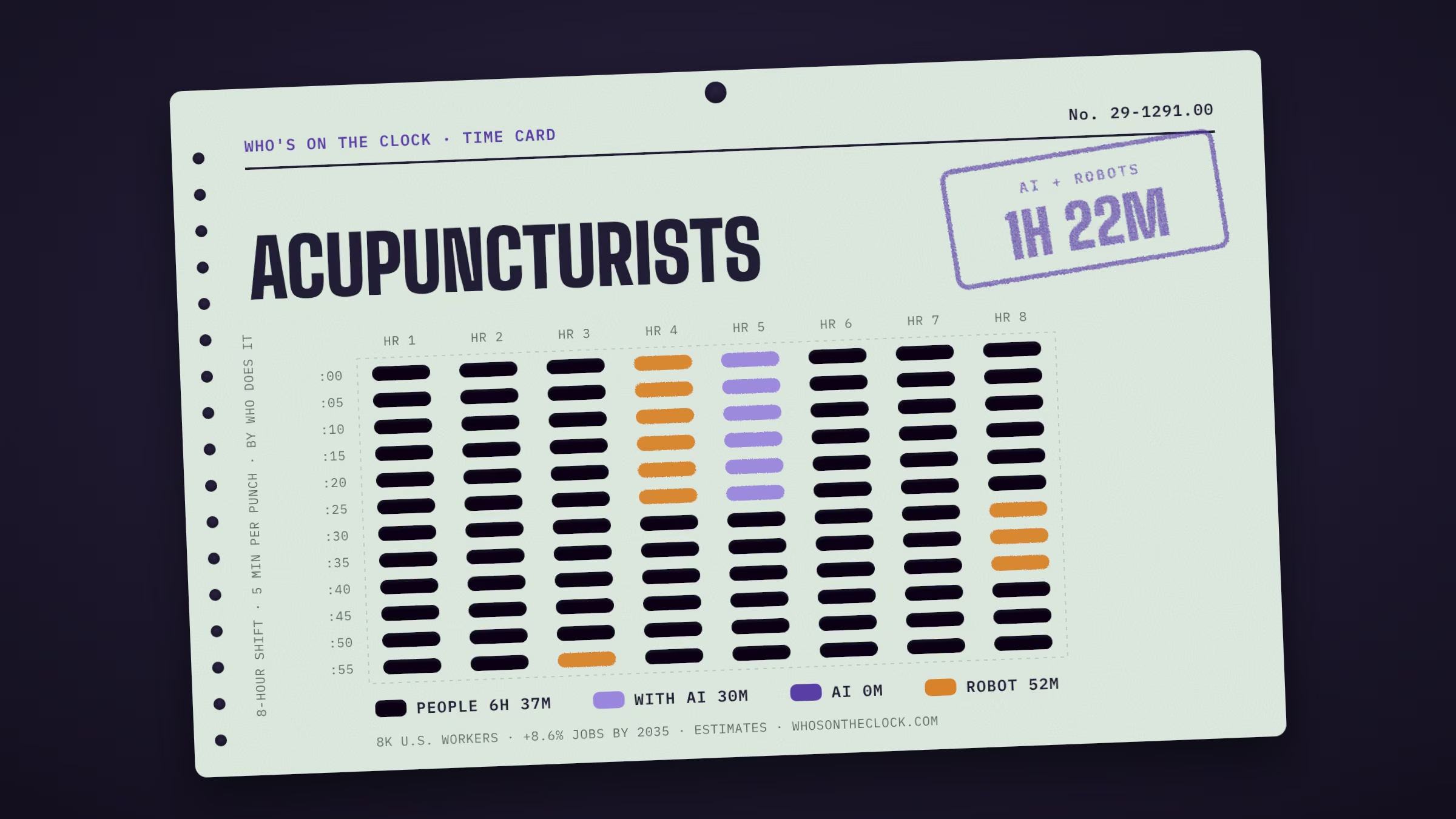
Unlikely, though parts of the work are changing. About 1h 22m of an 8-hour shift goes to tasks touched by robots. The breakdown: 30m done by people with AI help, 52m that robots have done in real workplaces. The other 6h 37m (83%) stays with people. Separately, BLS expects about 8.6% more of these jobs by 2035 (all jobs: +3.5%).

Time card for acupuncturists showing a typical 8-hour shift: 6h 37m done by people, 30m done by people with AI, 52m by robots.
Each mark is 5 minutes of a typical shift for acupuncturists, colored by who does that task today. Estimates from O*NET tasks and Anthropic Economic Index data. How it's made

Home / Healthcare practitioners / Acupuncturists

Diagnose, treat, and prevent disorders by stimulating specific acupuncture points within the body using acupuncture needles. May also use cups, nutritional supplements, therapeutic massage, acupressure, and other alternative health therapies.

Time card

Untick tasks you don't do, or set your own times.
MineTask, by time spentHumanWith AIAIRobot
Insert needles to provide acupuncture treatment.1h 30m a shift · No AI or robot evidence found
Maintain detailed and complete records of health care plans and prognoses.45m a shift · No AI or robot evidence found
Treat patients using tools, such as needles, cups, ear balls, seeds, pellets, or nutritional supplements.37m a shift · Robots only in factory cells
Identify correct anatomical and proportional point locations based on patients' anatomy and positions, contraindications, and precautions related to treatments, such as intradermal needles, moxibustion, electricity, guasha, or bleeding.37m a shift · Robots deployed · e.g. Intelligent moxibustion rehabilitation robot (Shanghai Junkong Robotics / Shanghai University of Engineering Science)
Develop individual treatment plans and strategies.30m a shift · No AI or robot evidence found
Collect medical histories and general health and lifestyle information from patients.30m a shift · Observed in AI use
Educate patients on topics, such as meditation, ergonomics, stretching, exercise, nutrition, the healing process, breathing, or relaxation techniques.30m a shift · No AI or robot evidence found
Analyze physical findings and medical histories to make diagnoses according to Oriental medicine traditions.30m a shift · No AI or robot evidence found
Maintain and follow standard quality, safety, environmental, and infection control policies and procedures.23m a shift · Robots only in factory cells
Evaluate treatment outcomes and recommend new or altered treatments as necessary to further promote, restore, or maintain health.23m a shift · No AI or robot evidence found
Treat medical conditions, using techniques such as acupressure, shiatsu, or tuina.23m a shift · No AI or robot evidence found
Assess patients' general physical appearance to make diagnoses.15m a shift · No AI or robot evidence found
Dispense herbal formulas and inform patients of dosages and frequencies, treatment duration, possible side effects, and drug interactions.15m a shift · Robots only in factory cells
Formulate herbal preparations to treat conditions considering herbal properties, such as taste, toxicity, effects of preparation, contraindications, and incompatibilities.15m a shift · No AI or robot evidence found
Apply moxibustion directly or indirectly to patients using Chinese, non-scarring, stick, or pole moxa.15m a shift · Robots deployed · e.g. Intelligent moxibustion rehabilitation robot (Shanghai Junkong Robotics / Xiong Genliang team)
Adhere to local, state, and federal laws, regulations, and statutes.7m a shift · No AI or robot evidence found
Consider Western medical procedures in health assessment, health care team communication, and care referrals.7m a shift · No AI or robot evidence found
Apply heat or cold therapy to patients using materials, such as heat pads, hydrocollator packs, warm compresses, cold compresses, heat lamps, or vapor coolants.7m a shift · Robots only in factory cells

On the floor

No company news tracked for this job yet. New stories are added as they happen.

Ask the clock

Will AI replace acupuncturists?

Unlikely, though parts of the work are changing. About 1h 22m of an 8-hour shift goes to tasks touched by robots. The breakdown: 30m done by people with AI help, 52m that robots have done in real workplaces. The other 6h 37m (83%) stays with people. Separately, BLS expects about 8.6% more of these jobs by 2035 (all jobs: +3.5%).

What can AI already do for acupuncturists?

AI shows up regularly in 1 of 18 tasks, about 30m of a typical shift. The biggest ones:

  • Collect medical histories and general health and lifestyle information from patients. (30m a shift, people use AI to help)
Where do robots fit in?

For some tasks, yes. Robots have done 2 of this job's tasks in workplaces like this one, about 52m of a typical shift. 4 more tasks have only been done in factory setups built around the machine, so they stay with people here. For 2 physical tasks, no robot has shown it can do the work yet.

  • Identify correct anatomical and proportional point locations based on patients' anatomy and positions, contraindications, and precautions related to treatments, such as intradermal needles, moxibustion, electricity, guasha, or bleeding. (37m a shift; e.g. Intelligent moxibustion rehabilitation robot (Shanghai Junkong Robotics / Shanghai University of Engineering Science), in use)
  • Apply moxibustion directly or indirectly to patients using Chinese, non-scarring, stick, or pole moxa. (15m a shift; e.g. Intelligent moxibustion rehabilitation robot (Shanghai Junkong Robotics / Xiong Genliang team), in use)
What still needs a person?

6h 37m of a typical shift, or 83%, goes to tasks with no AI or robot evidence yet. No AI usage or robot deployment has shown up for these so far. The biggest:

  • Insert needles to provide acupuncture treatment. (1h 30m a shift)
  • Maintain detailed and complete records of health care plans and prognoses. (45m a shift)
  • Treat patients using tools, such as needles, cups, ear balls, seeds, pellets, or nutritional supplements. (37m a shift)
  • Develop individual treatment plans and strategies. (30m a shift)
  • Educate patients on topics, such as meditation, ergonomics, stretching, exercise, nutrition, the healing process, breathing, or relaxation techniques. (30m a shift)
Why is that work hard to automate?

Much of it comes down to where and how the work happens. In-person, hands-on and high-stakes work is where AI and robots have made the least headway so far. In the official O*NET survey of people in this job:

  • 96% work at arm's length or closer to other people
  • 89% talk face to face with others every day
  • 81% use their hands on tools, objects or controls more than half the time
Are employers still hiring acupuncturists?

On Indeed, job postings in the Physicians & Surgeons sector are at 202% of their February 2020 level (all U.S. postings: 104%), up 8.8% from a year earlier, as of Oct 9, 2026. BLS separately expects about 800 openings a year in this job through 2035. Across all U.S. postings, 7.3% now mention AI skills. Sector postings cover more than this one job and move for many reasons besides AI.

How much do acupuncturists make?

The median pay is about $76,040 a year ($36.56 an hour), 49% above the median for all U.S. jobs ($50,980). Most people in this job earn between $38,830 and $161,470 a year; that range covers the middle 80%. Pay figures are from BLS, May 2025, and vary a lot by state and employer. Pick a state to compare:

Is this job growing or shrinking?

BLS projects growth of 8.6% from 2025 to 2035, compared with 3.5% growth for all jobs. That's about 16,000 jobs in 2035. It expects about 800 openings a year, mostly from people retiring or changing careers. These projections don't single out AI as a cause.

How many acupuncturists are there in the U.S.?

About 7,830 people in the U.S., roughly 0.01% of all workers (BLS, May 2025). That makes it the 698th largest of the 796 jobs on this site. BLS expects about 16,000 in 2035.

What training do acupuncturists need?

The most common requirement is a master's degree: about 68% of people in the job said so in the official O*NET survey. O*NET rates the job at level 5 of 5 for preparation, which usually means: graduate degree. Requirements vary by state and employer, especially for licensed work.

What should I learn to stay ahead of AI?

These come from the job's official skill ratings and from the tasks that AI and robots touch least today. Building them keeps you strong in the parts of the work that still need a person:

  • Skills that matter more here than in most jobs: Service Orientation, Social Perceptiveness, Active Listening, Judgment and Decision Making
  • Get strong at the parts of the job that stay with people (listed above), which take 6h 37m of a typical shift
  • Tools employers list: Microsoft Excel, Microsoft Office software, Microsoft Outlook, Microsoft Windows, Microsoft Word
  • Learn to use AI well on the tasks where it already shows up in this job (listed above)
What other jobs could acupuncturists move into?

These use similar skills, with less of a typical shift touched by AI or robots. Matches come from 109 official ratings of skills, knowledge and work activities, and each needs the same or less preparation unless the official list relates the jobs directly:

  • Massage Therapists (35m touched, $58k median pay)
  • Naturopathic Physicians (41m touched, $115k median pay)
  • Chiropractors (22m touched, $79k median pay)
How solid are these numbers?

Each task carries its own evidence label. For this job: 1 observed in real AI use, 2 with robots in real deployments, 15 with no AI or robot evidence found. The minutes per task are estimates, not measured hours, and "no evidence" doesn't prove a task is safe.

Tools in demand

  • Microsoft Excel
  • Microsoft Office software
  • Microsoft Outlook
  • Microsoft Windows
  • Microsoft Word

Also called

Acupressure Therapist, Acupressurist, Acupuncture Doctor, Acupuncture Physician, Acupuncture Provider, Acupuncturist, Auricular Acupuncturist, Auricular Detoxification Specialist, Auricular Therapist, Chinese Medical Doctor (Chinese MD), Chinese Medicine Doctor, Herbalist, Licensed Acupuncturist (LAC), Oriental Medicine Provider