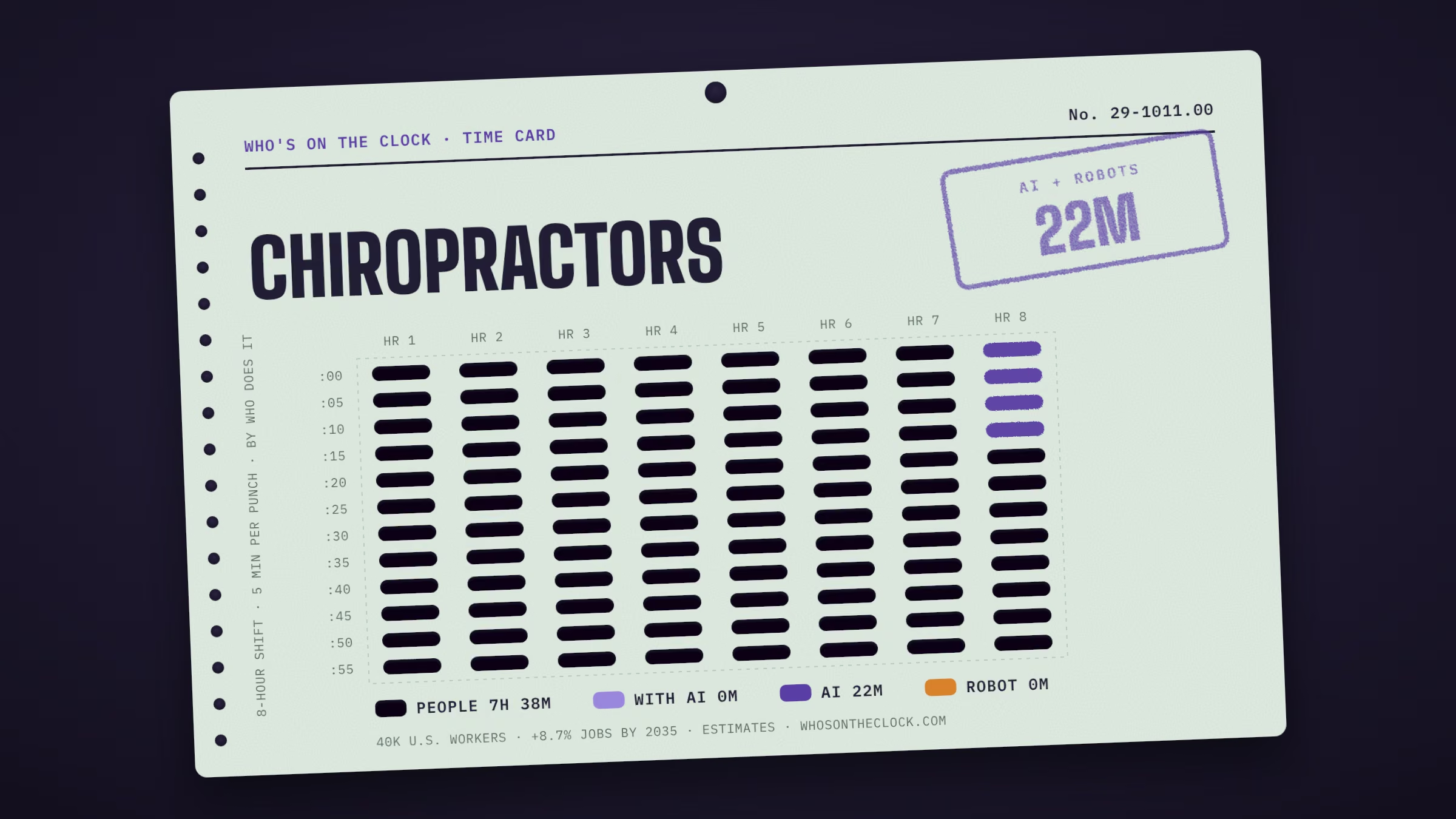
Not on current evidence. Less than 30 minutes of a typical shift goes to tasks that AI or robots are doing today. The other 7h 38m (96%) stays with people. Separately, BLS expects about 8.7% more of these jobs by 2035 (all jobs: +3.5%).
⤢ Full sizeEach mark is 5 minutes of a typical shift for chiropractors, colored by who does that task today. Estimates from O*NET tasks and Anthropic Economic Index data. How it's made
Assess, treat, and care for patients by manipulation of spine and musculoskeletal system. May provide spinal adjustment or address sacral or pelvic misalignment.
Time card
Untick tasks you don't do, or set your own times.
Mine
Task, by time spent
Human
With AI
AI
Robot
Perform a series of manual adjustments to the spine or other articulations of the body to correct the musculoskeletal system.2h 55m a shift · No AI or robot evidence found
Evaluate the functioning of the neuromuscularskeletal system and the spine using systems of chiropractic diagnosis.58m a shift · No AI or robot evidence found
Maintain accurate case histories of patients.58m a shift · No AI or robot evidence found
Diagnose health problems by reviewing patients' health and medical histories, questioning, observing, and examining patients and interpreting x-rays.51m a shift · No AI or robot evidence found
Advise patients about recommended courses of treatment.44m a shift · No AI or robot evidence found
Counsel patients about nutrition, exercise, sleeping habits, stress management, or other matters.29m a shift · No AI or robot evidence found
Obtain and record patients' medical histories.22m a shift · Observed in AI use
Analyze x-rays to locate the sources of patients' difficulties and to rule out fractures or diseases as sources of problems.15m a shift · No AI or robot evidence found
Suggest and apply the use of supports such as straps, tapes, bandages, or braces if necessary.15m a shift · No AI or robot evidence found
Consult with or refer patients to appropriate health practitioners when necessary.7m a shift · No AI or robot evidence found
Recommend and arrange for diagnostic procedures, such as blood chemistry tests, saliva tests, x-rays, or other imaging procedures.7m a shift · No AI or robot evidence found
On the floor
No company news tracked for this job yet. New stories are added as they happen.
Ask the clock
Will AI replace chiropractors?
Not on current evidence. Less than 30 minutes of a typical shift goes to tasks that AI or robots are doing today. The other 7h 38m (96%) stays with people. Separately, BLS expects about 8.7% more of these jobs by 2035 (all jobs: +3.5%).
What can AI already do for chiropractors?
AI shows up regularly in 1 of 11 tasks, about 22m of a typical shift. The biggest ones:
Obtain and record patients' medical histories. (22m a shift, AI mostly does it alone)
Where do robots fit in?
Not in workplaces like this one, based on a 2026 review of robot deployments. For 4 physical tasks, no robot has shown it can do the work yet.
What still needs a person?
7h 38m of a typical shift, or 96%, goes to tasks with no AI or robot evidence yet. No AI usage or robot deployment has shown up for these so far. The biggest:
Perform a series of manual adjustments to the spine or other articulations of the body to correct the musculoskeletal system. (2h 55m a shift)
Evaluate the functioning of the neuromuscularskeletal system and the spine using systems of chiropractic diagnosis. (58m a shift)
Maintain accurate case histories of patients. (58m a shift)
Diagnose health problems by reviewing patients' health and medical histories, questioning, observing, and examining patients and interpreting x-rays. (51m a shift)
Advise patients about recommended courses of treatment. (44m a shift)
Why is that work hard to automate?
Much of it comes down to where and how the work happens. In-person, hands-on and high-stakes work is where AI and robots have made the least headway so far. In the official O*NET survey of people in this job:
100% are in constant contact with other people
98% talk face to face with others every day
92% work at arm's length or closer to other people
Are employers still hiring chiropractors?
On Indeed, job postings in the Medical Technician sector are at 125% of their February 2020 level (all U.S. postings: 104%), down 2.6% from a year earlier, as of Oct 9, 2026. BLS separately expects about 2,600 openings a year in this job through 2035. Across all U.S. postings, 7.3% now mention AI skills. Sector postings cover more than this one job and move for many reasons besides AI.
How much do chiropractors make?
The median pay is about $79,200 a year ($38.08 an hour), 55% above the median for all U.S. jobs ($50,980). Most people in this job earn between $43,460 and $146,080 a year; that range covers the middle 80%. Pay figures are from BLS, May 2025, and vary a lot by state and employer. Pick a state to compare:
Is this job growing or shrinking?
BLS projects growth of 8.7% from 2025 to 2035, compared with 3.5% growth for all jobs. That's about 67,000 jobs in 2035. It expects about 2,600 openings a year, mostly from people retiring or changing careers. These projections don't single out AI as a cause.
How many chiropractors are there in the U.S.?
About 40,000 people in the U.S., roughly 0.03% of all workers (BLS, May 2025). That makes it the 424th largest of the 796 jobs on this site. BLS expects about 67,000 in 2035.
What training do chiropractors need?
The most common requirement is a doctoral degree: about 82% of people in the job said so in the official O*NET survey. O*NET rates the job at level 5 of 5 for preparation, which usually means: graduate degree. Requirements vary by state and employer, especially for licensed work.
What should I learn to stay ahead of AI?
These come from the job's official skill ratings and from the tasks that AI and robots touch least today. Building them keeps you strong in the parts of the work that still need a person:
Skills that matter more here than in most jobs: Science, Social Perceptiveness, Service Orientation, Active Listening
Get strong at the parts of the job that stay with people (listed above), which take 7h 38m of a typical shift
Tools employers list: Microsoft Excel, Microsoft Office software, Microsoft Outlook, Microsoft Word
Learn to use AI well on the tasks where it already shows up in this job (listed above)
What new tasks are chiropractors taking on?
Yes. Occupational experts recently added these to the official task list, a sign of how the work itself is shifting. New tasks aren't rated for AI or robots yet:
Provide guidance to patients on exercises they can perform to improve mobility.
Take x-rays.
What other jobs could chiropractors move into?
These use similar skills. Matches come from 109 official ratings of skills, knowledge and work activities, and each needs the same or less preparation unless the official list relates the jobs directly:
Naturopathic Physicians (41m touched, $115k median pay)
Optometrists (0m touched, $137k median pay)
Physical Medicine and Rehabilitation Physicians (0m touched, $266k median pay)
Podiatrists (0m touched, $160k median pay)
Physical Therapists (7m touched, $103k median pay)
How solid are these numbers?
Each task carries its own evidence label. For this job: 1 observed in real AI use, 10 with no AI or robot evidence found. The minutes per task are estimates, not measured hours, and "no evidence" doesn't prove a task is safe.
Tools in demand
Microsoft Excel
Microsoft Office software
Microsoft Outlook
Microsoft Word
Also called
Chiropractic Doctor (DC), Chiropractic Neurologist, Chiropractic Physician, Chiropractor