Will AI replace geological technicians?

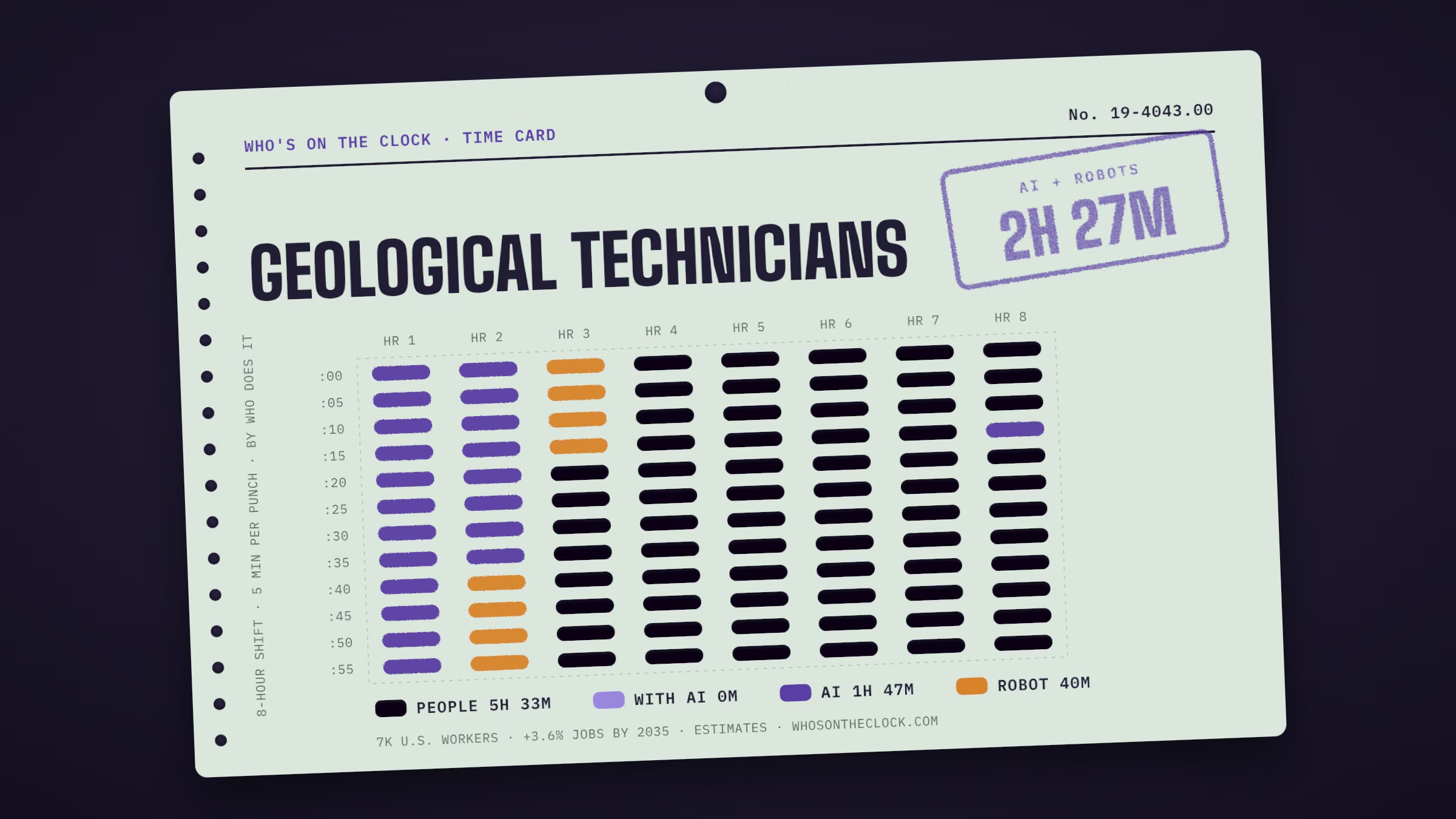
Parts of the job are being automated. About 2h 27m of an 8-hour shift goes to tasks that AI or robots already do largely on their own. The rest still needs a person. The breakdown: 1h 47m that AI mostly does alone, 40m that robots have done in real workplaces. The other 5h 34m (70%) stays with people. Separately, BLS expects about 3.6% more of these jobs by 2035 (all jobs: +3.5%).

Time card for geological technicians showing a typical 8-hour shift: 5h 34m done by people, 1h 47m by AI, 40m by robots.
Each mark is 5 minutes of a typical shift for geological technicians, colored by who does that task today. Estimates from O*NET tasks and Anthropic Economic Index data. How it's made

Home / Science / Geological Technicians

Assist scientists or engineers in the use of electronic, sonic, or nuclear measuring instruments in laboratory, exploration, and production activities to obtain data indicating resources such as metallic ore, minerals, gas, coal, or petroleum. Analyze mud and drill cuttings. Chart pressure, temperature, and other characteristics of wells or bore holes.

Time card

Untick tasks you don't do, or set your own times.
MineTask, by time spentHumanWith AIAIRobot
Test and analyze samples to determine their content and characteristics, using laboratory apparatus or testing equipment.51m a shift · Observed in AI use
Compile, log, or record testing or operational data for review and further analysis.51m a shift · Observed in AI useTypical AI request: about 3h 54m alone, 27m with AI
Collect or prepare solid or fluid samples for analysis.40m a shift · Robots deployed · e.g. RoboLogger EZ
Participate in geological, geophysical, geochemical, hydrographic, or oceanographic surveys, prospecting field trips, exploratory drilling, well logging, or underground mine survey programs.40m a shift · Robots only in factory cells
Prepare or review professional, technical, or other reports regarding sampling, testing, or recommendations of data analysis.34m a shift · No AI or robot evidence found
Operate or adjust equipment or apparatus used to obtain geological data.28m a shift · Robots only in factory cells
Prepare notes, sketches, geological maps, or cross-sections.23m a shift · No AI or robot evidence found
Record readings in order to compile data used in prospecting for oil or gas.23m a shift · No AI or robot evidence found
Evaluate and interpret core samples and cuttings, and other geological data used in prospecting for oil or gas.23m a shift · Robots only in factory cells
Adjust or repair testing, electrical, or mechanical equipment or devices.17m a shift · No AI or robot evidence found
Read and study reports in order to compile information and data for geological and geophysical prospecting.17m a shift · No AI or robot evidence found
Plot information from aerial photographs, well logs, section descriptions, or other databases.17m a shift · No AI or robot evidence found
Set up or direct set-up of instruments used to collect geological data.17m a shift · Robots only in factory cells
Measure geological characteristics used in prospecting for oil or gas, using measuring instruments.17m a shift · Robots only in factory cells
Plan and direct activities of workers who operate equipment to collect data.11m a shift · No AI or robot evidence found
Supervise well exploration, drilling activities, or well completions.11m a shift · No AI or robot evidence found
Evaluate and interpret seismic data with the aid of computers.11m a shift · No AI or robot evidence found
Interview individuals, and research public databases in order to obtain information.6m a shift · Observed in AI use
Assemble, maintain, or distribute information for library or record systems.6m a shift · No AI or robot evidence found
Participate in the evaluation of possible mining locations.6m a shift · Robots only in factory cells
Assess the environmental impacts of development projects on subsurface materials.6m a shift · No AI or robot evidence found
Collaborate with hydrogeologists to evaluate groundwater or well circulation.6m a shift · No AI or robot evidence found
Apply new technologies, such as improved seismic imaging techniques, to locate untapped oil or natural gas deposits.6m a shift · No AI or robot evidence found
Collect data on underground areas, such as reservoirs, that could be used in carbon sequestration operations.6m a shift · Robots only in factory cells
Collect geological data from potential geothermal energy plant sites.6m a shift · No AI or robot evidence found
Compile data used to address environmental issues, such as the suitability of potential landfill sites.6m a shift · No AI or robot evidence found
Create photographic recordings of information, using equipment.time not estimated · Observed in AI use
Inspect engines for wear or defective parts, using equipment or measuring devices.time not estimated · Robots deployed · e.g. Spot with Spot CAM+IR, Teledyne FLIR MUVE C360 and Enhanced Autonomy Payload
Conduct geophysical surveys of potential sites for wind farms or solar installations to determine their suitability.time not estimated · No AI or robot evidence found

On the floor

No company news tracked for this job yet. New stories are added as they happen.

Ask the clock

Will AI replace geological technicians?

Parts of the job are being automated. About 2h 27m of an 8-hour shift goes to tasks that AI or robots already do largely on their own. The rest still needs a person. The breakdown: 1h 47m that AI mostly does alone, 40m that robots have done in real workplaces. The other 5h 34m (70%) stays with people. Separately, BLS expects about 3.6% more of these jobs by 2035 (all jobs: +3.5%).

What parts of the job can AI already do?

AI shows up regularly in 3 of 29 tasks, about 1h 47m of a typical shift. The biggest ones:

  • Test and analyze samples to determine their content and characteristics, using laboratory apparatus or testing equipment. (51m a shift, AI mostly does it alone)
  • Compile, log, or record testing or operational data for review and further analysis. (51m a shift, AI mostly does it alone)
  • Interview individuals, and research public databases in order to obtain information. (6m a shift, AI mostly does it alone)
Can a robot do this job?

For some tasks, yes. Robots have done 1 of this job's tasks in workplaces like this one, about 40m of a typical shift. 9 more tasks have only been done in factory setups built around the machine, so they stay with people here. For 3 physical tasks, no robot has shown it can do the work yet.

  • Collect or prepare solid or fluid samples for analysis. (40m a shift; e.g. RoboLogger EZ, in use)
What parts of the job are still done by people?

5h 34m of a typical shift, or 70%, goes to tasks with no AI or robot evidence yet. No AI usage or robot deployment has shown up for these so far. The biggest:

  • Participate in geological, geophysical, geochemical, hydrographic, or oceanographic surveys, prospecting field trips, exploratory drilling, well logging, or underground mine survey programs. (40m a shift)
  • Prepare or review professional, technical, or other reports regarding sampling, testing, or recommendations of data analysis. (34m a shift)
  • Operate or adjust equipment or apparatus used to obtain geological data. (28m a shift)
  • Prepare notes, sketches, geological maps, or cross-sections. (23m a shift)
  • Record readings in order to compile data used in prospecting for oil or gas. (23m a shift)
How much time does AI save on this job's tasks?

For the 1 task in this job where AI shows up and timing data exists, a typical request takes about 3h 54m for a person alone and about 27m with AI. These are Claude's own estimates from real conversations in April and May 2026 (Anthropic Economic Index). They describe single requests, not whole workdays, and time saved on a task doesn't mean jobs are cut. The biggest gaps:

  • Compile, log, or record testing or operational data for review and further analysis (about 3h 54m alone, 27m with AI)
Are employers still hiring for this job?

On Indeed, job postings in the Scientific Research & Development sector are at 84% of their February 2020 level (all U.S. postings: 104%), up 19.9% from a year earlier, as of Oct 9, 2026. BLS separately expects about 1,000 openings a year in this job through 2035. Across all U.S. postings, 7.3% now mention AI skills. Sector postings cover more than this one job and move for many reasons besides AI.

How much do geological technicians make?

The median pay is about $53,350 a year ($25.65 an hour), 5% above the median for all U.S. jobs ($50,980). Most people in this job earn between $35,770 and $99,560 a year; that range covers the middle 80%. Pay figures are from BLS, May 2025, and vary a lot by state and employer. Pick a state to compare:

Is this job growing or shrinking?

BLS projects growth of 3.6% from 2025 to 2035, compared with 3.5% growth for all jobs. That's about 7,600 jobs in 2035. It expects about 1,000 openings a year, mostly from people retiring or changing careers. These projections don't single out AI as a cause.

How many people do this job?

About 6,980 people in the U.S., roughly 0.00% of all workers (BLS, May 2025). That makes it the 704th largest of the 796 jobs on this site. BLS expects about 7,600 in 2035.

What do you need to become one?

O*NET rates the job at level 4 of 5 for preparation, which usually means: bachelor's degree. Requirements vary by state and employer, especially for licensed work.

What should I learn to stay ahead?

These come from the job's official skill ratings and from the tasks that AI and robots touch least today. Building them keeps you strong in the parts of the work that still need a person:

  • Skills that matter more here than in most jobs: Operations Monitoring, Reading Comprehension, Time Management, Writing
  • Get strong at the parts of the job that stay with people (listed above), which take 5h 34m of a typical shift
  • Tools employers list: Microsoft Outlook, Microsoft Office software, Microsoft Excel, Adobe Illustrator, Autodesk AutoCAD
  • Learn to use AI well on the tasks where it already shows up in this job (listed above)
What similar jobs could I move into?

These use similar skills, with less of a typical shift touched by AI or robots. Matches come from 109 official ratings of skills, knowledge and work activities, and each needs the same or less preparation unless the official list relates the jobs directly:

  • Surveying and Mapping Technicians (1h 37m touched, $54k median pay)
  • Environmental Engineering Technologists and Technicians (1h 26m touched, $60k median pay)
How solid are these numbers?

Each task carries its own evidence label. For this job: 4 observed in real AI use, 2 with robots in real deployments, 23 with no AI or robot evidence found. The minutes per task are estimates, not measured hours, and "no evidence" doesn't prove a task is safe.

Tools in demand

  • Microsoft Outlook
  • Microsoft Office software
  • Microsoft Excel
  • Adobe Illustrator
  • Autodesk AutoCAD
  • ESRI ArcGIS software
  • Microsoft Access
  • Microsoft PowerPoint

Also called

Acid Tester, Chalk Tester, Construction Material Technician, Construction Materials Field Technician (Construction Materials Field Tech), Construction Materials Technician (Construction Materials Tech), Construction Materials Testing Technician (Construction Materials Testing Tech), Core Inspector, Crude Tester, Directional Drill Locator, Directional Drill Operator, Drilling Fluids Specialist, Echometer Engineer, Electric Well Logging Operator, Electrical Logger