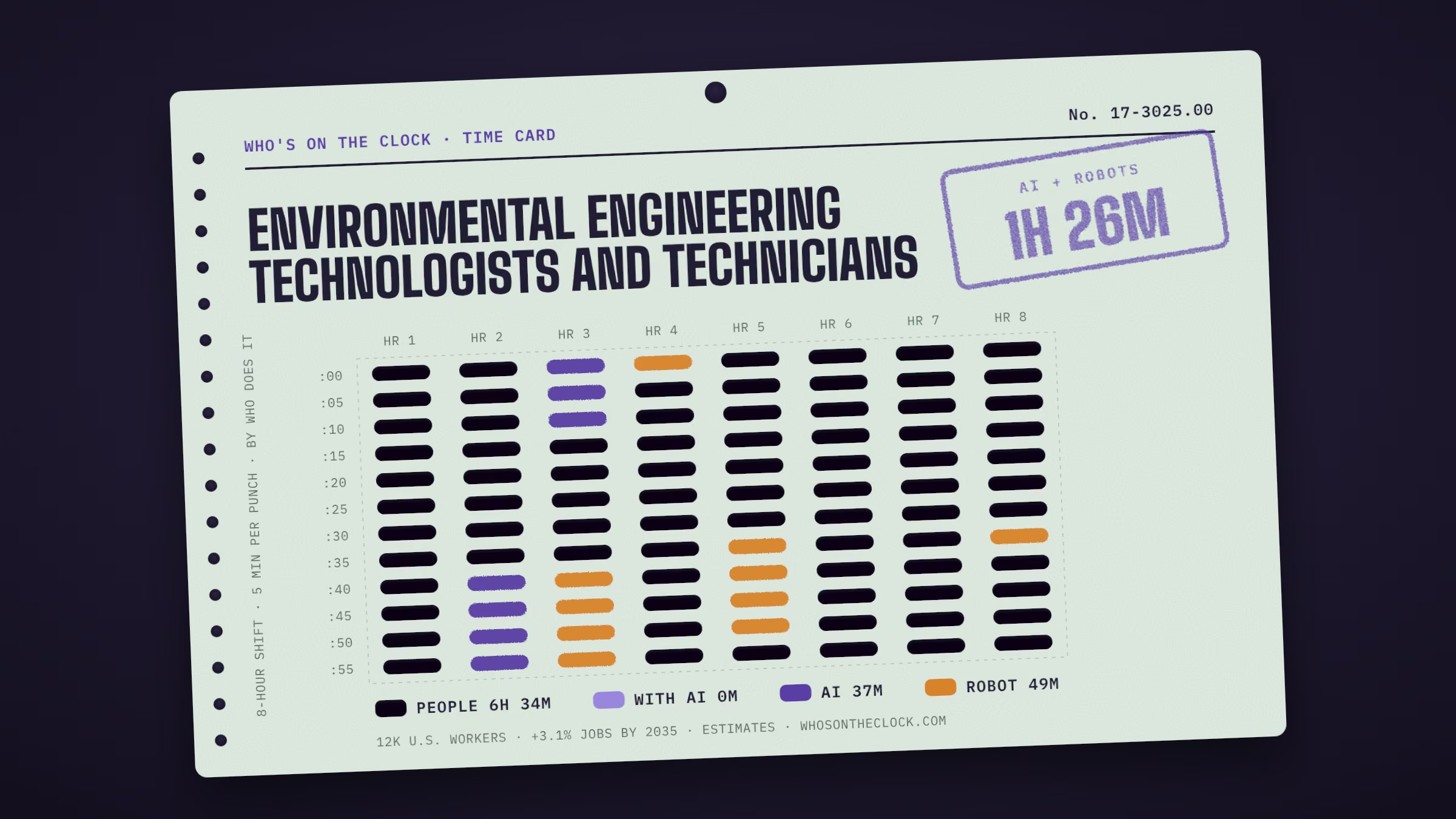
Apply theory and principles of environmental engineering to modify, test, and operate equipment and devices used in the prevention, control, and remediation of environmental problems, including waste treatment and site remediation, under the direction of engineering staff or scientists. May assist in the development of environmental remediation devices.
Time card
Untick tasks you don't do, or set your own times.
| Mine | Task, by time spent | Human | With AI | AI | Robot |
|---|---|---|---|---|---|
Collect and analyze pollution samples, such as air or ground water.55m a shift · Robots only in factory cellsWhy this label?Robots have done this only in factory setups built around the machine, so it stays Human for environmental engineering technologists and technicians. How labels work | |||||
Produce environmental assessment reports, tabulating data and preparing charts, graphs, or sketches.43m a shift · No AI or robot evidence foundWhy this label?No AI use or robot deployment showed up for this task in our data. That isn't proof it's safe; it may just be rare in the data. How labels work | |||||
Record laboratory or field data, including numerical data, test results, photographs, or summaries of visual observations.37m a shift · Observed in AI useWhy this label?Marked AI because this task shows up regularly in real AI conversations (Anthropic Economic Index, 2025 usage), and in most of them AI does the task on its own rather than helping a person. Many workplaces may not use AI for it at all. How labels work | |||||
Maintain project logbook records or computer program files.25m a shift · No AI or robot evidence foundWhy this label?No AI use or robot deployment showed up for this task in our data. That isn't proof it's safe; it may just be rare in the data. How labels work | |||||
Perform environmental quality work in field or office settings.25m a shift · Robots deployed · e.g. WSD 4th-generation Unmanned Surface Vessel (USV) water quality monitoring and sampling systemWhy this label?Marked Robot because WSD 4th-generation Unmanned Surface Vessel (USV) water quality monitoring and sampling system (in real use) has done this task in a real workplace. It shows a robot can do it somewhere, not that most environmental engineering technologists and technicians work alongside one. How labels work | |||||
Prepare permit applications or review compliance with environmental permits.25m a shift · No AI or robot evidence foundWhy this label?No AI use or robot deployment showed up for this task in our data. That isn't proof it's safe; it may just be rare in the data. How labels work | |||||
Inspect facilities to monitor compliance with regulations governing substances, such as asbestos, lead, or wastewater.25m a shift · No AI or robot evidence foundWhy this label?This is physical work, and no robot has been shown doing it yet. How labels work | |||||
Decontaminate or test field equipment used to clean or test pollutants from soil, air, or water.18m a shift · Robots only in factory cellsWhy this label?Robots have done this only in factory setups built around the machine, so it stays Human for environmental engineering technologists and technicians. How labels work | |||||
Prepare and package environmental samples for shipping or testing.18m a shift · Robots only in factory cellsWhy this label?Robots have done this only in factory setups built around the machine, so it stays Human for environmental engineering technologists and technicians. How labels work | |||||
Maintain process parameters and evaluate process anomalies.18m a shift · Robots deployed · e.g. Ammonia-Based Aeration Control (ABAC) system (real-time controller module plus DO, ammonia, TSS and nitrate probes driving four aeration blowers)Why this label?Marked Robot because Ammonia-Based Aeration Control (ABAC) system (real-time controller module plus DO, ammonia, TSS and nitrate probes driving four aeration blowers) (in real use) has done this task in a real workplace. It shows a robot can do it somewhere, not that most environmental engineering technologists and technicians work alongside one. How labels work | |||||
Review technical documents to ensure completeness and conformance to requirements.18m a shift · No AI or robot evidence foundWhy this label?No AI use or robot deployment showed up for this task in our data. That isn't proof it's safe; it may just be rare in the data. How labels work | |||||
Receive, set up, test, or decontaminate equipment.18m a shift · Robots only in factory cellsWhy this label?Robots have done this only in factory setups built around the machine, so it stays Human for environmental engineering technologists and technicians. How labels work | |||||
Develop work plans, including writing specifications or establishing material, manpower, or facilities needs.18m a shift · No AI or robot evidence foundWhy this label?No AI use or robot deployment showed up for this task in our data. That isn't proof it's safe; it may just be rare in the data. How labels work | |||||
Perform statistical analysis and correction of air or water pollution data submitted by industry or other agencies.18m a shift · No AI or robot evidence foundWhy this label?No AI use or robot deployment showed up for this task in our data. That isn't proof it's safe; it may just be rare in the data. How labels work | |||||
Provide technical engineering support in the planning of projects, such as wastewater treatment plants, to ensure compliance with environmental regulations and policies.18m a shift · No AI or robot evidence foundWhy this label?No AI use or robot deployment showed up for this task in our data. That isn't proof it's safe; it may just be rare in the data. How labels work | |||||
Review work plans to schedule activities.12m a shift · No AI or robot evidence foundWhy this label?No AI use or robot deployment showed up for this task in our data. That isn't proof it's safe; it may just be rare in the data. How labels work | |||||
Assist in the cleanup of hazardous material spills.12m a shift · No AI or robot evidence foundWhy this label?This is physical work, and no robot has been shown doing it yet. How labels work | |||||
Arrange for the disposal of lead, asbestos, or other hazardous materials.12m a shift · No AI or robot evidence foundWhy this label?No AI use or robot deployment showed up for this task in our data. That isn't proof it's safe; it may just be rare in the data. How labels work | |||||
Work with customers to assess the environmental impact of proposed construction or to develop pollution prevention programs.12m a shift · No AI or robot evidence foundWhy this label?No AI use or robot deployment showed up for this task in our data. That isn't proof it's safe; it may just be rare in the data. How labels work | |||||
Obtain product information, identify vendors or suppliers, or order materials or equipment to maintain inventory.12m a shift · No AI or robot evidence foundWhy this label?No AI use or robot deployment showed up for this task in our data. That isn't proof it's safe; it may just be rare in the data. How labels work | |||||
Evaluate and select technologies to clean up polluted sites, restore polluted air, water, or soil, or rehabilitate degraded ecosystems.6m a shift · No AI or robot evidence foundWhy this label?No AI use or robot deployment showed up for this task in our data. That isn't proof it's safe; it may just be rare in the data. How labels work | |||||
Assess the ability of environments to naturally remove or reduce conventional or emerging contaminants from air, water, or soil.6m a shift · Robots deployed · e.g. Environmental Sample Processor (2G/3G ESP), including LRAUV-mounted versionsWhy this label?Marked Robot because Environmental Sample Processor (2G/3G ESP), including LRAUV-mounted versions (in real use) has done this task in a real workplace. It shows a robot can do it somewhere, not that most environmental engineering technologists and technicians work alongside one. How labels work | |||||
Model biological, chemical, or physical treatment processes to remove or degrade pollutants.6m a shift · No AI or robot evidence foundWhy this label?No AI use or robot deployment showed up for this task in our data. That isn't proof it's safe; it may just be rare in the data. How labels work | |||||
Oversee support staff.6m a shift · No AI or robot evidence foundWhy this label?No AI use or robot deployment showed up for this task in our data. That isn't proof it's safe; it may just be rare in the data. How labels work | |||||
Create models to demonstrate or predict the process by which pollutants move through or impact an environment.6m a shift · No AI or robot evidence foundWhy this label?No AI use or robot deployment showed up for this task in our data. That isn't proof it's safe; it may just be rare in the data. How labels work | |||||
Improve chemical processes to reduce toxic emissions.6m a shift · No AI or robot evidence foundWhy this label?This is physical work, and no robot has been shown doing it yet. How labels work |