Will AI replace medical and health services managers?

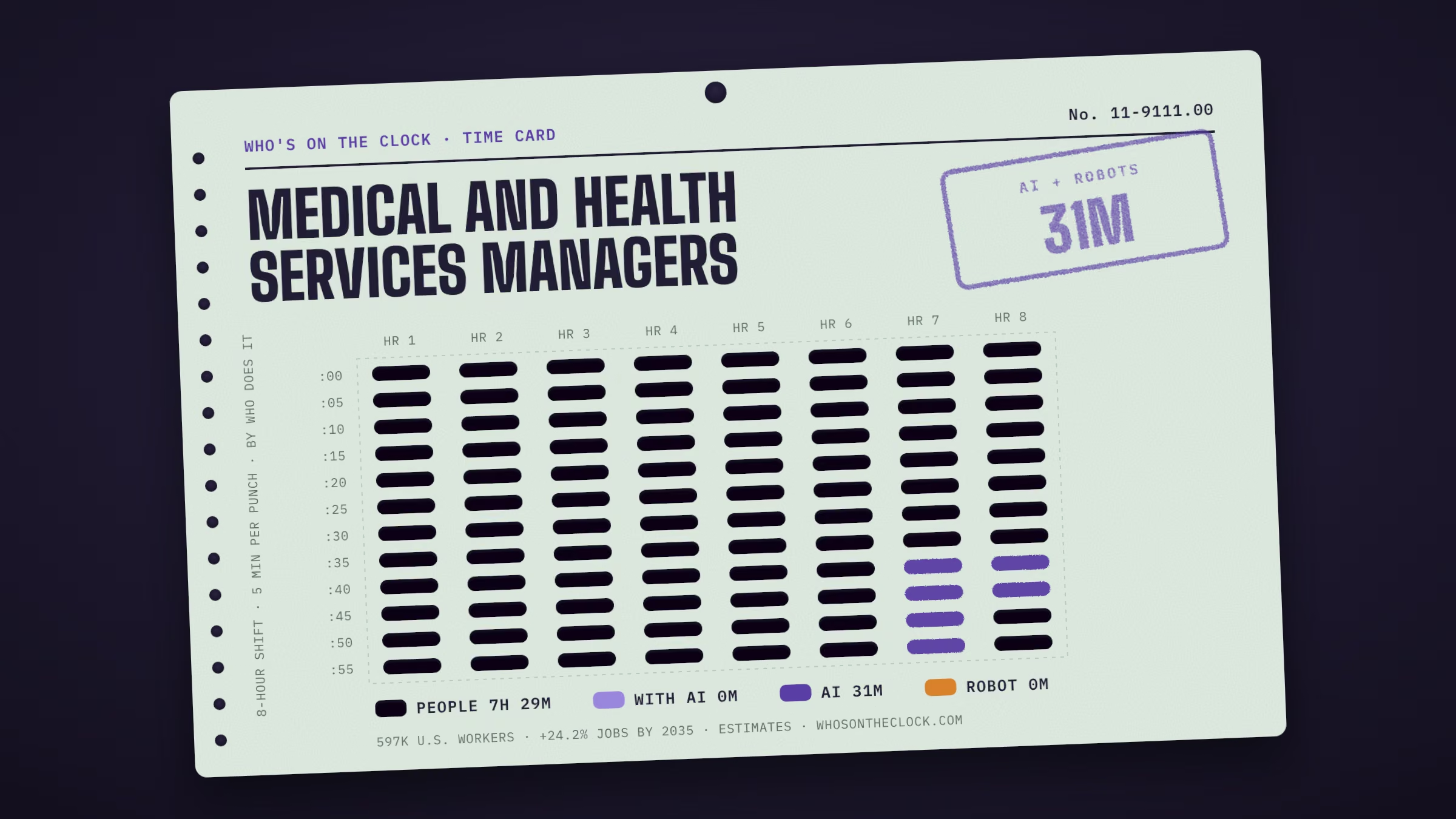
Unlikely, though parts of the work are changing. About 31m of an 8-hour shift goes to tasks touched by AI working on its own. The other 7h 29m (94%) stays with people. Separately, BLS expects about 24.2% more of these jobs by 2035 (all jobs: +3.5%).

Time card for medical and health services managers showing a typical 8-hour shift: 7h 29m done by people, 31m by AI.
Each mark is 5 minutes of a typical shift for medical and health services managers, colored by who does that task today. Estimates from O*NET tasks and Anthropic Economic Index data. How it's made

Home / Management / Medical and Health Services Managers

Plan, direct, or coordinate medical and health services in hospitals, clinics, managed care organizations, public health agencies, or similar organizations.

Time card

Untick tasks you don't do, or set your own times.
MineTask, by time spentHumanWith AIAIRobot
Direct, supervise and evaluate work activities of medical, nursing, technical, clerical, service, maintenance, and other personnel.1h 13m a shift · No AI or robot evidence found
Plan, implement, and administer programs and services in a health care or medical facility, including personnel administration, training, and coordination of medical, nursing and physical plant staff.47m a shift · No AI or robot evidence found
Conduct and administer fiscal operations, including accounting, planning budgets, authorizing expenditures, establishing rates for services, and coordinating financial reporting.42m a shift · No AI or robot evidence found
Maintain communication between governing boards, medical staff, and department heads by attending board meetings and coordinating interdepartmental functioning.42m a shift · No AI or robot evidence found
Monitor the use of diagnostic services, inpatient beds, facilities, and staff to ensure effective use of resources and assess the need for additional staff, equipment, and services.31m a shift · No AI or robot evidence found
Direct or conduct recruitment, hiring, and training of personnel.31m a shift · No AI or robot evidence found
Establish work schedules and assignments for staff, according to workload, space, and equipment availability.26m a shift · No AI or robot evidence found
Maintain awareness of advances in medicine, computerized diagnostic and treatment equipment, data processing technology, government regulations, health insurance changes, and financing options.21m a shift · No AI or robot evidence found
Manage change in integrated health care delivery systems, such as work restructuring, technological innovations, and shifts in the focus of care.21m a shift · No AI or robot evidence found
Establish objectives and evaluative or operational criteria for units managed.21m a shift · No AI or robot evidence found
Develop and implement organizational policies and procedures for the facility or medical unit.21m a shift · No AI or robot evidence found
Review and analyze facility activities and data to aid planning and cash and risk management and to improve service utilization.21m a shift · No AI or robot evidence found
Prepare activity reports to inform management of the status and implementation plans of programs, services, and quality initiatives.21m a shift · Observed in AI useTypical AI request: about 2h 31m alone, 18m with AI
Develop and maintain computerized record management systems to store and process data, such as personnel activities and information, and to produce reports.16m a shift · No AI or robot evidence found
Consult with medical, business, and community groups to discuss service problems, respond to community needs, enhance public relations, coordinate activities and plans, and promote health programs.16m a shift · No AI or robot evidence found
Develop or expand and implement medical programs or health services that promote research, rehabilitation, and community health.10m a shift · No AI or robot evidence found
Develop instructional materials and conduct in-service and community-based educational programs.10m a shift · Observed in AI use
Inspect facilities and recommend building or equipment modifications to ensure emergency readiness and compliance to access, safety, and sanitation regulations.10m a shift · No AI or robot evidence found

On the floor

  1. Rolling outTampa General Hospital
    Tampa General uses AI agents for claims, denials and appeal letters

    Tampa General Hospital deploys AI agents for billing and claims follow-up, denial management, appeal letter writing and release of information. It uses Palantir, Epic and Anthropic tools.

    Becker's Hospital Review

Ask the clock

Will AI replace medical and health services managers?

Unlikely, though parts of the work are changing. About 31m of an 8-hour shift goes to tasks touched by AI working on its own. The other 7h 29m (94%) stays with people. Separately, BLS expects about 24.2% more of these jobs by 2035 (all jobs: +3.5%).

What can AI already do for medical and health services managers?

AI shows up regularly in 2 of 18 tasks, about 31m of a typical shift. The biggest ones:

  • Prepare activity reports to inform management of the status and implementation plans of programs, services, and quality initiatives. (21m a shift, AI mostly does it alone)
  • Develop instructional materials and conduct in-service and community-based educational programs. (10m a shift, AI mostly does it alone)
Where do robots fit in?

Not in workplaces like this one, based on a 2026 review of robot deployments. For 1 physical task, no robot has shown it can do the work yet.

What still needs a person?

7h 29m of a typical shift, or 94%, goes to tasks with no AI or robot evidence yet. No AI usage or robot deployment has shown up for these so far. The biggest:

  • Direct, supervise and evaluate work activities of medical, nursing, technical, clerical, service, maintenance, and other personnel. (1h 13m a shift)
  • Plan, implement, and administer programs and services in a health care or medical facility, including personnel administration, training, and coordination of medical, nursing and physical plant staff. (47m a shift)
  • Conduct and administer fiscal operations, including accounting, planning budgets, authorizing expenditures, establishing rates for services, and coordinating financial reporting. (42m a shift)
  • Maintain communication between governing boards, medical staff, and department heads by attending board meetings and coordinating interdepartmental functioning. (42m a shift)
  • Monitor the use of diagnostic services, inpatient beds, facilities, and staff to ensure effective use of resources and assess the need for additional staff, equipment, and services. (31m a shift)
Why is that work hard to automate?

Much of it comes down to where and how the work happens. In-person, hands-on and high-stakes work is where AI and robots have made the least headway so far. In the official O*NET survey of people in this job:

  • 82% are in constant contact with other people
  • 75% talk face to face with others every day
  • 71% say dealing with the public is very or extremely important
What are companies actually doing?

We track 1 sourced company move that affects this job. Most recent:

  • May 12, 2026: Tampa General uses AI agents for claims, denials and appeal letters (Rolling out)
How much time does AI save on these tasks?

For the 1 task in this job where AI shows up and timing data exists, a typical request takes about 2h 31m for a person alone and about 18m with AI. These are Claude's own estimates from real conversations in April and May 2026 (Anthropic Economic Index). They describe single requests, not whole workdays, and time saved on a task doesn't mean jobs are cut. The biggest gaps:

  • Prepare activity reports to inform management of the status and implementation plans of programs, services, and quality initiatives (about 2h 31m alone, 18m with AI)
Are employers still hiring medical and health services managers?

On Indeed, job postings in the Management sector are at 104% of their February 2020 level (all U.S. postings: 104%), up 8.3% from a year earlier, as of Oct 9, 2026. BLS separately expects about 62,000 openings a year in this job through 2035. Across all U.S. postings, 7.3% now mention AI skills. Sector postings cover more than this one job and move for many reasons besides AI.

How much do medical and health services managers make?

The median pay is about $123,860 a year ($59.55 an hour), 143% above the median for all U.S. jobs ($50,980). Most people in this job earn between $73,390 and $224,340 a year; that range covers the middle 80%. Pay figures are from BLS, May 2025, and vary a lot by state and employer. Pick a state to compare:

Is this job growing or shrinking?

BLS projects growth of 24.2% from 2025 to 2035, compared with 3.5% growth for all jobs. That's about 796,000 jobs in 2035. It expects about 62,000 openings a year, mostly from people retiring or changing careers. These projections don't single out AI as a cause.

How many medical and health services managers are there in the U.S.?

About 597,000 people in the U.S., roughly 0.38% of all workers (BLS, May 2025). That makes it the 71st largest of the 796 jobs on this site. BLS expects about 796,000 in 2035.

What training do medical and health services managers need?

The most common requirement is a bachelor's degree: about 46% of people in the job said so in the official O*NET survey. O*NET rates the job at level 4 of 5 for preparation, which usually means: bachelor's degree. Requirements vary by state and employer, especially for licensed work.

What should I learn to stay ahead of AI?

These come from the job's official skill ratings and from the tasks that AI and robots touch least today. Building them keeps you strong in the parts of the work that still need a person:

  • Skills that matter more here than in most jobs: Management of Material Resources, Management of Financial Resources, Management of Personnel Resources, Time Management
  • Get strong at the parts of the job that stay with people (listed above), which take 7h 29m of a typical shift
  • Tools employers list: Microsoft PowerPoint, Microsoft Outlook, Microsoft Office software, Microsoft Excel, Adobe Acrobat
  • Learn to use AI well on the tasks where it already shows up in this job (listed above)
What other jobs could medical and health services managers move into?

These use similar skills, with less of a typical shift touched by AI or robots. Matches come from 109 official ratings of skills, knowledge and work activities, and each needs the same or less preparation unless the official list relates the jobs directly:

  • Human Resources Managers (0m touched, $149k median pay)
  • Emergency Management Directors (0m touched, $93k median pay)
  • Administrative Services Managers (0m touched, $114k median pay)
  • Supply Chain Managers (0m touched, $107k median pay)
How solid are these numbers?

Each task carries its own evidence label. For this job: 2 observed in real AI use, 16 with no AI or robot evidence found. The minutes per task are estimates, not measured hours, and "no evidence" doesn't prove a task is safe.

Tools in demand

  • Microsoft PowerPoint
  • Microsoft Outlook
  • Microsoft Office software
  • Microsoft Excel
  • Adobe Acrobat
  • Apache Hadoop
  • Apache Maven
  • Autodesk Revit

Also called

Assisted Living Administrator, Assisted Living Manager, Cancer Center Director, Care Coordinator, Client Services Director, Clinic Director, Clinical Director, Clinical Informatics Director, Clinical Manager, Clinical Services Director, Clinical Supervisor, Community Health Nursing Director, Correctional Therapy Director, Dental Laboratory Manager (Dental Lab Manager)