Will AI replace human resources managers?

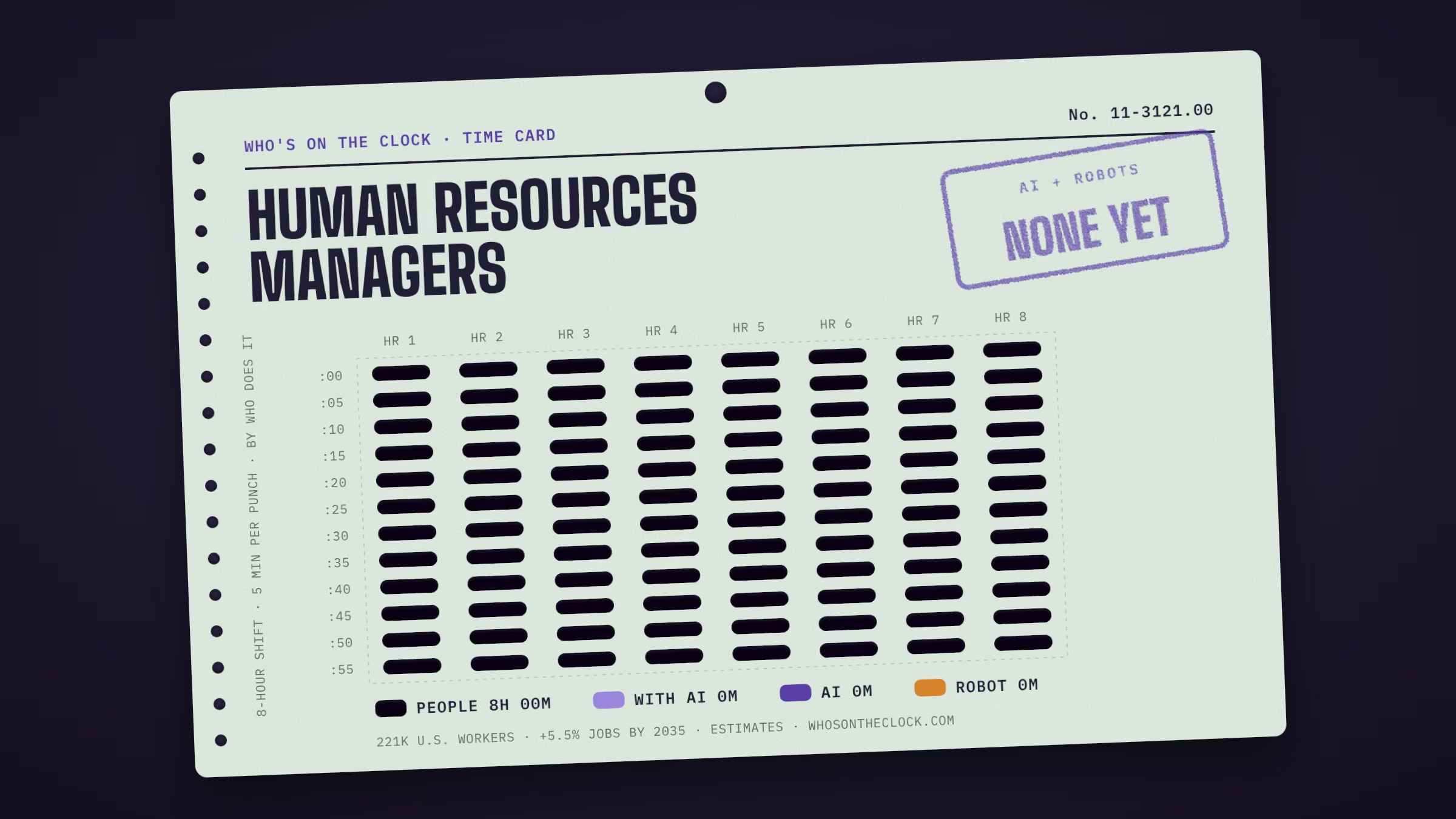
Not on current evidence. Less than 30 minutes of a typical shift goes to tasks that AI or robots are doing today. The other 8h (100%) stays with people. Separately, BLS expects about 5.5% more of these jobs by 2035 (all jobs: +3.5%).

Time card for human resources managers showing a typical 8-hour shift: 8h done by people.
Each mark is 5 minutes of a typical shift for human resources managers, colored by who does that task today. Estimates from O*NET tasks and Anthropic Economic Index data. How it's made

Home / Management / Human Resources Managers

Plan, direct, or coordinate human resources activities and staff of an organization.

Time card

Untick tasks you don't do, or set your own times.
MineTask, by time spentHumanWith AIAIRobot
Serve as a link between management and employees by handling questions, interpreting and administering contracts and helping resolve work-related problems.50m a shift · No AI or robot evidence found
Plan, direct, supervise, and coordinate work activities of subordinates and staff relating to employment, compensation, labor relations, and employee relations.39m a shift · No AI or robot evidence found
Identify staff vacancies and recruit, interview, and select applicants.39m a shift · No AI or robot evidence found
Perform difficult staffing duties, including dealing with understaffing, refereeing disputes, firing employees, and administering disciplinary procedures.34m a shift · No AI or robot evidence found
Advise managers on organizational policy matters, such as equal employment opportunity and sexual harassment, and recommend needed changes.34m a shift · No AI or robot evidence found
Administer compensation, benefits, and performance management systems, and safety and recreation programs.34m a shift · No AI or robot evidence found
Analyze and modify compensation and benefits policies to establish competitive programs and ensure compliance with legal requirements.28m a shift · No AI or robot evidence found
Provide current and prospective employees with information about policies, job duties, working conditions, wages, opportunities for promotion, and employee benefits.22m a shift · No AI or robot evidence found
Plan, organize, direct, control, or coordinate the personnel, training, or labor relations activities of an organization.22m a shift · No AI or robot evidence found
Analyze statistical data and reports to identify and determine causes of personnel problems and develop recommendations for improvement of organization's personnel policies and practices.17m a shift · No AI or robot evidence found
Maintain records and compile statistical reports concerning personnel-related data such as hires, transfers, performance appraisals, and absenteeism rates.17m a shift · No AI or robot evidence found
Analyze training needs to design employee development, language training, and health and safety programs.17m a shift · No AI or robot evidence found
Represent organization at personnel-related hearings and investigations.11m a shift · No AI or robot evidence found
Plan and conduct new employee orientation to foster positive attitude toward organizational objectives.11m a shift · No AI or robot evidence found
Prepare and follow budgets for personnel operations.11m a shift · No AI or robot evidence found
Oversee the evaluation, classification, and rating of occupations and job positions.11m a shift · No AI or robot evidence found
Allocate human resources, ensuring appropriate matches between personnel.11m a shift · No AI or robot evidence found
Prepare personnel forecast to project employment needs.11m a shift · No AI or robot evidence found
Study legislation, arbitration decisions, and collective bargaining contracts to assess industry trends.11m a shift · No AI or robot evidence found
Develop or administer special projects in areas such as pay equity, savings bond programs, day care, and employee awards.11m a shift · No AI or robot evidence found
Contract with vendors to provide employee services, such as food service, transportation, or relocation service.11m a shift · No AI or robot evidence found
Negotiate bargaining agreements and help interpret labor contracts.6m a shift · No AI or robot evidence found
Investigate and report on industrial accidents for insurance carriers.6m a shift · No AI or robot evidence found
Conduct exit interviews to identify reasons for employee termination.6m a shift · No AI or robot evidence found
Develop, administer, and evaluate applicant tests.6m a shift · No AI or robot evidence found
Provide terminated employees with outplacement or relocation assistance.6m a shift · No AI or robot evidence found

On the floor

No company news tracked for this job yet. New stories are added as they happen.

Ask the clock

Will AI replace human resources managers?

Not on current evidence. Less than 30 minutes of a typical shift goes to tasks that AI or robots are doing today. The other 8h (100%) stays with people. Separately, BLS expects about 5.5% more of these jobs by 2035 (all jobs: +3.5%).

What parts of the job can AI already do?

None of this job's tasks show regular AI use yet. That can mean the work is hands-on or in person, or simply that it rarely comes up in AI usage data.

What parts of the job are still done by people?

8h of a typical shift, or 100%, goes to tasks with no AI or robot evidence yet. No AI usage or robot deployment has shown up for these so far. The biggest:

  • Serve as a link between management and employees by handling questions, interpreting and administering contracts and helping resolve work-related problems. (50m a shift)
  • Plan, direct, supervise, and coordinate work activities of subordinates and staff relating to employment, compensation, labor relations, and employee relations. (39m a shift)
  • Identify staff vacancies and recruit, interview, and select applicants. (39m a shift)
  • Perform difficult staffing duties, including dealing with understaffing, refereeing disputes, firing employees, and administering disciplinary procedures. (34m a shift)
  • Advise managers on organizational policy matters, such as equal employment opportunity and sexual harassment, and recommend needed changes. (34m a shift)
Why does a person still do this work?

Part of the answer is the setting, not just the tasks. Work that is in person, hands on or high stakes is where AI and robots have made the least headway so far. In the official O*NET survey of people in this job:

  • 81% talk face to face with others every day
  • 73% handle conflict at least once a week
  • 73% are in constant contact with other people
Are employers still hiring for this job?

On Indeed, job postings in the Human Resources sector are at 99% of their February 2020 level (all U.S. postings: 104%), up 18.9% from a year earlier, as of Oct 9, 2026. BLS separately expects about 17,000 openings a year in this job through 2035. Across all U.S. postings, 7.3% now mention AI skills. Sector postings cover more than this one job and move for many reasons besides AI.

How much do human resources managers make?

The median pay is about $149,280 a year ($71.77 an hour), 193% above the median for all U.S. jobs ($50,980). Most people in this job earn between $88,200 and $267,810 or more a year; that range covers the middle 80%. Pay figures are from BLS, May 2025, and vary a lot by state and employer. Pick a state to compare:

Is this job growing or shrinking?

BLS projects growth of 5.5% from 2025 to 2035, compared with 3.5% growth for all jobs. That's about 237,000 jobs in 2035. It expects about 17,000 openings a year, mostly from people retiring or changing careers. These projections don't single out AI as a cause.

How many people do this job?

About 221,000 people in the U.S., roughly 0.14% of all workers (BLS, May 2025). That makes it the 163rd largest of the 796 jobs on this site. BLS expects about 237,000 in 2035.

What do you need to become one?

The most common requirement is a bachelor's degree: about 82% of people in the job said so in the official O*NET survey. O*NET rates the job at level 4 of 5 for preparation, which usually means: bachelor's degree. Requirements vary by state and employer, especially for licensed work.

What should I learn to stay ahead?

These come from the job's official skill ratings and from the tasks that AI and robots touch least today. Building them keeps you strong in the parts of the work that still need a person:

  • Skills that matter more here than in most jobs: Management of Personnel Resources, Time Management, Coordination, Negotiation
  • Get strong at the parts of the job that stay with people (listed above), which take 8h of a typical shift
  • Tools employers list: Workday software, Microsoft PowerPoint, Microsoft Outlook, Microsoft Office software, Microsoft Excel
What similar jobs could I move into?

These use similar skills. Matches come from 109 official ratings of skills, knowledge and work activities, and each needs the same or less preparation unless the official list relates the jobs directly:

  • Medical and Health Services Managers (31m touched, $124k median pay)
  • Social and Community Service Managers (1h 46m touched, $80k median pay)
  • Sales Managers (26m touched, $148k median pay)
  • Loss Prevention Managers (23m touched, $142k median pay)
  • Industrial-Organizational Psychologists (1h 51m touched, $194k median pay)
How solid are these numbers?

Each task carries its own evidence label. For this job: 26 with no AI or robot evidence found. The minutes per task are estimates, not measured hours, and "no evidence" doesn't prove a task is safe.

Tools in demand

  • Workday software
  • Microsoft PowerPoint
  • Microsoft Outlook
  • Microsoft Office software
  • Microsoft Excel
  • Facebook
  • IBM SPSS Statistics
  • Intuit QuickBooks

Also called

Diversity Manager, Diversity and Inclusion Director, Efficiency Manager, Employee Relations Manager, Employee Welfare Manager, Employment Manager, HR Admin Director (Human Resources Administration Director), HR Coordinator (Human Resources Coordinator), HR Department Supervisor (Human Resources Department Supervisor), HR Director (Human Resources Director), HR Manager (Human Resources Manager), HR Ops Manager (Human Resources Operations Manager), HR Supervisor (Human Resources Supervisor), HR VP (Human Resources Vice President)