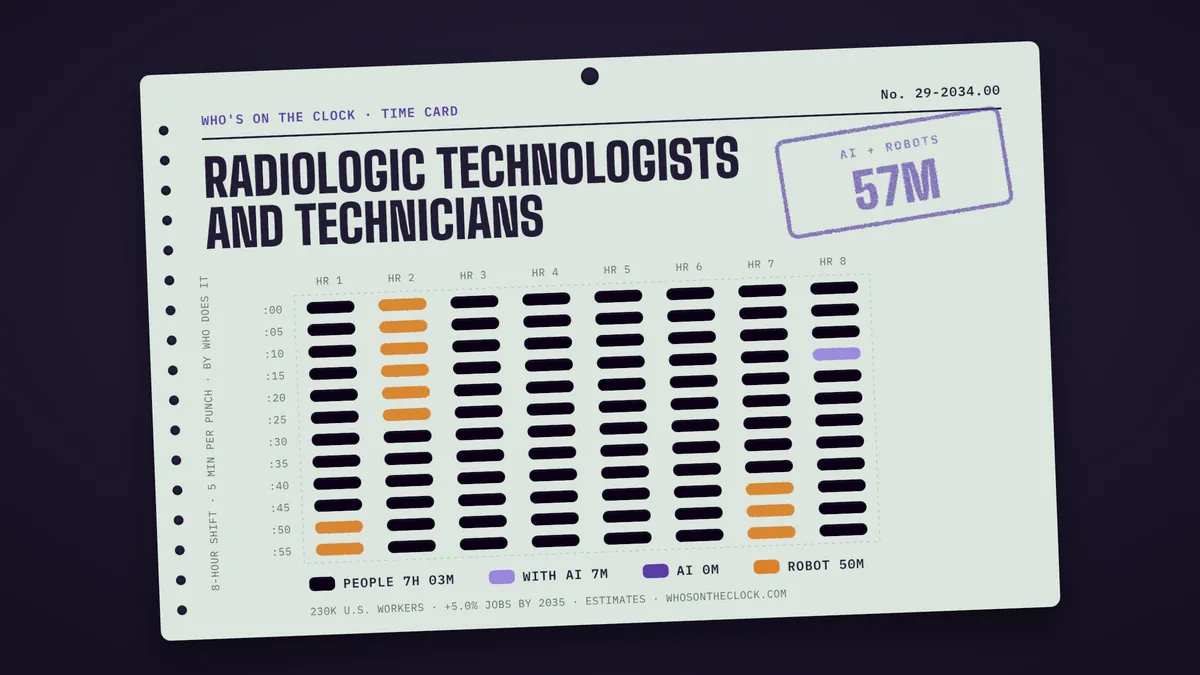
Radiologic technologists and technicians or diagnostic medical sonographers: which will AI change more? AI and robots touch more of the day for radiologic technologists and technicians: 57m of an 8-hour shift, against 0m for diagnostic medical sonographers. Diagnostic medical sonographers earn more, a median of $96,590 against $80,110.
The two jobs share related skills, including operation and control, social perceptiveness, equipment selection, so moving between them is realistic for many people. Each column links to the full time card with every task.
| Radiologic Technologists and Technicians | Diagnostic Medical Sonographers | |
|---|---|---|
| Touched by AI or robots | 57m | 0m |
| Done with AI's help | 7m | 0m |
| AI mostly alone | 0m | 0m |
| Robots | 50m | 0m |
| Still done by people | 7h 4m | 8h |
| Median pay | $80,110 | $96,590 |
| U.S. workers | 230,000 | 90,000 |
| Outlook to 2035 | +5% | +13.9% |
| Openings a year | 13,000 | 6,000 |
| Typical preparation | Vocational school or associate's degree | Vocational school or associate's degree |
| Biggest AI or robot task | Position imaging equipment and adjust controls to set exposure time and distance, according to specification of examination | none found |
Radiologic Technologists and Technicians
Where AI or robots show up most:
- Position imaging equipment and adjust controls to set exposure time and distance, according to specification of examination. (38m a shift)
- Transport patients to or from exam rooms. (13m a shift)
- Take thorough and accurate patient medical histories. (6m a shift)
Still done by people:
- Position patient on examining table and set up and adjust equipment to obtain optimum view of specific body area as requested by physician. (51m a shift)
- Explain procedures and observe patients to ensure safety and comfort during scan. (32m a shift)
- Review and evaluate developed x-rays, video tape, or computer-generated information to determine if images are satisfactory for diagnostic purposes. (32m a shift)
Diagnostic Medical Sonographers
No AI or robot use documented for any task yet.
Still done by people:
- Operate ultrasound equipment to produce and record images of the motion, shape, and composition of blood, organs, tissues, or bodily masses, such as fluid accumulations. (2h 3m a shift)
- Observe screen during scan to ensure that image produced is satisfactory for diagnostic purposes, making adjustments to equipment as required. (1h 2m a shift)
- Select appropriate equipment settings and adjust patient positions to obtain the best sites and angles. (37m a shift)