Will AI replace diagnostic medical sonographers?

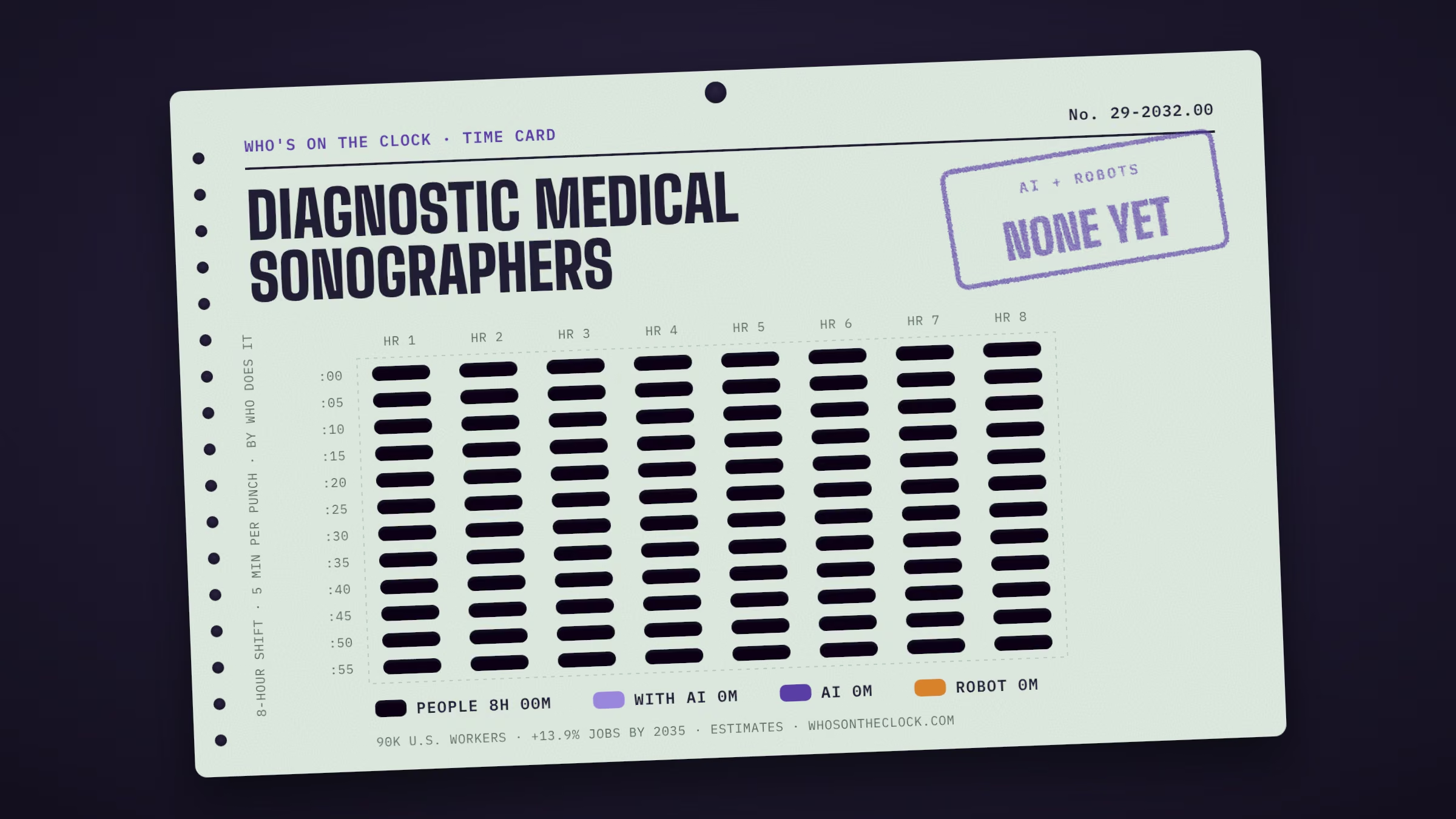
“Operate ultrasound equipment to produce and record images of the motion” is the largest task here, and like every other task on this time card it is still done by people. We found no AI use or robot deployment for any of them. That reflects today's evidence and could change. BLS expects about 13.9% more of these jobs by 2035.

Time card for diagnostic medical sonographers showing a typical 8-hour shift: 8h done by people.
Each mark is 5 minutes of a typical shift for diagnostic medical sonographers, colored by who does that task today. Estimates from O*NET tasks and Anthropic Economic Index data. How it's made

Home / Healthcare practitioners / Diagnostic Medical Sonographers

Produce ultrasonic recordings of internal organs for use by physicians. Includes vascular technologists.

Time card

Untick tasks you don't do, or set your own times.
MineTask, by time spentHumanWith AIAIRobot
Operate ultrasound equipment to produce and record images of the motion, shape, and composition of blood, organs, tissues, or bodily masses, such as fluid accumulations.2h 3m a shift · No AI or robot evidence found
Why this label?This is physical work, and no robot has been shown doing it yet. How labels work
Observe screen during scan to ensure that image produced is satisfactory for diagnostic purposes, making adjustments to equipment as required.1h 2m a shift · No AI or robot evidence found
Why this label?This is physical work, and no robot has been shown doing it yet. How labels work
Select appropriate equipment settings and adjust patient positions to obtain the best sites and angles.37m a shift · No AI or robot evidence found
Why this label?This is physical work, and no robot has been shown doing it yet. How labels work
Prepare patient for exam by explaining procedure, transferring patient to ultrasound table, scrubbing skin and applying gel, and positioning patient properly.37m a shift · No AI or robot evidence found
Why this label?This is physical work, and no robot has been shown doing it yet. How labels work
Observe and care for patients throughout examinations to ensure their safety and comfort.25m a shift · No AI or robot evidence found
Why this label?This is physical work, and no robot has been shown doing it yet. How labels work
Provide sonogram and oral or written summary of technical findings to physician for use in medical diagnosis.25m a shift · No AI or robot evidence found
Why this label?No AI use or robot deployment showed up for this task in our data. That isn't proof it's safe; it may just be rare in the data. How labels work
Decide which images to include, looking for differences between healthy and pathological areas.25m a shift · No AI or robot evidence found
Why this label?No AI use or robot deployment showed up for this task in our data. That isn't proof it's safe; it may just be rare in the data. How labels work
Record and store suitable images, using camera unit connected to the ultrasound equipment.25m a shift · No AI or robot evidence found
Why this label?This is physical work, and no robot has been shown doing it yet. How labels work
Obtain and record accurate patient history, including prior test results or information from physical examinations.18m a shift · No AI or robot evidence found
Why this label?No AI use or robot deployment showed up for this task in our data. That isn't proof it's safe; it may just be rare in the data. How labels work
Maintain records that include patient information, sonographs and interpretations, files of correspondence, publications and regulations, or quality assurance records, such as pathology, biopsy, or post-operative reports.18m a shift · No AI or robot evidence found
Why this label?No AI use or robot deployment showed up for this task in our data. That isn't proof it's safe; it may just be rare in the data. How labels work
Coordinate work with physicians or other healthcare team members, including providing assistance during invasive procedures.18m a shift · No AI or robot evidence found
Why this label?This is physical work, and no robot has been shown doing it yet. How labels work
Perform clerical duties, such as scheduling exams or special procedures, keeping records, or archiving computerized images.18m a shift · No AI or robot evidence found
Why this label?No AI use or robot deployment showed up for this task in our data. That isn't proof it's safe; it may just be rare in the data. How labels work
Clean, check, and maintain sonographic equipment, submitting maintenance requests or performing minor repairs as necessary.12m a shift · No AI or robot evidence found
Why this label?This is physical work, and no robot has been shown doing it yet. How labels work
Supervise or train students or other medical sonographers.12m a shift · No AI or robot evidence found
Why this label?No AI use or robot deployment showed up for this task in our data. That isn't proof it's safe; it may just be rare in the data. How labels work
Determine whether scope of exam should be extended, based on findings.6m a shift · No AI or robot evidence found
Why this label?No AI use or robot deployment showed up for this task in our data. That isn't proof it's safe; it may just be rare in the data. How labels work
Perform legal and ethical duties, including preparing safety or accident reports, obtaining written consent from patient to perform invasive procedures, or reporting symptoms of abuse or neglect.6m a shift · No AI or robot evidence found
Why this label?No AI use or robot deployment showed up for this task in our data. That isn't proof it's safe; it may just be rare in the data. How labels work
Perform medical procedures, such as administering oxygen, inserting and removing airways, taking vital signs, or giving emergency treatment, such as first aid or cardiopulmonary resuscitation (CPR).6m a shift · Robots only in factory cells
Why this label?Robots have done this only in factory setups built around the machine, so it stays Human for diagnostic medical sonographers. How labels work
Maintain stock and supplies, preparing supplies for special examinations and ordering supplies when necessary.6m a shift · Robots only in factory cells
Why this label?Robots have done this only in factory setups built around the machine, so it stays Human for diagnostic medical sonographers. How labels work
Process and code film from procedures and complete appropriate documentation.time not estimated · No AI or robot evidence found
Why this label?No AI use or robot deployment showed up for this task in our data. That isn't proof it's safe; it may just be rare in the data. How labels work
Load and unload film cassettes used to record images from procedures.time not estimated · Robots deployed · e.g. Moxi
Why this label?Marked Robot because Moxi (in real use) has done this task in a real workplace. It shows a robot can do it somewhere, not that most diagnostic medical sonographers work alongside one. How labels work

Clock history

  1. 0m touchedFirst published: O*NET 30.1, Anthropic Economic Index (2025 usage and September 2026 robot study), BLS May 2025

When new data changes this clock, the date, the new numbers and the reason are logged here. Company news alone never moves the clock.

On the floor

No company news tracked for this job yet. New stories are added as they happen.

Ask the clock

Will AI replace diagnostic medical sonographers?

Not on current evidence. Less than 30 minutes of a typical shift goes to tasks that AI or robots are doing today. The other 8h (100%) stays with people. Separately, BLS expects about 13.9% more of these jobs by 2035 (all jobs: +3.5%).

What can AI already do for diagnostic medical sonographers?

None of this job's tasks show regular AI use yet. That can mean the work is hands-on or in person, or simply that it rarely comes up in AI usage data.

Where do robots fit in?

Not in workplaces like this one, based on a 2026 review of robot deployments. 2 more tasks have only been done in factory setups built around the machine, so they stay with people here. For 8 physical tasks, no robot has shown it can do the work yet.

What still needs a person?

8h of a typical shift, or 100%, goes to tasks with no AI or robot evidence yet. No AI usage or robot deployment has shown up for these so far. The biggest:

  • Operate ultrasound equipment to produce and record images of the motion, shape, and composition of blood, organs, tissues, or bodily masses, such as fluid accumulations. (2h 3m a shift)
  • Observe screen during scan to ensure that image produced is satisfactory for diagnostic purposes, making adjustments to equipment as required. (1h 2m a shift)
  • Select appropriate equipment settings and adjust patient positions to obtain the best sites and angles. (37m a shift)
  • Prepare patient for exam by explaining procedure, transferring patient to ultrasound table, scrubbing skin and applying gel, and positioning patient properly. (37m a shift)
  • Observe and care for patients throughout examinations to ensure their safety and comfort. (25m a shift)
Why is that work hard to automate?

Much of it comes down to where and how the work happens. In-person, hands-on and high-stakes work is where AI and robots have made the least headway so far. In the official O*NET survey of people in this job:

  • 100% use their hands on tools, objects or controls more than half the time
  • 97% work at arm's length or closer to other people
  • 81% say dealing with the public is very or extremely important
Are employers still hiring diagnostic medical sonographers?

On Indeed, job postings in the Medical Technician sector are at 125% of their February 2020 level (all U.S. postings: 104%), down 2.6% from a year earlier, as of Oct 9, 2026. BLS separately expects about 6,000 openings a year in this job through 2035. Across all U.S. postings, 7.3% now mention AI skills. Sector postings cover more than this one job and move for many reasons besides AI.

How much do diagnostic medical sonographers make?

The median pay is about $96,590 a year ($46.44 an hour), 89% above the median for all U.S. jobs ($50,980). Most people in this job earn between $67,820 and $129,370 a year; that range covers the middle 80%. Pay figures are from BLS, May 2025, and vary a lot by state and employer. Pick a state to compare:

Is this job growing or shrinking?

BLS projects growth of 13.9% from 2025 to 2035, compared with 3.5% growth for all jobs. That's about 105,000 jobs in 2035. It expects about 6,000 openings a year, mostly from people retiring or changing careers. These projections don't single out AI as a cause.

How many diagnostic medical sonographers are there in the U.S.?

About 90,000 people in the U.S., roughly 0.06% of all workers (BLS, May 2025). That makes it the 292nd largest of the 796 jobs on this site. BLS expects about 105,000 in 2035.

What training do diagnostic medical sonographers need?

The most common requirement is an associate's degree: about 47% of people in the job said so in the official O*NET survey. O*NET rates the job at level 3 of 5 for preparation, which usually means: vocational school or associate's degree. Requirements vary by state and employer, especially for licensed work.

What should I learn to stay ahead of AI?

These come from the job's official skill ratings and from the tasks that AI and robots touch least today. Building them keeps you strong in the parts of the work that still need a person:

  • Skills that matter more here than in most jobs: Science, Social Perceptiveness, Operation and Control, Time Management
  • Get strong at the parts of the job that stay with people (listed above), which take 8h of a typical shift
  • Tools employers list: eClinicalWorks EHR software, MEDITECH software, Microsoft Excel, Microsoft Office software
What other jobs could diagnostic medical sonographers move into?

These use similar skills. Matches come from 109 official ratings of skills, knowledge and work activities, and each needs the same or less preparation unless the official list relates the jobs directly:

  • Cardiovascular Technologists and Technicians (57m touched, $74k median pay)
  • Nuclear Medicine Technologists (1h 41m touched, $101k median pay)
  • Respiratory Therapists (0m touched, $82k median pay)
  • Radiation Therapists (1h 31m touched, $105k median pay)
  • Radiologic Technologists and Technicians (57m touched, $80k median pay)
How solid are these numbers?

Each task carries its own evidence label. For this job: 1 with robots in real deployments, 19 with no AI or robot evidence found. The minutes per task are estimates, not measured hours, and "no evidence" doesn't prove a task is safe.

Tools in demand

  • eClinicalWorks EHR software
  • MEDITECH software

Plus everyday office tools: Microsoft Excel, Microsoft Office software.

Also called

Cardiac Sonographer, Cardiovascular Sonographer, Diagnostic Medical Sonographer, Echo Sonographer (Echocardiograph Sonographer), Echo Tech (Echocardiographic Technician), Echocardiogram Technician, Echocardiographer, Echocardiographic Technologist, Echocardiography Technician, Echocardiology Technologist, Medical Sonographer, Polysomnographic Technician, Polysomnographic Technologist, Registered Diagnostic Cardiac Sonographer