Will AI replace radiologic technologists and technicians?

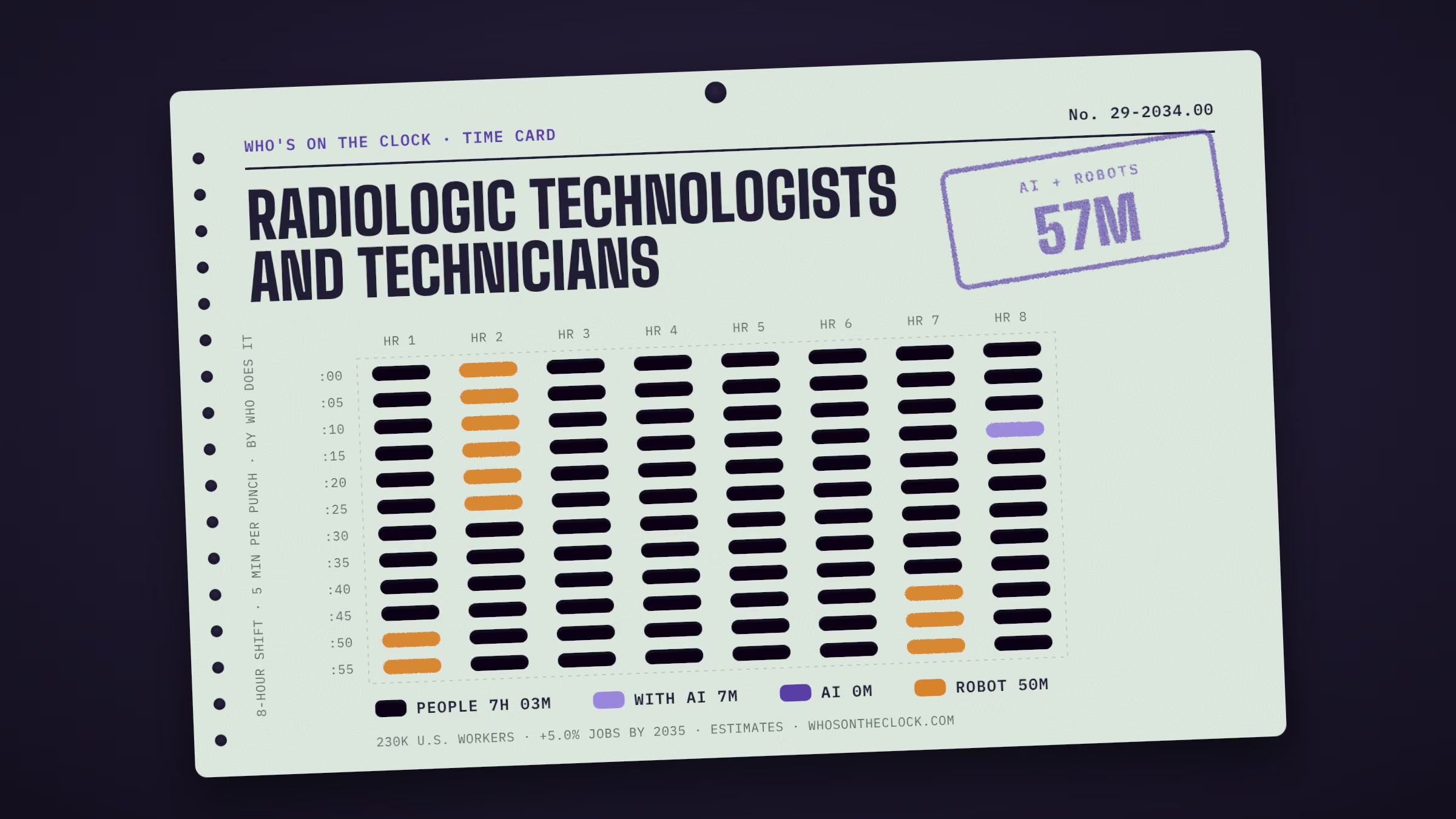
Unlikely, though parts of the work are changing. About 57m of an 8-hour shift goes to tasks touched by robots. The breakdown: 7m done by people with AI help, 50m that robots have done in real workplaces. The other 7h 4m (88%) stays with people. Separately, BLS expects about 5% more of these jobs by 2035 (all jobs: +3.5%).

Time card for radiologic technologists and technicians showing a typical 8-hour shift: 7h 4m done by people, 7m done by people with AI, 50m by robots.
Each mark is 5 minutes of a typical shift for radiologic technologists and technicians, colored by who does that task today. Estimates from O*NET tasks and Anthropic Economic Index data. How it's made

Home / Healthcare practitioners / Radiologic Technologists and Technicians

Take x-rays and CAT scans or administer nonradioactive materials into patient's bloodstream for diagnostic or research purposes. Includes radiologic technologists and technicians who specialize in other scanning modalities.

Time card

Untick tasks you don't do, or set your own times.
MineTask, by time spentHumanWith AIAIRobot
Position patient on examining table and set up and adjust equipment to obtain optimum view of specific body area as requested by physician.51m a shift · Robots only in factory cells
Position imaging equipment and adjust controls to set exposure time and distance, according to specification of examination.38m a shift · Robots deployed · e.g. Multitom Rax Twin Robotic X-ray
Explain procedures and observe patients to ensure safety and comfort during scan.32m a shift · No AI or robot evidence found
Review and evaluate developed x-rays, video tape, or computer-generated information to determine if images are satisfactory for diagnostic purposes.32m a shift · No AI or robot evidence found
Make exposures necessary for the requested procedures, rejecting and repeating work that does not meet established standards.32m a shift · No AI or robot evidence found
Operate or oversee operation of radiologic or magnetic imaging equipment to produce images of the body for diagnostic purposes.32m a shift · Robots only in factory cells
Determine patients' x-ray needs by reading requests or instructions from physicians.19m a shift · No AI or robot evidence found
Process exposed radiographs using film processors or computer generated methods.19m a shift · No AI or robot evidence found
Operate mobile x-ray equipment in operating room, emergency room, or at patient's bedside.19m a shift · Robots only in factory cells
Operate digital picture archiving communications systems.19m a shift · No AI or robot evidence found
Perform procedures, such as linear tomography, mammography, sonograms, joint and cyst aspirations, routine contrast studies, routine fluoroscopy, or examinations of the head, trunk, or extremities under supervision of physician.19m a shift · No AI or robot evidence found
Record, process, and maintain patient data or treatment records and prepare reports.19m a shift · No AI or robot evidence found
Monitor patients' conditions and reactions, reporting abnormal signs to physician.13m a shift · No AI or robot evidence found
Use radiation safety measures and protection devices to comply with government regulations and to ensure safety of patients and staff.13m a shift · No AI or robot evidence found
Provide assistance to physicians or other technologists in the performance of more complex procedures.13m a shift · No AI or robot evidence found
Key commands and data into computer to document and specify scan sequences, adjust transmitters and receivers, or photograph certain images.13m a shift · No AI or robot evidence found
Set up examination rooms, ensuring that all necessary equipment is ready.13m a shift · No AI or robot evidence found
Transport patients to or from exam rooms.13m a shift · Robots deployed · e.g. WHILL Autonomous Mobility Service
Perform general administrative tasks, such as answering phones, scheduling patient appointments, or pulling and filing films.13m a shift · No AI or robot evidence found
Prepare contrast material, radiopharmaceuticals, or anesthetic or antispasmodic drugs under the direction of a radiologist.6m a shift · Robots only in factory cells
Take thorough and accurate patient medical histories.6m a shift · Observed in AI use
Operate fluoroscope to aid physician to view and guide wire or catheter through blood vessels to area of interest.6m a shift · No AI or robot evidence found
Assist with on-the-job training of new employees or students or provide input to supervisors regarding training performance.6m a shift · No AI or robot evidence found
Complete quality control activities, monitor equipment operation, and report malfunctioning equipment to supervisor.6m a shift · No AI or robot evidence found
Assign duties to radiologic staff to maintain patient flows and achieve production goals.6m a shift · No AI or robot evidence found
Provide assistance in dressing or changing seriously ill or injured patients or patients with disabilities.6m a shift · No AI or robot evidence found
Coordinate work with clerical personnel or other technologists and technicians.6m a shift · No AI or robot evidence found
Perform supervisory duties, such as developing departmental operating budget, coordinating purchases of supplies or equipment, or preparing work schedules.6m a shift · No AI or robot evidence found
Provide students or other technicians and technologists with suggestions of additional views, alternate positioning, or improved techniques to ensure the images produced are of the highest quality.6m a shift · No AI or robot evidence found
Maintain a current file of examination protocols.time not estimated · No AI or robot evidence found

On the floor

  1. Rolling outMercy
    Mercy rolls out Aidoc AI to review most diagnostic imaging

    Mercy began a phased rollout of Aidoc's AI platform across its hospitals to give most diagnostic imaging an additional review. It flags suspected conditions such as brain hemorrhage and pulmonary embolism to help radiologists prioritize cases.

    Mercy

Ask the clock

Will AI replace radiologic technologists and technicians?

Unlikely, though parts of the work are changing. About 57m of an 8-hour shift goes to tasks touched by robots. The breakdown: 7m done by people with AI help, 50m that robots have done in real workplaces. The other 7h 4m (88%) stays with people. Separately, BLS expects about 5% more of these jobs by 2035 (all jobs: +3.5%).

What can AI already do for radiologic technologists and technicians?

AI shows up regularly in 1 of 30 tasks, about 7m of a typical shift. The biggest ones:

  • Take thorough and accurate patient medical histories. (6m a shift, people use AI to help)
Where do robots fit in?

For some tasks, yes. Robots have done 2 of this job's tasks in workplaces like this one, about 50m of a typical shift. 4 more tasks have only been done in factory setups built around the machine, so they stay with people here. For 8 physical tasks, no robot has shown it can do the work yet.

  • Position imaging equipment and adjust controls to set exposure time and distance, according to specification of examination. (38m a shift; e.g. Multitom Rax Twin Robotic X-ray, in use)
  • Transport patients to or from exam rooms. (13m a shift; e.g. WHILL Autonomous Mobility Service, in use)
What still needs a person?

7h 4m of a typical shift, or 88%, goes to tasks with no AI or robot evidence yet. No AI usage or robot deployment has shown up for these so far. The biggest:

  • Position patient on examining table and set up and adjust equipment to obtain optimum view of specific body area as requested by physician. (51m a shift)
  • Explain procedures and observe patients to ensure safety and comfort during scan. (32m a shift)
  • Review and evaluate developed x-rays, video tape, or computer-generated information to determine if images are satisfactory for diagnostic purposes. (32m a shift)
  • Make exposures necessary for the requested procedures, rejecting and repeating work that does not meet established standards. (32m a shift)
  • Operate or oversee operation of radiologic or magnetic imaging equipment to produce images of the body for diagnostic purposes. (32m a shift)
Why is that work hard to automate?

Much of it comes down to where and how the work happens. In-person, hands-on and high-stakes work is where AI and robots have made the least headway so far. In the official O*NET survey of people in this job:

  • 95% work at arm's length or closer to other people
  • 94% are exposed to disease or infection every day
  • 92% say dealing with the public is very or extremely important
What are companies actually doing?

We track 1 sourced company move that affects this job. Most recent:

  • Feb 3, 2025: Mercy rolls out Aidoc AI to review most diagnostic imaging (Rolling out)
Are employers still hiring radiologic technologists and technicians?

On Indeed, job postings in the Medical Technician sector are at 125% of their February 2020 level (all U.S. postings: 104%), down 2.6% from a year earlier, as of Oct 9, 2026. BLS separately expects about 13,000 openings a year in this job through 2035. Across all U.S. postings, 7.3% now mention AI skills. Sector postings cover more than this one job and move for many reasons besides AI.

How much do radiologic technologists and technicians make?

The median pay is about $80,110 a year ($38.52 an hour), 57% above the median for all U.S. jobs ($50,980). Most people in this job earn between $55,980 and $118,660 a year; that range covers the middle 80%. Pay figures are from BLS, May 2025, and vary a lot by state and employer. Pick a state to compare:

Is this job growing or shrinking?

BLS projects growth of 5% from 2025 to 2035, compared with 3.5% growth for all jobs. That's about 246,000 jobs in 2035. It expects about 13,000 openings a year, mostly from people retiring or changing careers. These projections don't single out AI as a cause.

How many radiologic technologists and technicians are there in the U.S.?

About 230,000 people in the U.S., roughly 0.15% of all workers (BLS, May 2025). That makes it the 156th largest of the 796 jobs on this site. BLS expects about 246,000 in 2035.

What training do radiologic technologists and technicians need?

The most common requirement is an associate's degree: about 73% of people in the job said so in the official O*NET survey. O*NET rates the job at level 3 of 5 for preparation, which usually means: vocational school or associate's degree. Requirements vary by state and employer, especially for licensed work.

What should I learn to stay ahead of AI?

These come from the job's official skill ratings and from the tasks that AI and robots touch least today. Building them keeps you strong in the parts of the work that still need a person:

  • Skills that matter more here than in most jobs: Operation and Control, Service Orientation, Social Perceptiveness, Quality Control Analysis
  • Get strong at the parts of the job that stay with people (listed above), which take 7h 4m of a typical shift
  • Tools employers list: R, eClinicalWorks EHR software, MEDITECH software, Microsoft Excel, Microsoft Office software
  • Learn to use AI well on the tasks where it already shows up in this job (listed above)
What other jobs could radiologic technologists and technicians move into?

These use similar skills, with less of a typical shift touched by AI or robots. Matches come from 109 official ratings of skills, knowledge and work activities, and each needs the same or less preparation unless the official list relates the jobs directly:

  • Diagnostic Medical Sonographers (0m touched, $97k median pay)
  • Neurodiagnostic Technologists (0m touched, $50k median pay)
How solid are these numbers?

Each task carries its own evidence label. For this job: 1 observed in real AI use, 2 with robots in real deployments, 27 with no AI or robot evidence found. The minutes per task are estimates, not measured hours, and "no evidence" doesn't prove a task is safe.

Tools in demand

  • R
  • eClinicalWorks EHR software
  • MEDITECH software
  • Microsoft Excel
  • Microsoft Office software
  • Microsoft Outlook
  • Microsoft PowerPoint
  • Microsoft Word

Also called

3D Technologist, Angiogram Special Procedures Technologist, CAT Technologist (Computed Axial Tomography Technologist), CT Radiology Technologist (Computerized Tomography Radiology Technologist), CT Scan Special Procedures Technologist (Computed Tomography Scan Special Procedures Technologist), CT Scan Tech (Computed Tomography Scan Technologist), CT Scanner Operator (Computed Tomography Scanner Operator), CT Tech (Computer Tomography Technician), Computed Tomography Radiologic Technologist (CT RT), Computed Tomography Technician (CT Technician), Computed Tomography Technologist (CT Tech), Diagnostic Radiologic Technologist (DRT), Document Imaging Technician, EEG Tech (Electroencephalogram Technician)