Will AI replace agricultural equipment operators?

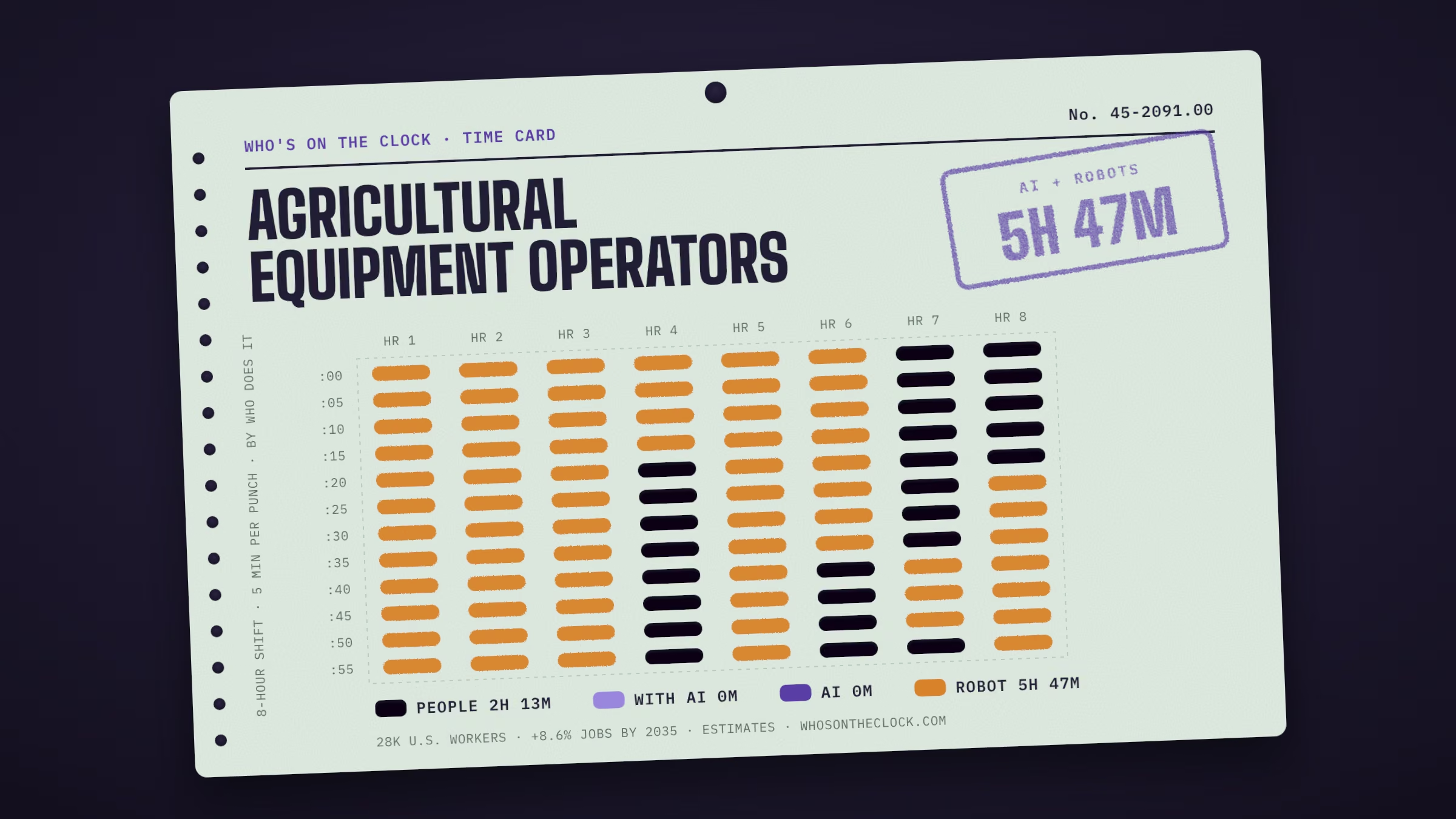
The biggest change here is physical: systems like John Deere autonomous 8R/9R tillage tractor have done tasks such as “Operate or tend equipment used in agricultural production” in real workplaces, about 5h 47m of a typical shift. Only 2h 13m of the shift has no AI or robot evidence. BLS expects about 8.6% more of these jobs by 2035.

Time card for agricultural equipment operators showing a typical 8-hour shift: 2h 13m done by people, 5h 47m by robots.
Each mark is 5 minutes of a typical shift for agricultural equipment operators, colored by who does that task today. Estimates from O*NET tasks and Anthropic Economic Index data. How it's made

Home / Farming & fishing / Agricultural Equipment Operators

Drive and control equipment to support agricultural activities such as tilling soil; planting, cultivating, and harvesting crops; feeding and herding livestock; or removing animal waste. May perform tasks such as crop baling or hay bucking. May operate stationary equipment to perform post-harvest tasks such as husking, shelling, threshing, and ginning.

Time card

Untick tasks you don't do, or set your own times.
MineTask, by time spentHumanWith AIAIRobot
Operate or tend equipment used in agricultural production, such as tractors, combines, and irrigation equipment.2h 23m a shift · Robots deployed · e.g. John Deere autonomous 8R/9R tillage tractor
Why this label?Marked Robot because John Deere autonomous 8R/9R tillage tractor (in real use) has done this task in a real workplace. It shows a robot can do it somewhere, not that most agricultural equipment operators work alongside one. How labels work
Adjust, repair, and service farm machinery and notify supervisors when machinery malfunctions.51m a shift · Robots deployed · e.g. Combine Advisor AutoMaintain (S700 series combines)
Why this label?Marked Robot because Combine Advisor AutoMaintain (S700 series combines) (in real use) has done this task in a real workplace. It shows a robot can do it somewhere, not that most agricultural equipment operators work alongside one. How labels work
Load and unload crops or containers of materials, manually or using conveyors, handtrucks, forklifts, or transfer augers.41m a shift · Robots only in factory cells
Why this label?Robots have done this only in factory setups built around the machine, so it stays Human for agricultural equipment operators. How labels work
Operate towed machines such as seed drills or manure spreaders to plant, fertilize, dust, and spray crops.41m a shift · Robots deployed · e.g. Sabanto Retrofit Autonomy Kit (Steward) on John Deere 6130E + 8-row planter
Why this label?Marked Robot because Sabanto Retrofit Autonomy Kit (Steward) on John Deere 6130E + 8-row planter (in real use) has done this task in a real workplace. It shows a robot can do it somewhere, not that most agricultural equipment operators work alongside one. How labels work
Manipulate controls to set, activate, and adjust mechanisms on machinery.31m a shift · Robots deployed · e.g. GUSS / mini GUSS autonomous orchard sprayer
Why this label?Marked Robot because GUSS / mini GUSS autonomous orchard sprayer (in real use) has done this task in a real workplace. It shows a robot can do it somewhere, not that most agricultural equipment operators work alongside one. How labels work
Drive trucks to haul crops, supplies, tools, or farm workers.31m a shift · Robots deployed · e.g. Burro Grande 15
Why this label?Marked Robot because Burro Grande 15 (in real use) has done this task in a real workplace. It shows a robot can do it somewhere, not that most agricultural equipment operators work alongside one. How labels work
Mix specified materials or chemicals, and dump solutions, powders, or seeds into planter or sprayer machinery.20m a shift · Robots only in factory cells
Why this label?Robots have done this only in factory setups built around the machine, so it stays Human for agricultural equipment operators. How labels work
Attach farm implements such as plows, discs, sprayers, or harvesters to tractors, using bolts and hand tools.20m a shift · Robots only in factory cells
Why this label?Robots have done this only in factory setups built around the machine, so it stays Human for agricultural equipment operators. How labels work
Irrigate soil, using portable pipes or ditch systems, and maintain ditches or pipes and pumps.20m a shift · No AI or robot evidence found
Why this label?This is physical work, and no robot has been shown doing it yet. How labels work
Observe and listen to machinery operation to detect equipment malfunctions.15m a shift · Robots deployed · e.g. John Deere autonomy kit on 8R/9RX tractors
Why this label?Marked Robot because John Deere autonomy kit on 8R/9RX tractors (in real use) has done this task in a real workplace. It shows a robot can do it somewhere, not that most agricultural equipment operators work alongside one. How labels work
Load hoppers, containers, or conveyors to feed machines with products, using forklifts, transfer augers, suction gates, shovels, or pitchforks.15m a shift · Robots only in factory cells
Why this label?Robots have done this only in factory setups built around the machine, so it stays Human for agricultural equipment operators. How labels work
Direct and monitor the activities of work crews engaged in planting, weeding, or harvesting activities.15m a shift · No AI or robot evidence found
Why this label?No AI use or robot deployment showed up for this task in our data. That isn't proof it's safe; it may just be rare in the data. How labels work
Spray fertilizer or pesticide solutions to control insects, fungus and weed growth, and diseases, using hand sprayers.10m a shift · Robots deployed · e.g. SwarmFarm SwarmBot with Calibre/WEED-IT spot-spray boom
Why this label?Marked Robot because SwarmFarm SwarmBot with Calibre/WEED-IT spot-spray boom (in real use) has done this task in a real workplace. It shows a robot can do it somewhere, not that most agricultural equipment operators work alongside one. How labels work
Weigh crop-filled containers, and record weights and other identifying information.10m a shift · Robots deployed · e.g. CompuWeigh SmartTruck / SmartView unattended scale automation
Why this label?Marked Robot because CompuWeigh SmartTruck / SmartView unattended scale automation (in real use) has done this task in a real workplace. It shows a robot can do it somewhere, not that most agricultural equipment operators work alongside one. How labels work
Walk beside or ride on planting machines while inserting plants in planter mechanisms at specified intervals.5m a shift · Robots deployed · e.g. PlantTape automated transplanter
Why this label?Marked Robot because PlantTape automated transplanter (in real use) has done this task in a real workplace. It shows a robot can do it somewhere, not that most agricultural equipment operators work alongside one. How labels work
Guide products on conveyors to regulate flow through machines, and to discard diseased or rotten products.5m a shift · Robots deployed · e.g. Key Technology VERYX B175 digital sorter
Why this label?Marked Robot because Key Technology VERYX B175 digital sorter (in real use) has done this task in a real workplace. It shows a robot can do it somewhere, not that most agricultural equipment operators work alongside one. How labels work
Position boxes or attach bags at discharge ends of machinery to catch products, removing and closing full containers.5m a shift · Robots deployed · e.g. Haith QuantaFill box filler
Why this label?Marked Robot because Haith QuantaFill box filler (in real use) has done this task in a real workplace. It shows a robot can do it somewhere, not that most agricultural equipment operators work alongside one. How labels work

Clock history

  1. 5h 47m touchedFirst published: O*NET 30.1, Anthropic Economic Index (2025 usage and September 2026 robot study), BLS May 2025

When new data changes this clock, the date, the new numbers and the reason are logged here. Company news alone never moves the clock.

On the floor

No company news tracked for this job yet. New stories are added as they happen.

Ask the clock

Will AI replace agricultural equipment operators?

Some tasks are already being done by AI or machines; the rest still needs a person. About 5h 47m of a typical shift is made up of tasks that AI or robots have done on their own in real use somewhere. That doesn't mean those hours are automated in a typical workplace. The other 2h 13m (28%) stays with people. Separately, BLS expects about 8.6% more of these jobs by 2035 (all jobs: +3.5%).

What can AI already do for agricultural equipment operators?

None of this job's tasks show regular AI use yet. That can mean the work is hands-on or in person, or simply that it rarely comes up in AI usage data.

Where do robots fit in?

For some tasks, yes. Robots have done 11 of this job's tasks in workplaces like this one, about 5h 47m of a typical shift. 4 more tasks have only been done in factory setups built around the machine, so they stay with people here. For 1 physical task, no robot has shown it can do the work yet.

  • Operate or tend equipment used in agricultural production, such as tractors, combines, and irrigation equipment. (2h 23m a shift; e.g. John Deere autonomous 8R/9R tillage tractor, in use)
  • Adjust, repair, and service farm machinery and notify supervisors when machinery malfunctions. (51m a shift; e.g. Combine Advisor AutoMaintain (S700 series combines), in use)
  • Operate towed machines such as seed drills or manure spreaders to plant, fertilize, dust, and spray crops. (41m a shift; e.g. Sabanto Retrofit Autonomy Kit (Steward) on John Deere 6130E + 8-row planter, in use)
  • Manipulate controls to set, activate, and adjust mechanisms on machinery. (31m a shift; e.g. GUSS / mini GUSS autonomous orchard sprayer, in use)
What still needs a person?

2h 13m of a typical shift, or 28%, goes to tasks with no AI or robot evidence yet. No AI usage or robot deployment has shown up for these so far. The biggest:

  • Load and unload crops or containers of materials, manually or using conveyors, handtrucks, forklifts, or transfer augers. (41m a shift)
  • Mix specified materials or chemicals, and dump solutions, powders, or seeds into planter or sprayer machinery. (20m a shift)
  • Attach farm implements such as plows, discs, sprayers, or harvesters to tractors, using bolts and hand tools. (20m a shift)
  • Irrigate soil, using portable pipes or ditch systems, and maintain ditches or pipes and pumps. (20m a shift)
  • Load hoppers, containers, or conveyors to feed machines with products, using forklifts, transfer augers, suction gates, shovels, or pitchforks. (15m a shift)
Why is that work hard to automate?

Much of it comes down to where and how the work happens. In-person, hands-on and high-stakes work is where AI and robots have made the least headway so far. In the official O*NET survey of people in this job:

  • 71% talk face to face with others every day
  • 66% work outdoors in all weather every day
  • 60% work in very hot or cold conditions at least weekly
How much do agricultural equipment operators make?

The median pay is about $41,730 a year ($20.06 an hour), 18% below the median for all U.S. jobs ($50,980). Most people in this job earn between $33,500 and $58,650 a year; that range covers the middle 80%. Pay figures are from BLS, May 2025, and vary a lot by state and employer. Pick a state to compare:

Is this job growing or shrinking?

BLS projects growth of 8.6% from 2025 to 2035, compared with 3.5% growth for all jobs. That's about 73,000 jobs in 2035. It expects about 10,000 openings a year, mostly from people retiring or changing careers. These projections don't single out AI as a cause.

How many agricultural equipment operators are there in the U.S.?

About 29,000 people in the U.S., roughly 0.02% of all workers (BLS, May 2025). That makes it the 486th largest of the 796 jobs on this site. BLS expects about 73,000 in 2035.

What training do agricultural equipment operators need?

The most common requirement is less than a high school diploma: about 57% of people in the job said so in the official O*NET survey. O*NET rates the job at level 1 of 5 for preparation, which usually means: little or no preparation. Requirements vary by state and employer, especially for licensed work.

What should I learn to stay ahead of AI?

These come from the job's official skill ratings and from the tasks that AI and robots touch least today. Building them keeps you strong in the parts of the work that still need a person:

  • Skills that matter more here than in most jobs: Operation and Control, Operations Monitoring, Repairing, Equipment Maintenance
  • Get strong at the parts of the job that stay with people (listed above), which take 2h 13m of a typical shift
  • Tools employers list: Microsoft Access, Microsoft Excel, Microsoft PowerPoint
What new tasks are agricultural equipment operators taking on?

Yes. Occupational experts recently added these to the official task list, a sign of how the work itself is shifting. New tasks aren't rated for AI or robots yet:

  • Operate drones to monitor crop health, growth and pest infestations, and apply targeted treatments.
What other jobs could agricultural equipment operators move into?

These use similar skills, with less of a typical shift touched by AI or robots. Matches come from 109 official ratings of skills, knowledge and work activities, and each needs the same or less preparation unless the official list relates the jobs directly:

  • Farmworkers and Laborers, Crop, Nursery, and Greenhouse (2h 20m touched, $36k median pay)
  • Machine Feeders and Offbearers (3h 26m touched, $41k median pay)
How solid are these numbers?

Each task carries its own evidence label. For this job: 11 with robots in real deployments, 6 with no AI or robot evidence found. The minutes per task are estimates, not measured hours, and "no evidence" doesn't prove a task is safe.

Tools in demand

  • Microsoft Access

Plus everyday office tools: Microsoft Excel, Microsoft PowerPoint.

Also called

Agricultural Equipment Operator (Ag Equipment Operator), Agricultural Equipment Operators, Agricultural Farm Equipment Operator, Agricultural Plow Operator, Agriculture Equipment Operator, Baler, Baler Operator, Bean Picker Machine Operator, Berry Picker Machine Operator, Broomcorn Thresher, Cane Cutter Machine Operator, Cane Flume Chute Operator, Cane Flume Feeding Machine Operator, Cane Piler