Will AI replace arbitrators, mediators, and conciliators?

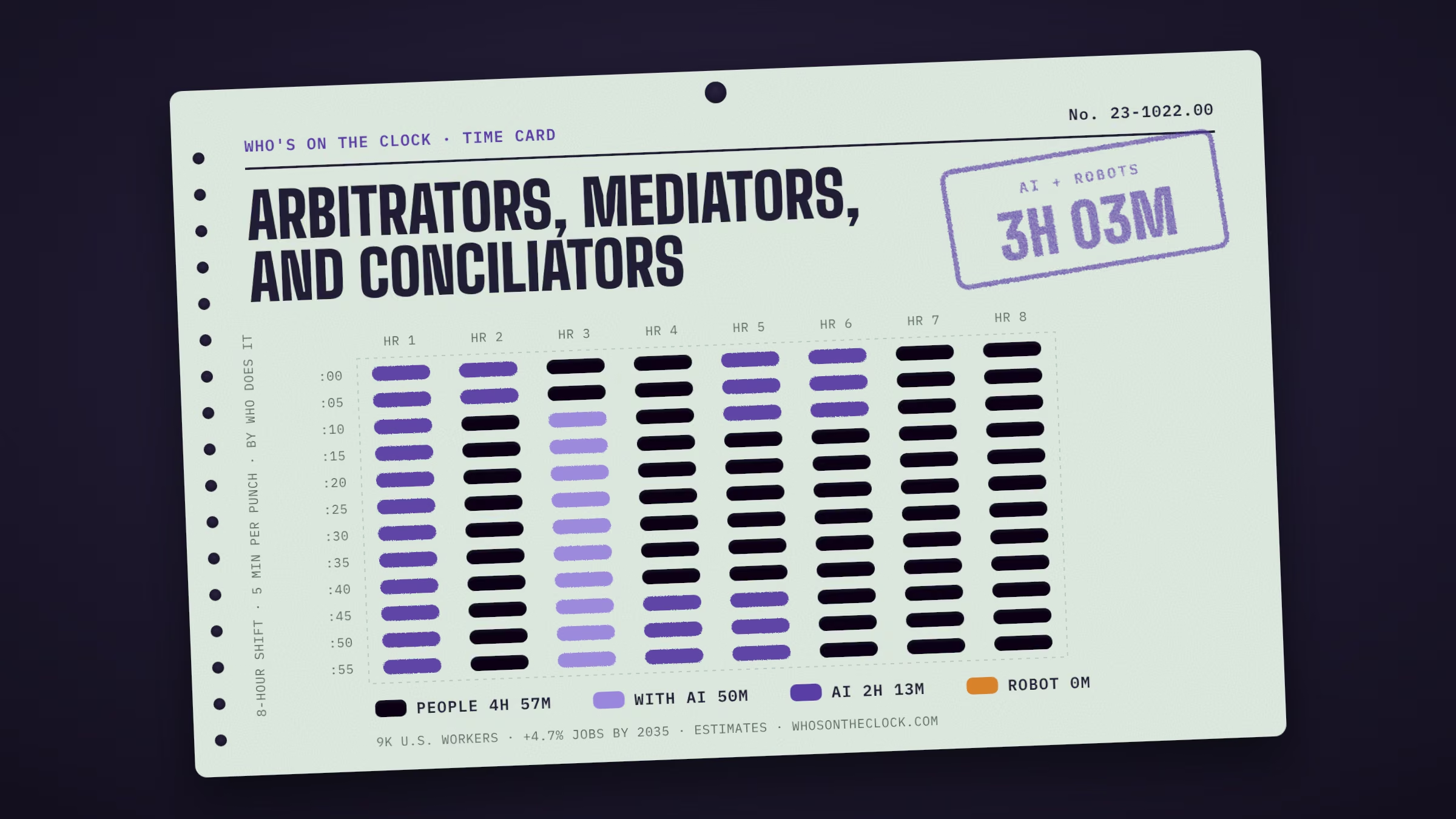
AI already handles some of this work on its own in real use, for tasks like “Use mediation techniques to facilitate communication between disputants”. That's 2h 13m of a typical shift; 4h 57m still has no AI or robot evidence. BLS expects about 4.7% more of these jobs by 2035.

Time card for arbitrators, mediators, and conciliators showing a typical 8-hour shift: 4h 57m done by people, 50m done by people with AI, 2h 13m by AI.
Each mark is 5 minutes of a typical shift for arbitrators, mediators, and conciliators, colored by who does that task today. Estimates from O*NET tasks and Anthropic Economic Index data. How it's made

Home / Legal / Arbitrators, Mediators, and Conciliators

Facilitate negotiation and conflict resolution through dialogue. Resolve conflicts outside of the court system by mutual consent of parties involved.

Time card

Untick tasks you don't do, or set your own times.
MineTask, by time spentHumanWith AIAIRobot
Use mediation techniques to facilitate communication between disputants, to further parties' understanding of different perspectives, and to guide parties toward mutual agreement.1h 9m a shift · Observed in AI use
Why this label?Marked AI because this task shows up regularly in real AI conversations (Anthropic Economic Index, 2025 usage), and in most of them AI does the task on its own rather than helping a person. Many workplaces may not use AI for it at all. How labels work
Confer with disputants to clarify issues, identify underlying concerns, and develop an understanding of their respective needs and interests.57m a shift · No AI or robot evidence found
Why this label?No AI use or robot deployment showed up for this task in our data. That isn't proof it's safe; it may just be rare in the data. How labels work
Prepare written opinions or decisions regarding cases.51m a shift · Observed in AI useTypical AI request: about 4h 12m alone, 26m with AI
Why this label?Marked With AI because people regularly use AI to help with this task in real conversations (Anthropic Economic Index, 2025 usage), but AI doesn't usually finish it alone. How labels work
Conduct hearings to obtain information or evidence relative to disposition of claims.44m a shift · No AI or robot evidence found
Why this label?No AI use or robot deployment showed up for this task in our data. That isn't proof it's safe; it may just be rare in the data. How labels work
Apply relevant laws, regulations, policies, or precedents to reach conclusions.32m a shift · Observed in AI useTypical AI request: about 5h 33m alone, 35m with AI
Why this label?Marked AI because this task shows up regularly in real AI conversations (Anthropic Economic Index, 2025 usage), and in most of them AI does the task on its own rather than helping a person. Many workplaces may not use AI for it at all. How labels work
Evaluate information from documents, such as claim applications, birth or death certificates, or physician or employer records.32m a shift · No AI or robot evidence found
Why this label?No AI use or robot deployment showed up for this task in our data. That isn't proof it's safe; it may just be rare in the data. How labels work
Research laws, regulations, policies, or precedent decisions to prepare for hearings.32m a shift · Observed in AI useTypical AI request: about 10h 49m alone, 58m with AI
Why this label?Marked AI because this task shows up regularly in real AI conversations (Anthropic Economic Index, 2025 usage), and in most of them AI does the task on its own rather than helping a person. Many workplaces may not use AI for it at all. How labels work
Prepare settlement agreements for disputants to sign.25m a shift · No AI or robot evidence found
Why this label?No AI use or robot deployment showed up for this task in our data. That isn't proof it's safe; it may just be rare in the data. How labels work
Determine extent of liability according to evidence, laws, or administrative or judicial precedents.19m a shift · No AI or robot evidence found
Why this label?No AI use or robot deployment showed up for this task in our data. That isn't proof it's safe; it may just be rare in the data. How labels work
Conduct initial meetings with disputants to outline the arbitration process, settle procedural matters, such as fees, or determine details, such as witness numbers or time requirements.19m a shift · No AI or robot evidence found
Why this label?No AI use or robot deployment showed up for this task in our data. That isn't proof it's safe; it may just be rare in the data. How labels work
Set up appointments for parties to meet for mediation.19m a shift · No AI or robot evidence found
Why this label?No AI use or robot deployment showed up for this task in our data. That isn't proof it's safe; it may just be rare in the data. How labels work
Interview claimants, agents, or witnesses to obtain information about disputed issues.19m a shift · No AI or robot evidence found
Why this label?No AI use or robot deployment showed up for this task in our data. That isn't proof it's safe; it may just be rare in the data. How labels work
Rule on exceptions, motions, or admissibility of evidence.13m a shift · No AI or robot evidence found
Why this label?No AI use or robot deployment showed up for this task in our data. That isn't proof it's safe; it may just be rare in the data. How labels work
Participate in court proceedings.13m a shift · No AI or robot evidence found
Why this label?No AI use or robot deployment showed up for this task in our data. That isn't proof it's safe; it may just be rare in the data. How labels work
Issue subpoenas or administer oaths to prepare for formal hearings.6m a shift · No AI or robot evidence found
Why this label?No AI use or robot deployment showed up for this task in our data. That isn't proof it's safe; it may just be rare in the data. How labels work
Recommend acceptance or rejection of compromise settlement offers.6m a shift · No AI or robot evidence found
Why this label?No AI use or robot deployment showed up for this task in our data. That isn't proof it's safe; it may just be rare in the data. How labels work
Authorize payment of valid claims.6m a shift · No AI or robot evidence found
Why this label?No AI use or robot deployment showed up for this task in our data. That isn't proof it's safe; it may just be rare in the data. How labels work
Conduct studies of appeals procedures to ensure adherence to legal requirements or to facilitate disposition of cases.6m a shift · No AI or robot evidence found
Why this label?No AI use or robot deployment showed up for this task in our data. That isn't proof it's safe; it may just be rare in the data. How labels work
Specialize in the negotiation and resolution of environmental conflicts involving issues such as natural resource allocation or regional development planning.6m a shift · No AI or robot evidence found
Why this label?No AI use or robot deployment showed up for this task in our data. That isn't proof it's safe; it may just be rare in the data. How labels work
Organize or deliver public presentations about mediation to organizations, such as community agencies or schools.6m a shift · No AI or robot evidence found
Why this label?No AI use or robot deployment showed up for this task in our data. That isn't proof it's safe; it may just be rare in the data. How labels work

Clock history

  1. 3h 3m touchedFirst published: O*NET 30.1, Anthropic Economic Index (2025 usage and September 2026 robot study), BLS May 2025

When new data changes this clock, the date, the new numbers and the reason are logged here. Company news alone never moves the clock.

On the floor

No company news tracked for this job yet. New stories are added as they happen.

Ask the clock

Will AI replace arbitrators, mediators, and conciliators?

Some tasks are already being done by AI or machines; the rest still needs a person. About 2h 13m of a typical shift is made up of tasks that AI or robots have done on their own in real use somewhere. That doesn't mean those hours are automated in a typical workplace. The breakdown: 50m done by people with AI help, 2h 13m that AI mostly does alone. The other 4h 57m (62%) stays with people. Separately, BLS expects about 4.7% more of these jobs by 2035 (all jobs: +3.5%).

What can AI already do for arbitrators, mediators, and conciliators?

AI shows up regularly in 4 of 20 tasks, about 3h 3m of a typical shift. The biggest ones:

  • Use mediation techniques to facilitate communication between disputants, to further parties' understanding of different perspectives, and to guide parties toward mutual agreement. (1h 9m a shift, AI mostly does it alone)
  • Apply relevant laws, regulations, policies, or precedents to reach conclusions. (32m a shift, AI mostly does it alone)
  • Research laws, regulations, policies, or precedent decisions to prepare for hearings. (32m a shift, AI mostly does it alone)
  • Prepare written opinions or decisions regarding cases. (51m a shift, people use AI to help)
What still needs a person?

4h 57m of a typical shift, or 62%, goes to tasks with no AI or robot evidence yet. No AI usage or robot deployment has shown up for these so far. The biggest:

  • Confer with disputants to clarify issues, identify underlying concerns, and develop an understanding of their respective needs and interests. (57m a shift)
  • Conduct hearings to obtain information or evidence relative to disposition of claims. (44m a shift)
  • Evaluate information from documents, such as claim applications, birth or death certificates, or physician or employer records. (32m a shift)
  • Prepare settlement agreements for disputants to sign. (25m a shift)
  • Determine extent of liability according to evidence, laws, or administrative or judicial precedents. (19m a shift)
Why is that work hard to automate?

Much of it comes down to where and how the work happens. In-person, hands-on and high-stakes work is where AI and robots have made the least headway so far. In the official O*NET survey of people in this job:

  • 65% handle conflict at least once a week
How much time does AI save on these tasks?

For the 3 tasks in this job where AI shows up and timing data exists, a typical request takes about 5h 33m for a person alone and about 35m with AI. These are Claude's own estimates from real conversations in April and May 2026 (Anthropic Economic Index). They describe single requests, not whole workdays, and time saved on a task doesn't mean jobs are cut. The biggest gaps:

  • Research laws, regulations, policies, or precedent decisions to prepare for hearings (about 10h 49m alone, 58m with AI)
  • Apply relevant laws, regulations, policies, or precedents to reach conclusions (about 5h 33m alone, 35m with AI)
  • Prepare written opinions or decisions regarding cases (about 4h 12m alone, 26m with AI)
Are employers still hiring arbitrators, mediators, and conciliators?

On Indeed, job postings in the Legal sector are at 122% of their February 2020 level (all U.S. postings: 104%), up 1.2% from a year earlier, as of Oct 9, 2026. BLS separately expects about 300 openings a year in this job through 2035. Across all U.S. postings, 7.3% now mention AI skills. Sector postings cover more than this one job and move for many reasons besides AI.

How much do arbitrators, mediators, and conciliators make?

The median pay is about $75,530 a year ($36.31 an hour), 48% above the median for all U.S. jobs ($50,980). Most people in this job earn between $47,220 and $155,440 a year; that range covers the middle 80%. Pay figures are from BLS, May 2025, and vary a lot by state and employer. Pick a state to compare:

Is this job growing or shrinking?

BLS projects growth of 4.7% from 2025 to 2035, compared with 3.5% growth for all jobs. That's about 11,000 jobs in 2035. It expects about 300 openings a year, mostly from people retiring or changing careers. These projections don't single out AI as a cause.

How many arbitrators, mediators, and conciliators are there in the U.S.?

About 9,210 people in the U.S., roughly 0.01% of all workers (BLS, May 2025). That makes it the 673rd largest of the 796 jobs on this site. BLS expects about 11,000 in 2035.

What training do arbitrators, mediators, and conciliators need?

The most common requirement is a first professional degree (such as law or medicine): about 37% of people in the job said so in the official O*NET survey. O*NET rates the job at level 5 of 5 for preparation, which usually means: graduate degree. Requirements vary by state and employer, especially for licensed work.

What should I learn to stay ahead of AI?

These come from the job's official skill ratings and from the tasks that AI and robots touch least today. Building them keeps you strong in the parts of the work that still need a person:

  • Skills that matter more here than in most jobs: Negotiation, Persuasion, Active Listening, Writing
  • Get strong at the parts of the job that stay with people (listed above), which take 4h 57m of a typical shift
  • Tools employers list: Microsoft Outlook, Microsoft Office software, Microsoft Excel, Microsoft Access, Microsoft PowerPoint
  • Learn to use AI well on the tasks where it already shows up in this job (listed above)
What other jobs could arbitrators, mediators, and conciliators move into?

These use similar skills, with less of a typical shift touched by AI or robots. Matches come from 109 official ratings of skills, knowledge and work activities, and each needs the same or less preparation unless the official list relates the jobs directly:

  • Labor Relations Specialists (0m touched, $95k median pay)
  • Judges, Magistrate Judges, and Magistrates (2h 31m touched, $154k median pay)
  • Equal Opportunity Representatives and Officers (1h 14m touched, $81k median pay)
  • Judicial Law Clerks (2h 14m touched, $65k median pay)
  • Lawyers (1h 36m touched, $160k median pay)
How solid are these numbers?

Each task carries its own evidence label. For this job: 4 observed in real AI use, 16 with no AI or robot evidence found. The minutes per task are estimates, not measured hours, and "no evidence" doesn't prove a task is safe.

Tools in demand

  • Microsoft Access
  • Microsoft SharePoint
  • Oracle PeopleSoft

Plus everyday office tools: Microsoft Outlook, Microsoft Office software, Microsoft Excel, Microsoft PowerPoint, Microsoft Word.

Also called

Adjudicator, Alternative Dispute Resolution Coordinator (ADR Coordinator), Alternative Dispute Resolution Mediator (ADR Mediator), Arbiter, Arbitration Manager, Arbitration Specialist, Arbitrator, Community Relations Representative (Community Relations Rep), Conciliator, Contracts Negotiator, Debt Settlement Negotiator, Dispute Coordinator, Divorce Mediator, Environmental Conflict Manager