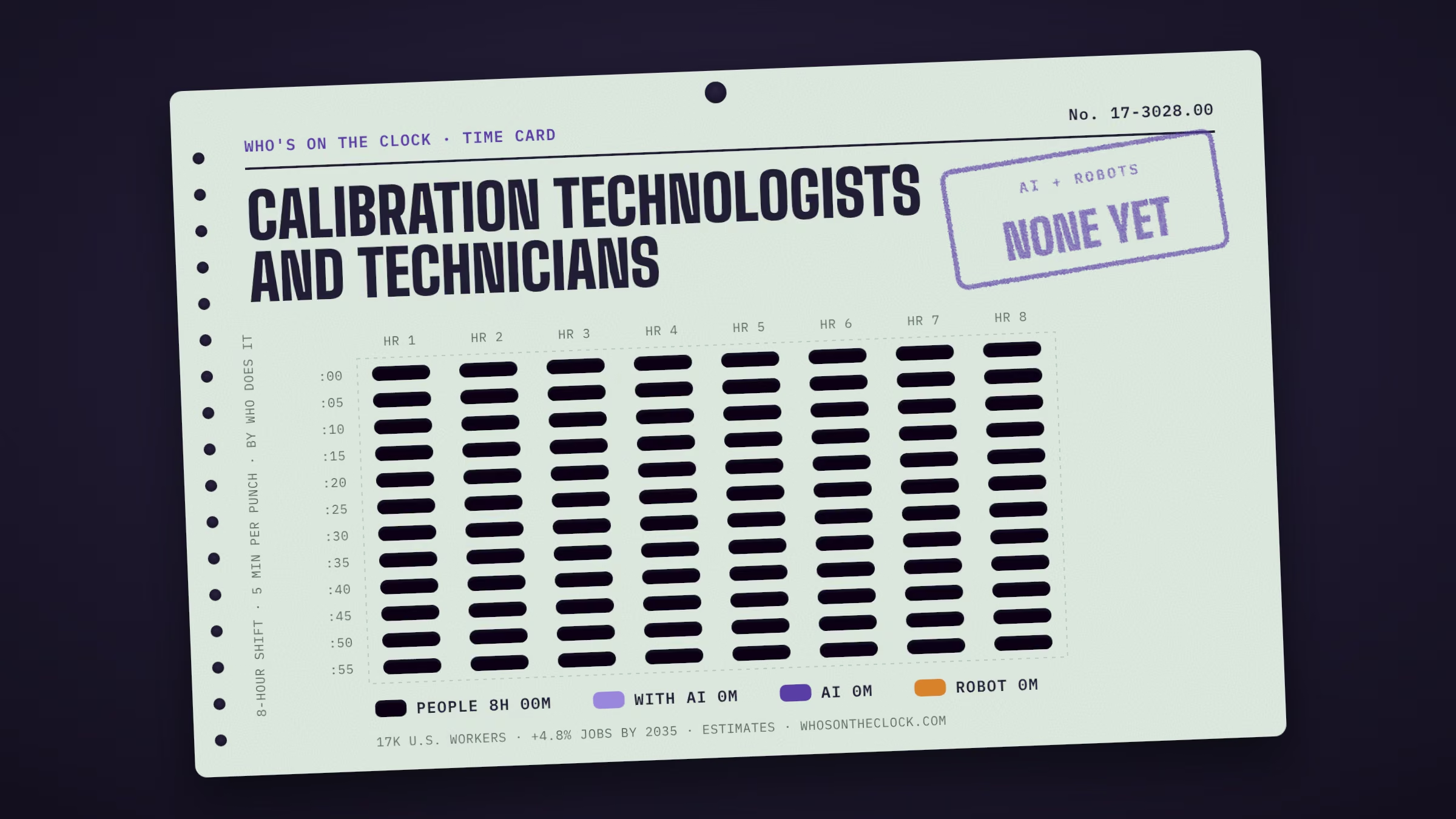
Execute or adapt procedures and techniques for calibrating measurement devices, by applying knowledge of measurement science, mathematics, physics, chemistry, and electronics, sometimes under the direction of engineering staff. Determine measurement standard suitability for calibrating measurement devices. May perform preventive maintenance on equipment. May perform corrective actions to address identified calibration problems.
Time card
Untick tasks you don't do, or set your own times.
| Mine | Task, by time spent | Human | With AI | AI | Robot |
|---|---|---|---|---|---|
Calibrate devices by comparing measurements of pressure, temperature, humidity, or other environmental conditions to known standards.2h 5m a shift · Robots only in factory cellsWhy this label?Robots have done this only in factory setups built around the machine, so it stays Human for calibration technologists and technicians. How labels work | |||||
Conduct calibration tests to determine performance or reliability of mechanical, structural, or electromechanical equipment.1h 27m a shift · Robots only in factory cellsWhy this label?Robots have done this only in factory setups built around the machine, so it stays Human for calibration technologists and technicians. How labels work | |||||
Write and submit reports about the results of calibration tests.56m a shift · No AI or robot evidence foundWhy this label?No AI use or robot deployment showed up for this task in our data. That isn't proof it's safe; it may just be rare in the data. How labels work | |||||
Analyze test data to identify defects or determine calibration requirements.37m a shift · No AI or robot evidence foundWhy this label?No AI use or robot deployment showed up for this task in our data. That isn't proof it's safe; it may just be rare in the data. How labels work | |||||
Maintain or repair measurement devices or equipment used for calibration testing.37m a shift · No AI or robot evidence foundWhy this label?This is physical work, and no robot has been shown doing it yet. How labels work | |||||
Plan sequences of calibration tests according to equipment specifications and scientific principles.25m a shift · No AI or robot evidence foundWhy this label?No AI use or robot deployment showed up for this task in our data. That isn't proof it's safe; it may just be rare in the data. How labels work | |||||
Verify part dimensions or clearances using precision measuring instruments to ensure conformance to specifications.25m a shift · Robots only in factory cellsWhy this label?Robots have done this only in factory setups built around the machine, so it stays Human for calibration technologists and technicians. How labels work | |||||
Disassemble and reassemble equipment for inspection.19m a shift · Robots only in factory cellsWhy this label?Robots have done this only in factory setups built around the machine, so it stays Human for calibration technologists and technicians. How labels work | |||||
Read blueprints, schematics, diagrams, or technical orders.19m a shift · No AI or robot evidence foundWhy this label?No AI use or robot deployment showed up for this task in our data. That isn't proof it's safe; it may just be rare in the data. How labels work | |||||
Develop new calibration methods or techniques based on measurement science, analyses, or calibration requirements.12m a shift · No AI or robot evidence foundWhy this label?No AI use or robot deployment showed up for this task in our data. That isn't proof it's safe; it may just be rare in the data. How labels work | |||||
Visually inspect equipment to detect surface defects.12m a shift · Robots only in factory cellsWhy this label?Robots have done this only in factory setups built around the machine, so it stays Human for calibration technologists and technicians. How labels work | |||||
Attend conferences, workshops, or other training sessions to learn about new tools or methods.6m a shift · No AI or robot evidence foundWhy this label?No AI use or robot deployment showed up for this task in our data. That isn't proof it's safe; it may just be rare in the data. How labels work | |||||
Draw plans for developing jigs, fixtures, instruments, or other devices.6m a shift · No AI or robot evidence foundWhy this label?No AI use or robot deployment showed up for this task in our data. That isn't proof it's safe; it may just be rare in the data. How labels work | |||||
Operate metalworking machines to fabricate housings, jigs, fittings, or fixtures.6m a shift · Robots only in factory cellsWhy this label?Robots have done this only in factory setups built around the machine, so it stays Human for calibration technologists and technicians. How labels work | |||||
Order replacement parts for malfunctioning equipment.6m a shift · No AI or robot evidence foundWhy this label?No AI use or robot deployment showed up for this task in our data. That isn't proof it's safe; it may just be rare in the data. How labels work |