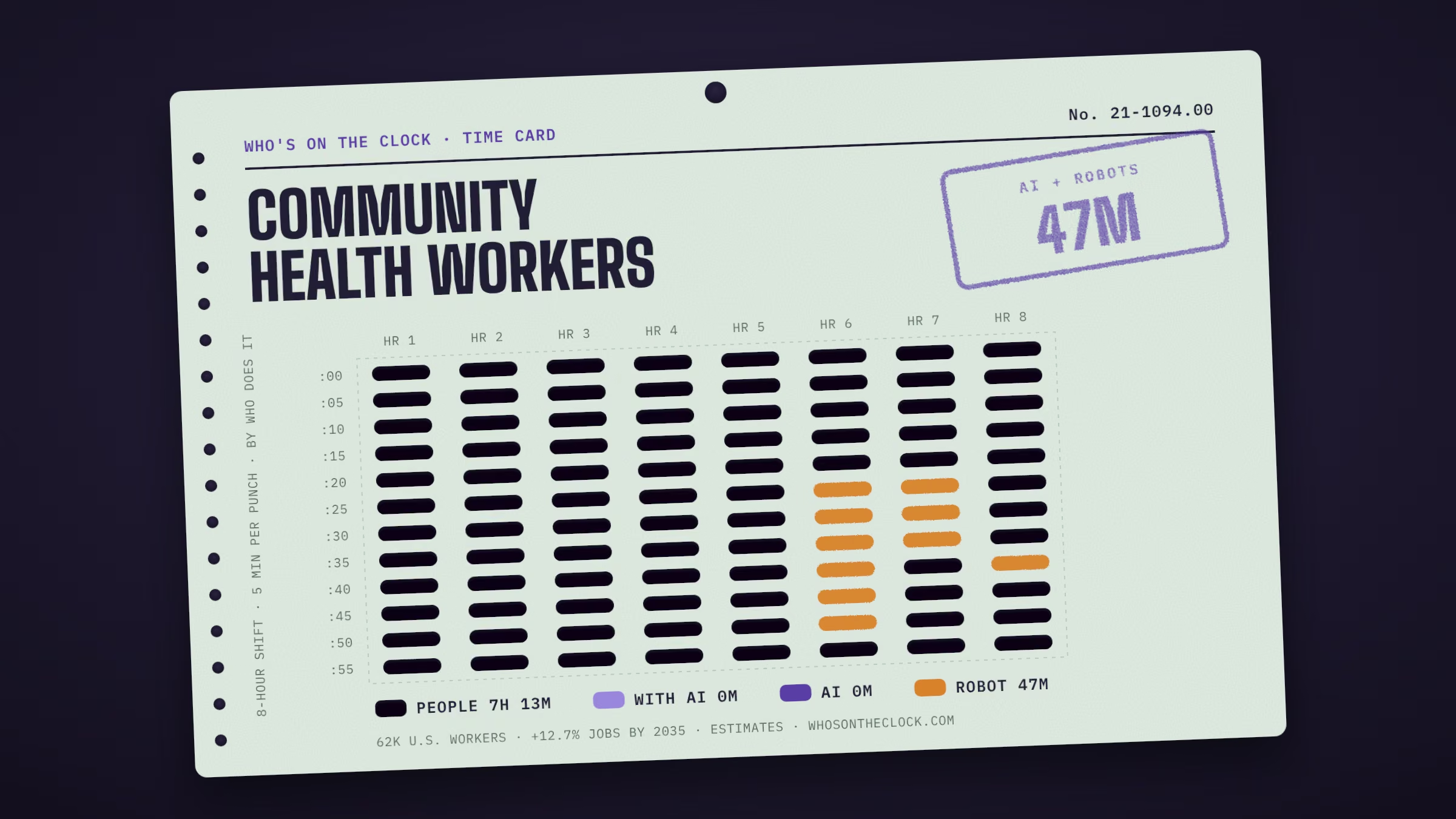
Promote health within a community by assisting individuals to adopt healthy behaviors. Serve as an advocate for the health needs of individuals by assisting community residents in effectively communicating with healthcare providers or social service agencies. Act as liaison or advocate and implement programs that promote, maintain, and improve individual and overall community health. May deliver health-related preventive services such as blood pressure, glaucoma, and hearing screenings. May collect data to help identify community health needs.
Time card
Untick tasks you don't do, or set your own times.
| Mine | Task, by time spent | Human | With AI | AI | Robot |
|---|---|---|---|---|---|
Maintain updated client records with plans, notes, appropriate forms, or related information.1h a shift · No AI or robot evidence foundWhy this label?No AI use or robot deployment showed up for this task in our data. That isn't proof it's safe; it may just be rare in the data. How labels work | |||||
Contact clients in person, by phone, or in writing to ensure they have completed required or recommended actions.40m a shift · No AI or robot evidence foundWhy this label?No AI use or robot deployment showed up for this task in our data. That isn't proof it's safe; it may just be rare in the data. How labels work | |||||
Conduct home visits for pregnant women, newborn infants, or other high-risk individuals to monitor their progress or assess their needs.40m a shift · No AI or robot evidence foundWhy this label?This is physical work, and no robot has been shown doing it yet. How labels work | |||||
Refer community members to needed health services.27m a shift · No AI or robot evidence foundWhy this label?No AI use or robot deployment showed up for this task in our data. That isn't proof it's safe; it may just be rare in the data. How labels work | |||||
Advise clients or community groups on issues related to improving general health, such as diet or exercise.20m a shift · No AI or robot evidence foundWhy this label?No AI use or robot deployment showed up for this task in our data. That isn't proof it's safe; it may just be rare in the data. How labels work | |||||
Identify or contact members of high-risk or otherwise targeted groups, such as members of minority populations, low-income populations, or pregnant women.20m a shift · No AI or robot evidence foundWhy this label?No AI use or robot deployment showed up for this task in our data. That isn't proof it's safe; it may just be rare in the data. How labels work | |||||
Attend community meetings or health fairs to understand community issues or build relationships with community members.20m a shift · No AI or robot evidence foundWhy this label?No AI use or robot deployment showed up for this task in our data. That isn't proof it's safe; it may just be rare in the data. How labels work | |||||
Identify the particular health care needs of individuals in a community or target area.20m a shift · No AI or robot evidence foundWhy this label?No AI use or robot deployment showed up for this task in our data. That isn't proof it's safe; it may just be rare in the data. How labels work | |||||
Advise clients or community groups on issues related to self-care, such as diabetes management.20m a shift · No AI or robot evidence foundWhy this label?No AI use or robot deployment showed up for this task in our data. That isn't proof it's safe; it may just be rare in the data. How labels work | |||||
Advocate for individual or community health needs with government agencies or health service providers.20m a shift · No AI or robot evidence foundWhy this label?No AI use or robot deployment showed up for this task in our data. That isn't proof it's safe; it may just be rare in the data. How labels work | |||||
Assist families to apply for social services, including Medicaid or Women, Infants, and Children (WIC).20m a shift · No AI or robot evidence foundWhy this label?No AI use or robot deployment showed up for this task in our data. That isn't proof it's safe; it may just be rare in the data. How labels work | |||||
Interpret, translate, or provide cultural mediation related to health services or information for community members.20m a shift · No AI or robot evidence foundWhy this label?No AI use or robot deployment showed up for this task in our data. That isn't proof it's safe; it may just be rare in the data. How labels work | |||||
Distribute flyers, brochures, or other informational or educational documents to inform members of a targeted community.13m a shift · Robots deployed · e.g. Relay / Relay2Why this label?Marked Robot because Relay / Relay2 (in real use) has done this task in a real workplace. It shows a robot can do it somewhere, not that most community health workers work alongside one. How labels work | |||||
Perform basic diagnostic procedures, such as blood pressure screening, breast cancer screening, or communicable disease screening.13m a shift · Robots deployed · e.g. Pursuant Health self-service health kioskWhy this label?Marked Robot because Pursuant Health self-service health kiosk (in real use) has done this task in a real workplace. It shows a robot can do it somewhere, not that most community health workers work alongside one. How labels work | |||||
Advise clients or community groups on issues related to diagnostic screenings, such as breast cancer screening, pap smears, glaucoma tests, or diabetes screenings.13m a shift · No AI or robot evidence foundWhy this label?No AI use or robot deployment showed up for this task in our data. That isn't proof it's safe; it may just be rare in the data. How labels work | |||||
Advise clients or community groups on issues related to risk or prevention of conditions, such as lead poisoning, human immunodeficiency virus (HIV), prenatal substance abuse, or domestic violence.13m a shift · No AI or robot evidence foundWhy this label?No AI use or robot deployment showed up for this task in our data. That isn't proof it's safe; it may just be rare in the data. How labels work | |||||
Transport or accompany clients to scheduled health appointments or referral sites.13m a shift · Robots deployed · e.g. Waymo OneWhy this label?Marked Robot because Waymo One (in real use) has done this task in a real workplace. It shows a robot can do it somewhere, not that most community health workers work alongside one. How labels work | |||||
Teach classes or otherwise disseminate medical or dental health information to school groups, community groups, or targeted families or individuals, in a manner consistent with cultural norms.13m a shift · No AI or robot evidence foundWhy this label?No AI use or robot deployment showed up for this task in our data. That isn't proof it's safe; it may just be rare in the data. How labels work | |||||
Collect information from individuals to compile vital statistics about the general health of community members.13m a shift · No AI or robot evidence foundWhy this label?No AI use or robot deployment showed up for this task in our data. That isn't proof it's safe; it may just be rare in the data. How labels work | |||||
Develop plans or formal contracts for individuals, families, or community groups to improve overall health.13m a shift · No AI or robot evidence foundWhy this label?No AI use or robot deployment showed up for this task in our data. That isn't proof it's safe; it may just be rare in the data. How labels work | |||||
Administer immunizations or other basic preventive treatments.7m a shift · Robots only in factory cellsWhy this label?Robots have done this only in factory setups built around the machine, so it stays Human for community health workers. How labels work | |||||
Advise clients or community groups on issues related to sanitation or hygiene, such as flossing or hand washing.7m a shift · No AI or robot evidence foundWhy this label?No AI use or robot deployment showed up for this task in our data. That isn't proof it's safe; it may just be rare in the data. How labels work | |||||
Advise clients or community groups on issues related to social or intellectual development, such as education, childcare, or problem solving.7m a shift · No AI or robot evidence foundWhy this label?No AI use or robot deployment showed up for this task in our data. That isn't proof it's safe; it may just be rare in the data. How labels work | |||||
Provide basic health services, such as first aid.7m a shift · Robots deployed · e.g. higi Smart Health StationWhy this label?Marked Robot because higi Smart Health Station (in real use) has done this task in a real workplace. It shows a robot can do it somewhere, not that most community health workers work alongside one. How labels work | |||||
Monitor nutrition of children, elderly, or other high-risk groups.7m a shift · No AI or robot evidence foundWhy this label?No AI use or robot deployment showed up for this task in our data. That isn't proof it's safe; it may just be rare in the data. How labels work | |||||
Advise clients or community groups to ensure parental understanding of the importance of childhood immunizations and how to access immunization services.7m a shift · No AI or robot evidence foundWhy this label?No AI use or robot deployment showed up for this task in our data. That isn't proof it's safe; it may just be rare in the data. How labels work | |||||
Provide feedback to health service providers regarding improving service accessibility or acceptability.7m a shift · No AI or robot evidence foundWhy this label?No AI use or robot deployment showed up for this task in our data. That isn't proof it's safe; it may just be rare in the data. How labels work | |||||
Report incidences of child or elder abuse, neglect, or threats of harm to authorities, as required.time not estimated · No AI or robot evidence foundWhy this label?No AI use or robot deployment showed up for this task in our data. That isn't proof it's safe; it may just be rare in the data. How labels work |