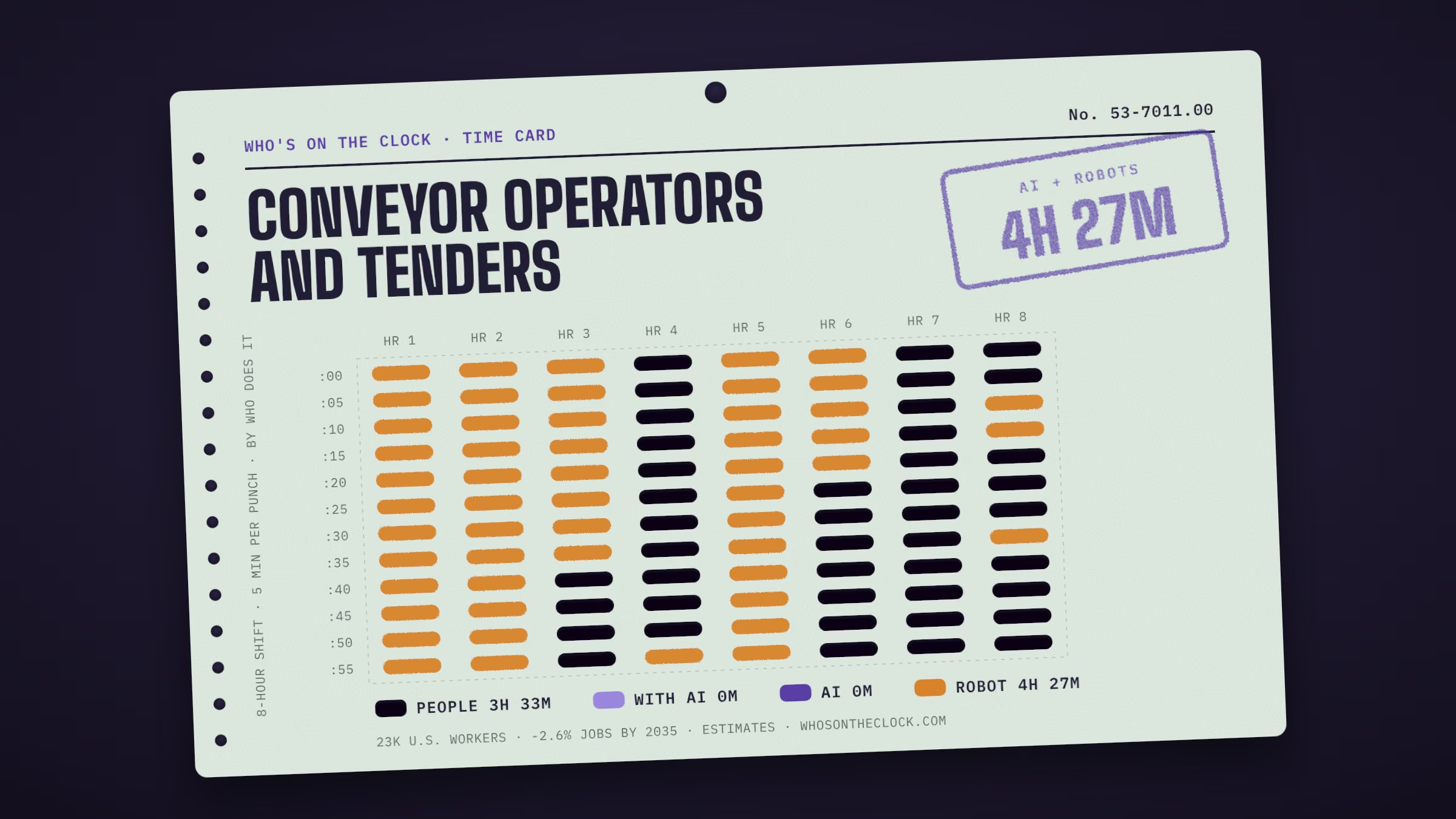
Control or tend conveyors or conveyor systems that move materials or products to and from stockpiles, processing stations, departments, or vehicles. May control speed and routing of materials or products.
Time card
Untick tasks you don't do, or set your own times.
| Mine | Task, by time spent | Human | With AI | AI | Robot |
|---|---|---|---|---|---|
Observe conveyor operations and monitor lights, dials, and gauges to maintain specified operating levels and to detect equipment malfunctions.1h 23m a shift · Robots deployed · e.g. ANYmal (ANYbotics) at Vale Caue plantWhy this label?Marked Robot because ANYmal (ANYbotics) at Vale Caue plant (in real use) has done this task in a real workplace. It shows a robot can do it somewhere, not that most conveyor operators and tenders work alongside one. How labels work | |||||
Load, unload, or adjust materials or products on conveyors by hand, by using lifts, hoists, and scoops, or by opening gates, chutes, or hoppers.1h 17m a shift · Robots deployed · e.g. Stretch at DHL Supply Chain sitesWhy this label?Marked Robot because Stretch at DHL Supply Chain sites (in real use) has done this task in a real workplace. It shows a robot can do it somewhere, not that most conveyor operators and tenders work alongside one. How labels work | |||||
Stop equipment or machinery and clear jams, using poles, bars, and hand tools, or remove damaged materials from conveyors.41m a shift · No AI or robot evidence foundWhy this label?This is physical work, and no robot has been shown doing it yet. How labels work | |||||
Clean, sterilize, and maintain equipment, machinery, and work stations, using hand tools, shovels, brooms, chemicals, hoses, and lubricants.36m a shift · Robots only in factory cellsWhy this label?Robots have done this only in factory setups built around the machine, so it stays Human for conveyor operators and tenders. How labels work | |||||
Distribute materials, supplies, and equipment to work stations, using lifts and trucks.30m a shift · Robots deployed · e.g. Seegrid AMRs (Lift RS1/CR1, Pallet Truck, Tow Tractor)Why this label?Marked Robot because Seegrid AMRs (Lift RS1/CR1, Pallet Truck, Tow Tractor) (in real use) has done this task in a real workplace. It shows a robot can do it somewhere, not that most conveyor operators and tenders work alongside one. How labels work | |||||
Observe packages moving along conveyors to identify packages, detect defective packaging, and perform quality control.30m a shift · Robots deployed · e.g. Project P.I. (imaging tunnels)Why this label?Marked Robot because Project P.I. (imaging tunnels) (in real use) has done this task in a real workplace. It shows a robot can do it somewhere, not that most conveyor operators and tenders work alongside one. How labels work | |||||
Manipulate controls, levers, and valves to start pumps, auxiliary equipment, or conveyors, and to adjust equipment positions, speeds, timing, and material flows.30m a shift · Robots deployed · e.g. thyssenkrupp autonomous rail-mounted stackers and reclaimer (BHP South Flank)Why this label?Marked Robot because thyssenkrupp autonomous rail-mounted stackers and reclaimer (BHP South Flank) (in real use) has done this task in a real workplace. It shows a robot can do it somewhere, not that most conveyor operators and tenders work alongside one. How labels work | |||||
Record production data such as weights, types, quantities, and storage locations of materials, as well as equipment performance problems and downtime.24m a shift · No AI or robot evidence foundWhy this label?No AI use or robot deployment showed up for this task in our data. That isn't proof it's safe; it may just be rare in the data. How labels work | |||||
Position deflector bars, gates, chutes, or spouts to divert flow of materials from one conveyor onto another conveyor.18m a shift · Robots only in factory cellsWhy this label?Robots have done this only in factory setups built around the machine, so it stays Human for conveyor operators and tenders. How labels work | |||||
Repair or replace equipment components or parts such as blades, rolls, and pumps.18m a shift · Robots only in factory cellsWhy this label?Robots have done this only in factory setups built around the machine, so it stays Human for conveyor operators and tenders. How labels work | |||||
Weigh or measure materials and products, using scales or other measuring instruments, or read scales on conveyors that continually weigh products, to verify specified tonnages and prevent overloads.18m a shift · No AI or robot evidence foundWhy this label?No AI use or robot deployment showed up for this task in our data. That isn't proof it's safe; it may just be rare in the data. How labels work | |||||
Read production and delivery schedules, and confer with supervisors, to determine sorting and transfer procedures, arrangement of packages on pallets, and destinations of loaded pallets.18m a shift · No AI or robot evidence foundWhy this label?No AI use or robot deployment showed up for this task in our data. That isn't proof it's safe; it may just be rare in the data. How labels work | |||||
Press console buttons to deflect packages to predetermined accumulators or reject lines.12m a shift · Robots deployed · e.g. USPS package sorting machines (e.g., Automated Delivery Unit Sorter and high-capacity package sorters)Why this label?Marked Robot because USPS package sorting machines (e.g., Automated Delivery Unit Sorter and high-capacity package sorters) (in real use) has done this task in a real workplace. It shows a robot can do it somewhere, not that most conveyor operators and tenders work alongside one. How labels work | |||||
Contact workers in work stations or other departments to request movement of materials, products, or machinery, or to notify them of incoming shipments and their estimated delivery times.12m a shift · No AI or robot evidence foundWhy this label?No AI use or robot deployment showed up for this task in our data. That isn't proof it's safe; it may just be rare in the data. How labels work | |||||
Inform supervisors of equipment malfunctions that need to be addressed.6m a shift · No AI or robot evidence foundWhy this label?No AI use or robot deployment showed up for this task in our data. That isn't proof it's safe; it may just be rare in the data. How labels work | |||||
Collect samples of materials or products, checking them to ensure conformance to specifications or sending them to laboratories for analysis.6m a shift · Robots deployed · e.g. McLanahan Cross Belt Sampler (Oklahoma aggregate site)Why this label?Marked Robot because McLanahan Cross Belt Sampler (Oklahoma aggregate site) (in real use) has done this task in a real workplace. It shows a robot can do it somewhere, not that most conveyor operators and tenders work alongside one. How labels work | |||||
Affix identifying information to materials or products, using hand tools.6m a shift · Robots only in factory cellsWhy this label?Robots have done this only in factory setups built around the machine, so it stays Human for conveyor operators and tenders. How labels work | |||||
Move, assemble, and connect hoses or nozzles to material hoppers, storage tanks, conveyor sections or chutes, and pumps.6m a shift · Robots only in factory cellsWhy this label?Robots have done this only in factory setups built around the machine, so it stays Human for conveyor operators and tenders. How labels work | |||||
Thread strapping through strapping tools and secure battens with strapping to form protective pallets around extrusions.6m a shift · Robots only in factory cellsWhy this label?Robots have done this only in factory setups built around the machine, so it stays Human for conveyor operators and tenders. How labels work | |||||
Join sections of conveyor frames at temporary working areas, and connect power units.6m a shift · Robots only in factory cellsWhy this label?Robots have done this only in factory setups built around the machine, so it stays Human for conveyor operators and tenders. How labels work |