Will AI replace desktop publishers?

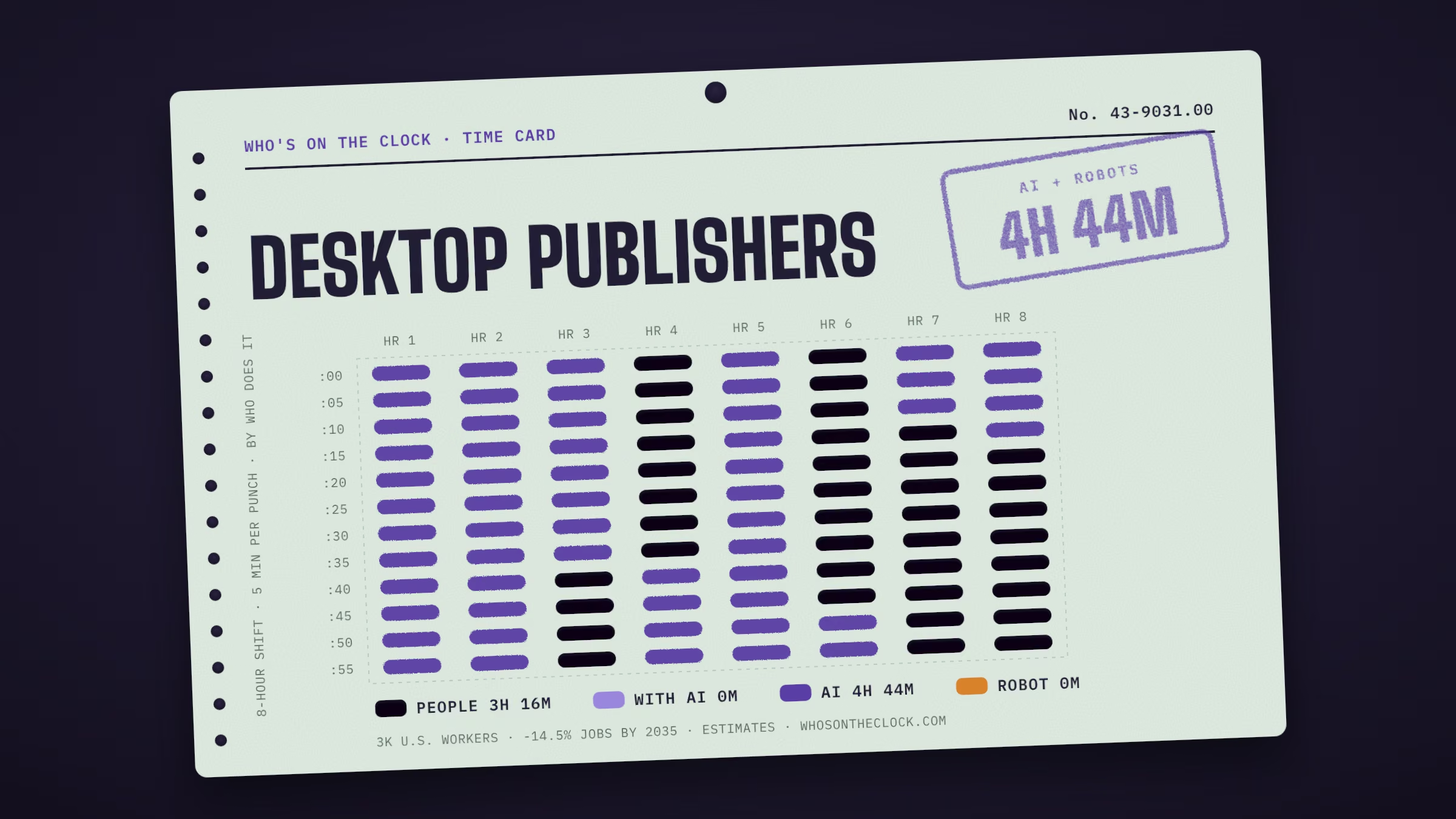
AI already handles some of this work on its own in real use, for tasks like “Operate desktop publishing software and equipment to design, lay out”. That's 4h 44m of a typical shift; 3h 16m still has no AI or robot evidence. BLS expects about 14.5% fewer of these jobs by 2035.

Time card for desktop publishers showing a typical 8-hour shift: 3h 16m done by people, 4h 44m by AI.
Each mark is 5 minutes of a typical shift for desktop publishers, colored by who does that task today. Estimates from O*NET tasks and Anthropic Economic Index data. How it's made

Home / Office & admin / Desktop Publishers

Format typescript and graphic elements using computer software to produce publication-ready material.

Time card

Untick tasks you don't do, or set your own times.
MineTask, by time spentHumanWith AIAIRobot
Operate desktop publishing software and equipment to design, lay out, and produce camera-ready copy.1h 28m a shift · Observed in AI useTypical AI request: about 6h 25m alone, 25m with AI
Why this label?Marked AI because this task shows up regularly in real AI conversations (Anthropic Economic Index, 2025 usage), and in most of them AI does the task on its own rather than helping a person. Many workplaces may not use AI for it at all. How labels work
Position text and art elements from a variety of databases in a visually appealing way to design print or web pages, using knowledge of type styles and size and layout patterns.1h 9m a shift · Observed in AI useTypical AI request: about 5h 12m alone, 19m with AI
Why this label?Marked AI because this task shows up regularly in real AI conversations (Anthropic Economic Index, 2025 usage), and in most of them AI does the task on its own rather than helping a person. Many workplaces may not use AI for it at all. How labels work
Check preliminary and final proofs for errors and make necessary corrections.57m a shift · No AI or robot evidence found
Why this label?No AI use or robot deployment showed up for this task in our data. That isn't proof it's safe; it may just be rare in the data. How labels work
Enter text into computer keyboard and select the size and style of type, column width, and appropriate spacing for printed materials.51m a shift · Observed in AI useTypical AI request: about 3h 26m alone, 15m with AI
Why this label?Marked AI because this task shows up regularly in real AI conversations (Anthropic Economic Index, 2025 usage), and in most of them AI does the task on its own rather than helping a person. Many workplaces may not use AI for it at all. How labels work
Import text and art elements, such as electronic clip art or electronic files from photographs that have been scanned or produced with a digital camera, using computer software.32m a shift · Observed in AI useTypical AI request: about 2h 30m alone, 13m with AI
Why this label?Marked AI because this task shows up regularly in real AI conversations (Anthropic Economic Index, 2025 usage), and in most of them AI does the task on its own rather than helping a person. Many workplaces may not use AI for it at all. How labels work
View monitors for visual representation of work in progress and for instructions and feedback throughout process, making modifications as necessary.25m a shift · No AI or robot evidence found
Why this label?No AI use or robot deployment showed up for this task in our data. That isn't proof it's safe; it may just be rare in the data. How labels work
Prepare sample layouts for approval, using computer software.25m a shift · No AI or robot evidence found
Why this label?No AI use or robot deployment showed up for this task in our data. That isn't proof it's safe; it may just be rare in the data. How labels work
Edit graphics and photos, using pixel or bitmap editing, airbrushing, masking, or image retouching.25m a shift · Observed in AI useTypical AI request: about 1h 34m alone, 11m with AI
Why this label?Marked AI because this task shows up regularly in real AI conversations (Anthropic Economic Index, 2025 usage), and in most of them AI does the task on its own rather than helping a person. Many workplaces may not use AI for it at all. How labels work
Collaborate with graphic artists, editors and writers to produce master copies according to design specifications.25m a shift · No AI or robot evidence found
Why this label?No AI use or robot deployment showed up for this task in our data. That isn't proof it's safe; it may just be rare in the data. How labels work
Study layout or other design instructions to determine work to be done and sequence of operations.19m a shift · No AI or robot evidence found
Why this label?No AI use or robot deployment showed up for this task in our data. That isn't proof it's safe; it may just be rare in the data. How labels work
Convert various types of files for printing or for the Internet, using computer software.19m a shift · Observed in AI useTypical AI request: about 3h 22m alone, 13m with AI
Why this label?Marked AI because this task shows up regularly in real AI conversations (Anthropic Economic Index, 2025 usage), and in most of them AI does the task on its own rather than helping a person. Many workplaces may not use AI for it at all. How labels work
Enter digitized data into electronic prepress system computer memory, using scanner, camera, keyboard, or mouse.13m a shift · No AI or robot evidence found
Why this label?No AI use or robot deployment showed up for this task in our data. That isn't proof it's safe; it may just be rare in the data. How labels work
Select number of colors and determine color separations.6m a shift · No AI or robot evidence found
Why this label?No AI use or robot deployment showed up for this task in our data. That isn't proof it's safe; it may just be rare in the data. How labels work
Enter data, such as coordinates of images and color specifications, into system to retouch and make color corrections.6m a shift · No AI or robot evidence found
Why this label?No AI use or robot deployment showed up for this task in our data. That isn't proof it's safe; it may just be rare in the data. How labels work
Transmit, deliver, or mail publication master to printer for production into film and plates.6m a shift · No AI or robot evidence found
Why this label?No AI use or robot deployment showed up for this task in our data. That isn't proof it's safe; it may just be rare in the data. How labels work
Store copies of publications on paper, magnetic tape, film, or diskette.6m a shift · No AI or robot evidence found
Why this label?No AI use or robot deployment showed up for this task in our data. That isn't proof it's safe; it may just be rare in the data. How labels work
Create special effects such as vignettes, mosaics, and image combining, and add elements such as sound and animation to electronic publications.6m a shift · No AI or robot evidence found
Why this label?No AI use or robot deployment showed up for this task in our data. That isn't proof it's safe; it may just be rare in the data. How labels work
Load floppy disks or tapes containing information into system.time not estimated · Robots only in factory cells
Why this label?Robots have done this only in factory setups built around the machine, so it stays Human for desktop publishers. How labels work

Clock history

  1. 4h 44m touchedFirst published: O*NET 30.1, Anthropic Economic Index (2025 usage and September 2026 robot study), BLS May 2025

When new data changes this clock, the date, the new numbers and the reason are logged here. Company news alone never moves the clock.

On the floor

No company news tracked for this job yet. New stories are added as they happen.

Ask the clock

Will AI replace desktop publishers?

Some tasks are already being done by AI or machines; the rest still needs a person. About 4h 44m of a typical shift is made up of tasks that AI or robots have done on their own in real use somewhere. That doesn't mean those hours are automated in a typical workplace. The other 3h 16m (41%) stays with people. Separately, BLS expects about 14.5% fewer of these jobs by 2035 (all jobs: +3.5%).

What can AI already do for desktop publishers?

AI shows up regularly in 6 of 18 tasks, about 4h 44m of a typical shift. The biggest ones:

  • Operate desktop publishing software and equipment to design, lay out, and produce camera-ready copy. (1h 28m a shift, AI mostly does it alone)
  • Position text and art elements from a variety of databases in a visually appealing way to design print or web pages, using knowledge of type styles and size and layout patterns. (1h 9m a shift, AI mostly does it alone)
  • Enter text into computer keyboard and select the size and style of type, column width, and appropriate spacing for printed materials. (51m a shift, AI mostly does it alone)
  • Import text and art elements, such as electronic clip art or electronic files from photographs that have been scanned or produced with a digital camera, using computer software. (32m a shift, AI mostly does it alone)
  • Edit graphics and photos, using pixel or bitmap editing, airbrushing, masking, or image retouching. (25m a shift, AI mostly does it alone)
Where do robots fit in?

Not in workplaces like this one, based on a 2026 review of robot deployments. 1 more task has only been done in factory setups built around the machine, so it stays with people here.

What still needs a person?

3h 16m of a typical shift, or 41%, goes to tasks with no AI or robot evidence yet. No AI usage or robot deployment has shown up for these so far. The biggest:

  • Check preliminary and final proofs for errors and make necessary corrections. (57m a shift)
  • View monitors for visual representation of work in progress and for instructions and feedback throughout process, making modifications as necessary. (25m a shift)
  • Prepare sample layouts for approval, using computer software. (25m a shift)
  • Collaborate with graphic artists, editors and writers to produce master copies according to design specifications. (25m a shift)
  • Study layout or other design instructions to determine work to be done and sequence of operations. (19m a shift)
Why is that work hard to automate?

Much of it comes down to where and how the work happens. In-person, hands-on and high-stakes work is where AI and robots have made the least headway so far. In the official O*NET survey of people in this job:

  • 76% talk face to face with others every day
  • 69% use their hands on tools, objects or controls more than half the time
How much time does AI save on these tasks?

For the 6 tasks in this job where AI shows up and timing data exists, a typical request takes about 3h 24m for a person alone and about 14m with AI. These are Claude's own estimates from real conversations in April and May 2026 (Anthropic Economic Index). They describe single requests, not whole workdays, and time saved on a task doesn't mean jobs are cut. The biggest gaps:

  • Operate desktop publishing software and equipment to design, lay out, and produce camera-ready copy (about 6h 25m alone, 25m with AI)
  • Position text and art elements from a variety of databases in a visually appealing way to design print or web pages, using knowledge of type styles and size and layout patterns (about 5h 12m alone, 19m with AI)
  • Enter text into computer keyboard and select the size and style of type, column width, and appropriate spacing for printed materials (about 3h 26m alone, 15m with AI)
Are employers still hiring desktop publishers?

On Indeed, job postings in the Administrative Assistance sector are at 96% of their February 2020 level (all U.S. postings: 104%), up 0.6% from a year earlier, as of Oct 9, 2026. BLS separately expects about 300 openings a year in this job through 2035. Across all U.S. postings, 7.3% now mention AI skills. Sector postings cover more than this one job and move for many reasons besides AI.

How much do desktop publishers make?

The median pay is about $55,290 a year ($26.58 an hour), 8% above the median for all U.S. jobs ($50,980). Most people in this job earn between $35,680 and $96,170 a year; that range covers the middle 80%. Pay figures are from BLS, May 2025, and vary a lot by state and employer. Pick a state to compare:

Is this job growing or shrinking?

BLS projects a decline of 14.5% from 2025 to 2035, compared with 3.5% growth for all jobs. That's about 4,000 jobs in 2035. Even so, it expects about 300 openings a year, mostly from people retiring or changing careers. These projections don't single out AI as a cause.

How many desktop publishers are there in the U.S.?

About 3,350 people in the U.S., roughly 0.00% of all workers (BLS, May 2025). That makes it the 751st largest of the 796 jobs on this site. BLS expects about 4,000 in 2035.

What training do desktop publishers need?

The most common requirement is a high school diploma: about 44% of people in the job said so in the official O*NET survey. O*NET rates the job at level 3 of 5 for preparation, which usually means: vocational school or associate's degree. Requirements vary by state and employer, especially for licensed work.

What should I learn to stay ahead of AI?

These come from the job's official skill ratings and from the tasks that AI and robots touch least today. Building them keeps you strong in the parts of the work that still need a person:

  • Skills that matter more here than in most jobs: Judgment and Decision Making, Critical Thinking, Reading Comprehension, Time Management
  • Get strong at the parts of the job that stay with people (listed above), which take 3h 16m of a typical shift
  • Tools employers list: Adobe InDesign, Adobe Acrobat, Adobe After Effects, Adobe Creative Cloud software, Adobe Illustrator
  • Learn to use AI well on the tasks where it already shows up in this job (listed above)
What other jobs could desktop publishers move into?

These use similar skills, with less of a typical shift touched by AI or robots. Matches come from 109 official ratings of skills, knowledge and work activities, and each needs the same or less preparation unless the official list relates the jobs directly:

  • Prepress Technicians and Workers (2h 23m touched, $49k median pay)
  • Graphic Designers (2h 19m touched, $63k median pay)
  • Special Effects Artists and Animators (3h 12m touched, $102k median pay)
  • Proofreaders and Copy Markers (2h 32m touched, $51k median pay)
How solid are these numbers?

Each task carries its own evidence label. For this job: 6 observed in real AI use, 12 with no AI or robot evidence found. The minutes per task are estimates, not measured hours, and "no evidence" doesn't prove a task is safe.

Tools in demand

  • Adobe InDesign
  • Adobe Acrobat
  • Adobe After Effects
  • Adobe Creative Cloud software
  • Adobe Illustrator
  • Adobe Photoshop
  • Cascading style sheets CSS

Plus everyday office tools: Apple macOS.

Also called

Advertising Associate, Compositor, Computer Compositor, Computer Publisher, Computer Typesetter, DTP Operator (Desktop Publishing Operator), Design Editor, Desktop Operator, Desktop Publisher, Desktop Publishing Associate, Desktop Publishing Specialist, Desktop Support Engineer, Digital Publisher, Digital Publishing Specialist