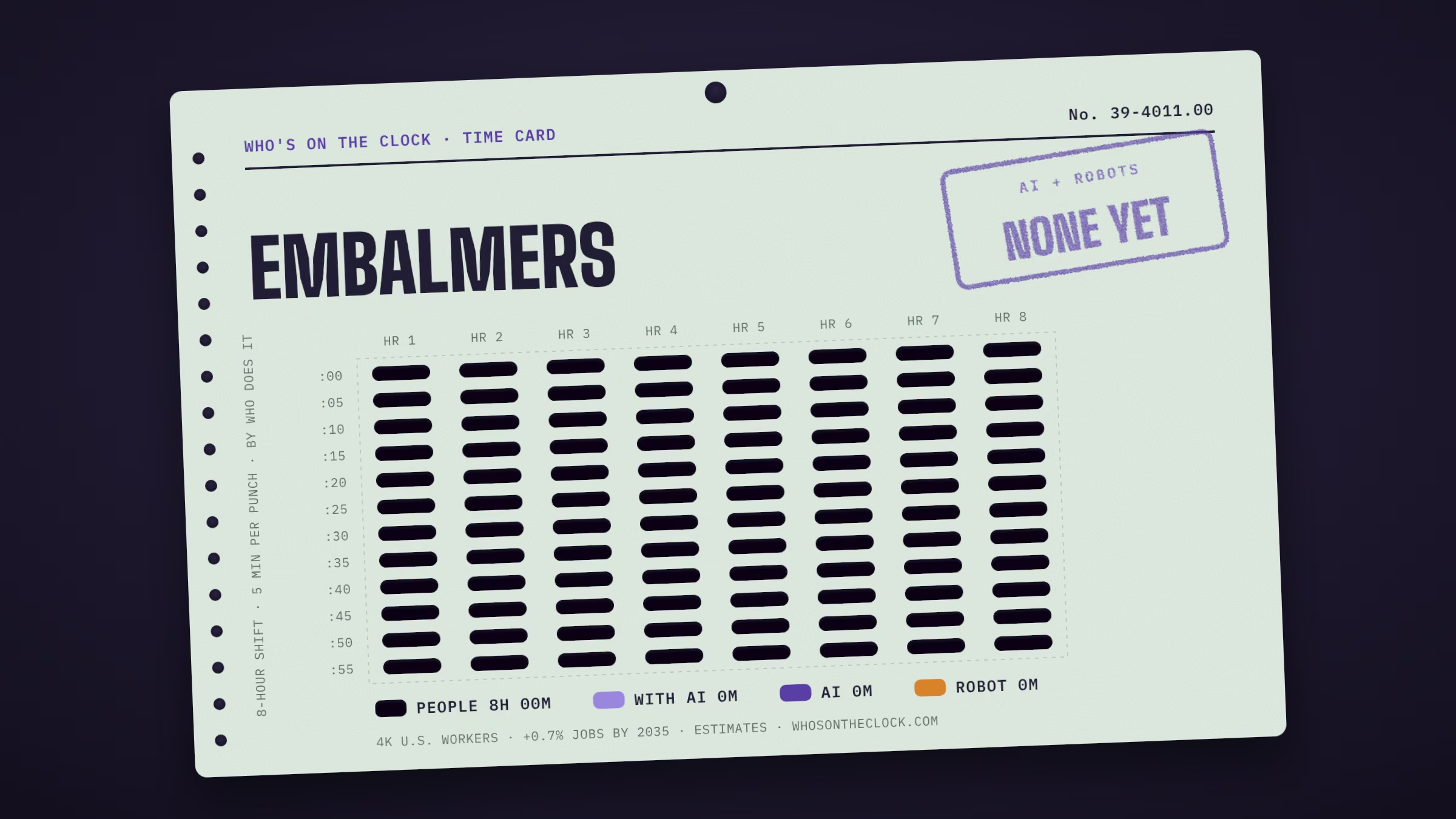
Prepare bodies for interment in conformity with legal requirements.
Time card
Untick tasks you don't do, or set your own times.
| Mine | Task, by time spent | Human | With AI | AI | Robot |
|---|---|---|---|---|---|
Perform the duties of funeral directors, including coordinating funeral activities.1h 9m a shift · No AI or robot evidence foundWhy this label?No AI use or robot deployment showed up for this task in our data. That isn't proof it's safe; it may just be rare in the data. How labels work | |||||
Remove the deceased from place of death and transport to funeral home.46m a shift · No AI or robot evidence foundWhy this label?This is physical work, and no robot has been shown doing it yet. How labels work | |||||
Make incisions in arms or thighs and drain blood from circulatory system and replace it with embalming fluid, using pump.40m a shift · No AI or robot evidence foundWhy this label?This is physical work, and no robot has been shown doing it yet. How labels work | |||||
Apply cosmetics to impart lifelike appearance to the deceased.35m a shift · No AI or robot evidence foundWhy this label?This is physical work, and no robot has been shown doing it yet. How labels work | |||||
Dress bodies and place them in caskets.35m a shift · No AI or robot evidence foundWhy this label?This is physical work, and no robot has been shown doing it yet. How labels work | |||||
Clean and disinfect areas in which bodies are prepared and embalmed.23m a shift · Robots only in factory cellsWhy this label?Robots have done this only in factory setups built around the machine, so it stays Human for embalmers. How labels work | |||||
Conduct interviews to arrange for the preparation of obituary notices, to assist with the selection of caskets or urns, and to determine the location and time of burials or cremations.23m a shift · No AI or robot evidence foundWhy this label?No AI use or robot deployment showed up for this task in our data. That isn't proof it's safe; it may just be rare in the data. How labels work | |||||
Serve as pallbearers, attend visiting rooms, and provide other assistance to the bereaved.23m a shift · No AI or robot evidence foundWhy this label?This is physical work, and no robot has been shown doing it yet. How labels work | |||||
Conform to laws of health and sanitation and ensure that legal requirements concerning embalming are met.17m a shift · No AI or robot evidence foundWhy this label?This is physical work, and no robot has been shown doing it yet. How labels work | |||||
Incise stomach and abdominal walls and probe internal organs, using trocar, to withdraw blood and waste matter from organs.17m a shift · No AI or robot evidence foundWhy this label?This is physical work, and no robot has been shown doing it yet. How labels work | |||||
Assist with placing caskets in hearses and organize cemetery processions.17m a shift · Robots only in factory cellsWhy this label?Robots have done this only in factory setups built around the machine, so it stays Human for embalmers. How labels work | |||||
Maintain records, such as itemized lists of clothing or valuables delivered with body and names of persons embalmed.17m a shift · No AI or robot evidence foundWhy this label?No AI use or robot deployment showed up for this task in our data. That isn't proof it's safe; it may just be rare in the data. How labels work | |||||
Wash and dry bodies, using germicidal soap and towels or hot air dryers.17m a shift · No AI or robot evidence foundWhy this label?This is physical work, and no robot has been shown doing it yet. How labels work | |||||
Arrange funeral home equipment and perform general maintenance.17m a shift · Robots only in factory cellsWhy this label?Robots have done this only in factory setups built around the machine, so it stays Human for embalmers. How labels work | |||||
Attach trocar to pump-tube, start pump, and repeat probing to force embalming fluid into organs.12m a shift · No AI or robot evidence foundWhy this label?This is physical work, and no robot has been shown doing it yet. How labels work | |||||
Reshape or reconstruct disfigured or maimed bodies when necessary, using dermasurgery techniques and materials such as clay, cotton, plaster of Paris, and wax.12m a shift · No AI or robot evidence foundWhy this label?This is physical work, and no robot has been shown doing it yet. How labels work | |||||
Supervise funeral attendants and other funeral home staff.12m a shift · No AI or robot evidence foundWhy this label?No AI use or robot deployment showed up for this task in our data. That isn't proof it's safe; it may just be rare in the data. How labels work | |||||
Direct casket and floral display placement and arrange guest seating.12m a shift · Robots only in factory cellsWhy this label?Robots have done this only in factory setups built around the machine, so it stays Human for embalmers. How labels work | |||||
Join lips, using needles and thread or wire.6m a shift · No AI or robot evidence foundWhy this label?This is physical work, and no robot has been shown doing it yet. How labels work | |||||
Close incisions, using needles and sutures.6m a shift · No AI or robot evidence foundWhy this label?This is physical work, and no robot has been shown doing it yet. How labels work | |||||
Pack body orifices with cotton saturated with embalming fluid to prevent escape of gases or waste matter.6m a shift · No AI or robot evidence foundWhy this label?This is physical work, and no robot has been shown doing it yet. How labels work | |||||
Insert convex celluloid or cotton between eyeballs and eyelids to prevent slipping and sinking of eyelids.6m a shift · No AI or robot evidence foundWhy this label?This is physical work, and no robot has been shown doing it yet. How labels work | |||||
Arrange for transporting the deceased to another state for interment.6m a shift · No AI or robot evidence foundWhy this label?No AI use or robot deployment showed up for this task in our data. That isn't proof it's safe; it may just be rare in the data. How labels work | |||||
Perform special procedures necessary for remains that are to be transported to other states or overseas, or where death was caused by infectious disease.6m a shift · No AI or robot evidence foundWhy this label?This is physical work, and no robot has been shown doing it yet. How labels work | |||||
Assist coroners at death scenes or at autopsies, file police reports, and testify at inquests or in court, if employed by a coroner.time not estimated · No AI or robot evidence foundWhy this label?This is physical work, and no robot has been shown doing it yet. How labels work | |||||
Press diaphragm to evacuate air from lungs.time not estimated · Robots only in factory cellsWhy this label?Robots have done this only in factory setups built around the machine, so it stays Human for embalmers. How labels work |