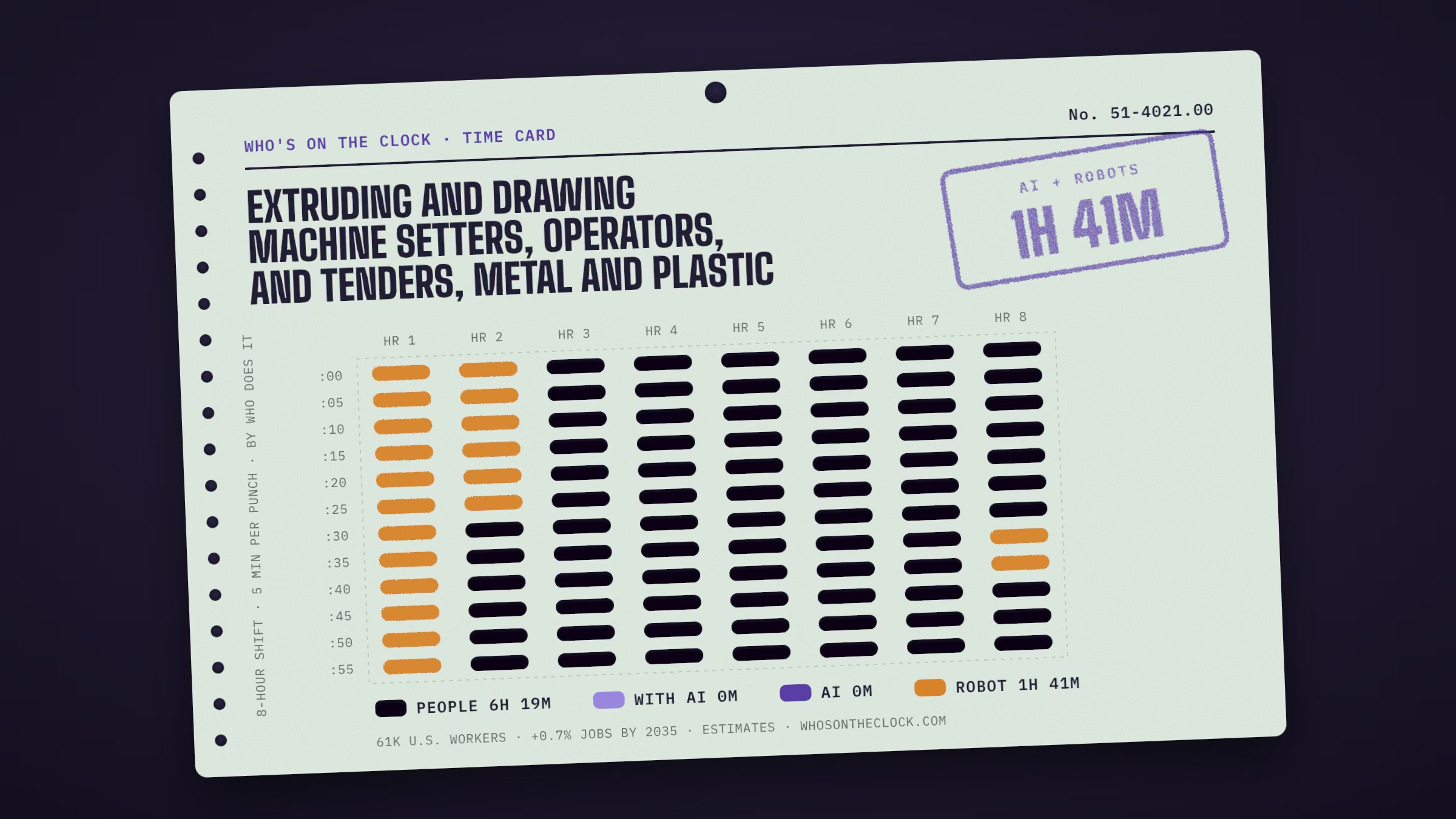
Set up, operate, or tend machines to extrude or draw thermoplastic or metal materials into tubes, rods, hoses, wire, bars, or structural shapes.
Time card
Untick tasks you don't do, or set your own times.
| Mine | Task, by time spent | Human | With AI | AI | Robot |
|---|---|---|---|---|---|
Measure and examine extruded products to locate defects and to check for conformance to specifications, adjusting controls as necessary to alter products.1h 29m a shift · Robots deployed · e.g. SIKORA X-RAY 6000 PRO at Wuxi Huacheng CableWhy this label?Marked Robot because SIKORA X-RAY 6000 PRO at Wuxi Huacheng Cable (in real use) has done this task in a real workplace. It shows a robot can do it somewhere, not that most extruding and drawing machine setters, operators, and tenders, metal and plastic work alongside one. How labels work | |||||
Start machines and set controls to regulate vacuum, air pressure, sizing rings, and temperature, and to synchronize speed of extrusion.47m a shift · Robots only in factory cellsWhy this label?Robots have done this only in factory setups built around the machine, so it stays Human for extruding and drawing machine setters, operators, and tenders, metal and plastic. How labels work | |||||
Reel extruded products into rolls of specified lengths and weights.41m a shift · Robots only in factory cellsWhy this label?Robots have done this only in factory setups built around the machine, so it stays Human for extruding and drawing machine setters, operators, and tenders, metal and plastic. How labels work | |||||
Troubleshoot, maintain, and make minor repairs to equipment.41m a shift · No AI or robot evidence foundWhy this label?This is physical work, and no robot has been shown doing it yet. How labels work | |||||
Clean work areas.36m a shift · Robots only in factory cellsWhy this label?Robots have done this only in factory setups built around the machine, so it stays Human for extruding and drawing machine setters, operators, and tenders, metal and plastic. How labels work | |||||
Install dies, machine screws, and sizing rings on machines that extrude thermoplastic or metal materials.30m a shift · No AI or robot evidence foundWhy this label?This is physical work, and no robot has been shown doing it yet. How labels work | |||||
Load machine hoppers with mixed materials, using augers, or stuff rolls of plastic dough into machine cylinders.30m a shift · Robots only in factory cellsWhy this label?Robots have done this only in factory setups built around the machine, so it stays Human for extruding and drawing machine setters, operators, and tenders, metal and plastic. How labels work | |||||
Adjust controls to draw or press metal into specified shapes and diameters.30m a shift · Robots only in factory cellsWhy this label?Robots have done this only in factory setups built around the machine, so it stays Human for extruding and drawing machine setters, operators, and tenders, metal and plastic. How labels work | |||||
Determine setup procedures and select machine dies and parts, according to specifications.24m a shift · No AI or robot evidence foundWhy this label?No AI use or robot deployment showed up for this task in our data. That isn't proof it's safe; it may just be rare in the data. How labels work | |||||
Change dies on extruding machines, according to production line changes.24m a shift · No AI or robot evidence foundWhy this label?This is physical work, and no robot has been shown doing it yet. How labels work | |||||
Weigh and mix pelletized, granular, or powdered thermoplastic materials and coloring pigments.24m a shift · Robots only in factory cellsWhy this label?Robots have done this only in factory setups built around the machine, so it stays Human for extruding and drawing machine setters, operators, and tenders, metal and plastic. How labels work | |||||
Test physical properties of products with testing devices such as acid-bath testers, burst testers, and impact testers.18m a shift · Robots only in factory cellsWhy this label?Robots have done this only in factory setups built around the machine, so it stays Human for extruding and drawing machine setters, operators, and tenders, metal and plastic. How labels work | |||||
Operate shearing mechanisms to cut rods to specified lengths.18m a shift · Robots only in factory cellsWhy this label?Robots have done this only in factory setups built around the machine, so it stays Human for extruding and drawing machine setters, operators, and tenders, metal and plastic. How labels work | |||||
Maintain an inventory of materials.12m a shift · Robots deployed · e.g. Corvus One Autonomous Inventory Management SystemWhy this label?Marked Robot because Corvus One Autonomous Inventory Management System (in real use) has done this task in a real workplace. It shows a robot can do it somewhere, not that most extruding and drawing machine setters, operators, and tenders, metal and plastic work alongside one. How labels work | |||||
Replace worn dies when products vary from specifications.12m a shift · Robots only in factory cellsWhy this label?Robots have done this only in factory setups built around the machine, so it stays Human for extruding and drawing machine setters, operators, and tenders, metal and plastic. How labels work | |||||
Select nozzles, spacers, and wire guides, according to diameters and lengths of rods.6m a shift · Robots only in factory cellsWhy this label?Robots have done this only in factory setups built around the machine, so it stays Human for extruding and drawing machine setters, operators, and tenders, metal and plastic. How labels work |