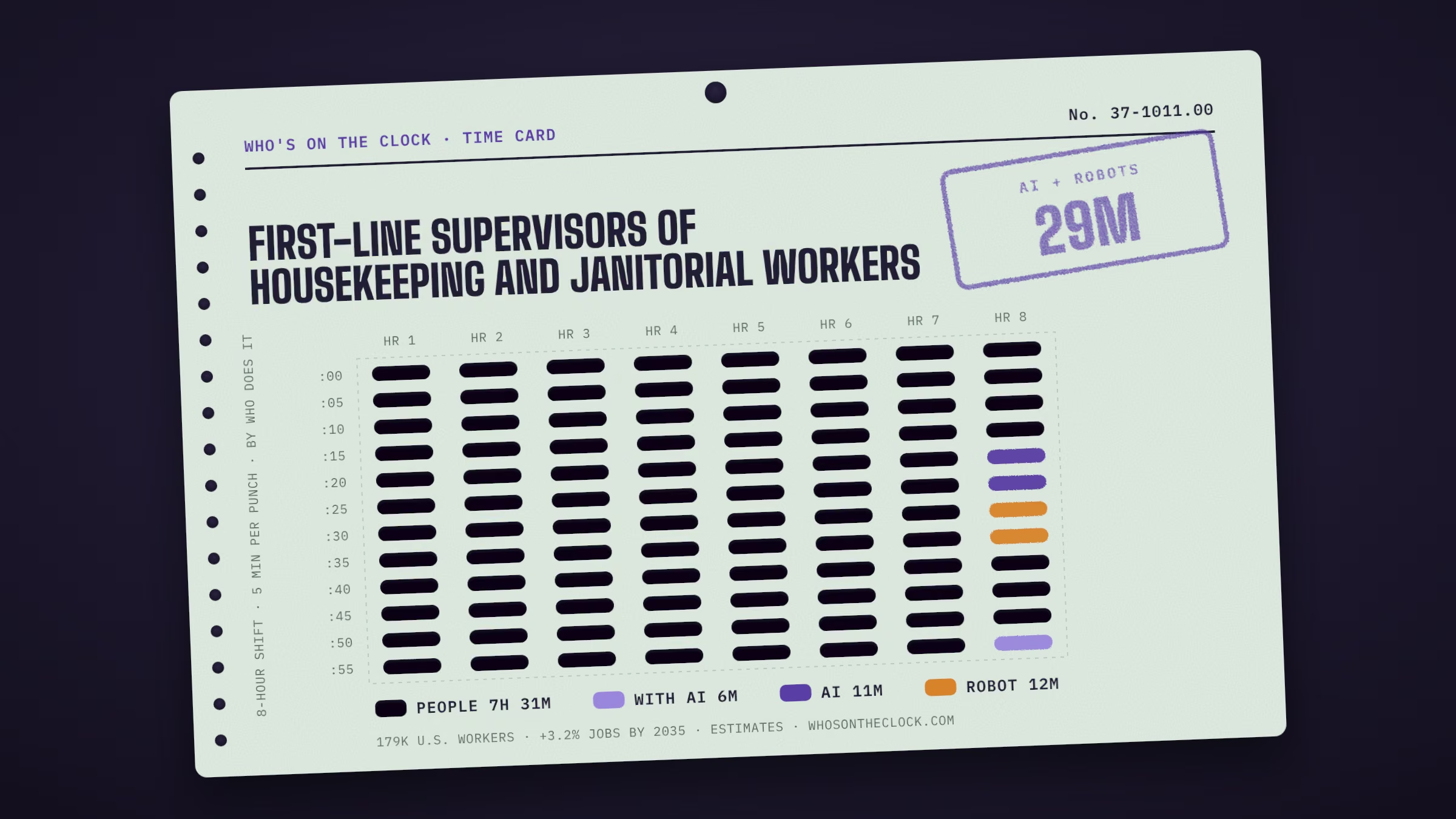
Directly supervise and coordinate work activities of cleaning personnel in hotels, hospitals, offices, and other establishments.
Time card
Untick tasks you don't do, or set your own times.
| Mine | Task, by time spent | Human | With AI | AI | Robot |
|---|---|---|---|---|---|
Inspect work performed to ensure that it meets specifications and established standards.1h 21m a shift · No AI or robot evidence foundWhy this label?This is physical work, and no robot has been shown doing it yet. How labels work | |||||
Perform or assist with cleaning duties as necessary.1h 9m a shift · No AI or robot evidence foundWhy this label?This is physical work, and no robot has been shown doing it yet. How labels work | |||||
Supervise in-house services, such as laundries, maintenance and repair, dry cleaning, or valet services.23m a shift · No AI or robot evidence foundWhy this label?No AI use or robot deployment showed up for this task in our data. That isn't proof it's safe; it may just be rare in the data. How labels work | |||||
Coordinate activities with other departments to ensure that services are provided in an efficient and timely manner.23m a shift · No AI or robot evidence foundWhy this label?No AI use or robot deployment showed up for this task in our data. That isn't proof it's safe; it may just be rare in the data. How labels work | |||||
Instruct staff in work policies and procedures, and the use and maintenance of equipment.23m a shift · No AI or robot evidence foundWhy this label?No AI use or robot deployment showed up for this task in our data. That isn't proof it's safe; it may just be rare in the data. How labels work | |||||
Confer with staff to resolve performance and personnel problems, and to discuss company policies.23m a shift · No AI or robot evidence foundWhy this label?No AI use or robot deployment showed up for this task in our data. That isn't proof it's safe; it may just be rare in the data. How labels work | |||||
Plan and prepare employee work schedules.17m a shift · No AI or robot evidence foundWhy this label?No AI use or robot deployment showed up for this task in our data. That isn't proof it's safe; it may just be rare in the data. How labels work | |||||
Inspect and evaluate the physical condition of facilities to determine the type of work required.17m a shift · No AI or robot evidence foundWhy this label?This is physical work, and no robot has been shown doing it yet. How labels work | |||||
Inventory stock to ensure that supplies and equipment are available in adequate amounts.17m a shift · Robots only in factory cellsWhy this label?Robots have done this only in factory setups built around the machine, so it stays Human for first-line supervisors of housekeeping and janitorial workers. How labels work | |||||
Maintain required records of work hours, budgets, payrolls, and other information.17m a shift · No AI or robot evidence foundWhy this label?No AI use or robot deployment showed up for this task in our data. That isn't proof it's safe; it may just be rare in the data. How labels work | |||||
Investigate complaints about service and equipment, and take corrective action.17m a shift · No AI or robot evidence foundWhy this label?This is physical work, and no robot has been shown doing it yet. How labels work | |||||
Advise managers, desk clerks, or admitting personnel of rooms ready for occupancy.12m a shift · No AI or robot evidence foundWhy this label?No AI use or robot deployment showed up for this task in our data. That isn't proof it's safe; it may just be rare in the data. How labels work | |||||
Establish and implement operational standards and procedures for the departments supervised.12m a shift · No AI or robot evidence foundWhy this label?No AI use or robot deployment showed up for this task in our data. That isn't proof it's safe; it may just be rare in the data. How labels work | |||||
Issue supplies and equipment to workers.12m a shift · Robots only in factory cellsWhy this label?Robots have done this only in factory setups built around the machine, so it stays Human for first-line supervisors of housekeeping and janitorial workers. How labels work | |||||
Check and maintain equipment to ensure that it is in working order.12m a shift · No AI or robot evidence foundWhy this label?This is physical work, and no robot has been shown doing it yet. How labels work | |||||
Direct activities for stopping the spread of infections in facilities, such as hospitals.12m a shift · No AI or robot evidence foundWhy this label?No AI use or robot deployment showed up for this task in our data. That isn't proof it's safe; it may just be rare in the data. How labels work | |||||
Select and order or purchase new equipment, supplies, or furnishings.12m a shift · No AI or robot evidence foundWhy this label?No AI use or robot deployment showed up for this task in our data. That isn't proof it's safe; it may just be rare in the data. How labels work | |||||
Prepare reports on activity, personnel, and information, such as occupancy, hours worked, facility usage, work performed, and departmental expenses.12m a shift · No AI or robot evidence foundWhy this label?No AI use or robot deployment showed up for this task in our data. That isn't proof it's safe; it may just be rare in the data. How labels work | |||||
Evaluate employee performance and recommend personnel actions, such as promotions, transfers, and dismissals.12m a shift · No AI or robot evidence foundWhy this label?No AI use or robot deployment showed up for this task in our data. That isn't proof it's safe; it may just be rare in the data. How labels work | |||||
Perform financial tasks, such as estimating costs and preparing and managing budgets.12m a shift · No AI or robot evidence foundWhy this label?No AI use or robot deployment showed up for this task in our data. That isn't proof it's safe; it may just be rare in the data. How labels work | |||||
Screen job applicants, and hire new employees.12m a shift · Observed in AI useWhy this label?Marked AI because this task shows up regularly in real AI conversations (Anthropic Economic Index, 2025 usage), and in most of them AI does the task on its own rather than helping a person. Many workplaces may not use AI for it at all. How labels work | |||||
Perform grounds maintenance tasks, such as removing snow and mowing the lawn.12m a shift · Robots deployed · e.g. Scythe Robotics M.52Why this label?Marked Robot because Scythe Robotics M.52 (in real use) has done this task in a real workplace. It shows a robot can do it somewhere, not that most first-line supervisors of housekeeping and janitorial workers work alongside one. How labels work | |||||
Select the most suitable cleaning materials for different types of linens, furniture, flooring, and surfaces.6m a shift · No AI or robot evidence foundWhy this label?No AI use or robot deployment showed up for this task in our data. That isn't proof it's safe; it may just be rare in the data. How labels work | |||||
Forecast necessary levels of staffing and stock at different times to facilitate effective scheduling and ordering.6m a shift · No AI or robot evidence foundWhy this label?No AI use or robot deployment showed up for this task in our data. That isn't proof it's safe; it may just be rare in the data. How labels work | |||||
Recommend or arrange for additional services, such as painting, repair work, renovations, and the replacement of furnishings and equipment.6m a shift · No AI or robot evidence foundWhy this label?No AI use or robot deployment showed up for this task in our data. That isn't proof it's safe; it may just be rare in the data. How labels work | |||||
Recommend changes that could improve service and increase operational efficiency.6m a shift · Observed in AI useTypical AI request: about 6h 39m alone, 48m with AIWhy this label?Marked With AI because people regularly use AI to help with this task in real conversations (Anthropic Economic Index, 2025 usage), but AI doesn't usually finish it alone. How labels work |