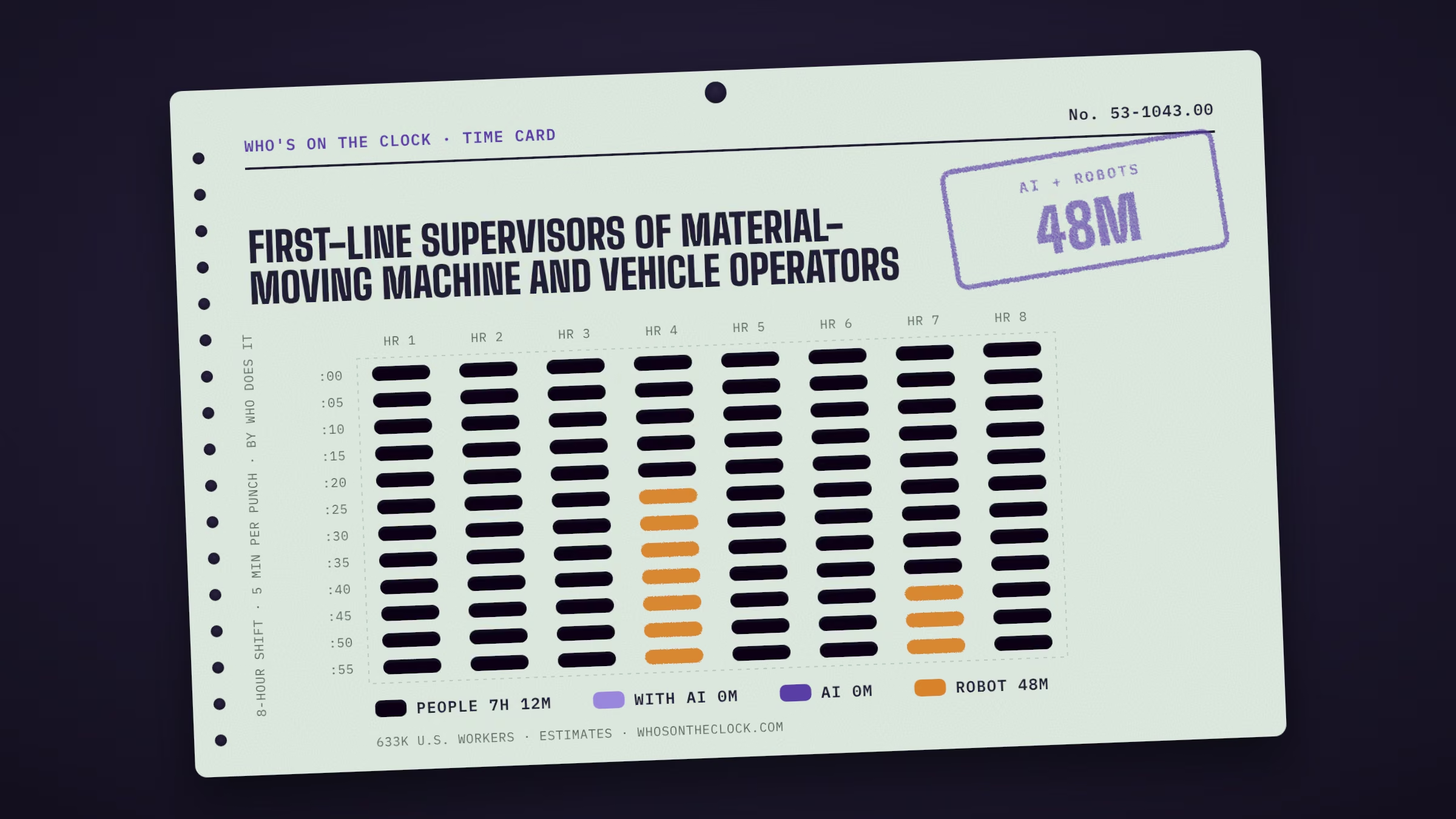
Directly supervise and coordinate activities of material-moving machine and vehicle operators and helpers.
Time card
Untick tasks you don't do, or set your own times.
| Mine | Task, by time spent | Human | With AI | AI | Robot |
|---|---|---|---|---|---|
Monitor field work to ensure proper performance and use of materials.43m a shift · No AI or robot evidence foundWhy this label?No AI use or robot deployment showed up for this task in our data. That isn't proof it's safe; it may just be rare in the data. How labels work | |||||
Direct workers in transportation or related services, such as pumping, moving, storing, or loading or unloading of materials.43m a shift · No AI or robot evidence foundWhy this label?No AI use or robot deployment showed up for this task in our data. That isn't proof it's safe; it may just be rare in the data. How labels work | |||||
Confer with customers, supervisors, contractors, or other personnel to exchange information or to resolve problems.37m a shift · No AI or robot evidence foundWhy this label?No AI use or robot deployment showed up for this task in our data. That isn't proof it's safe; it may just be rare in the data. How labels work | |||||
Plan work assignments and equipment allocations to meet transportation, operations or production goals.37m a shift · No AI or robot evidence foundWhy this label?No AI use or robot deployment showed up for this task in our data. That isn't proof it's safe; it may just be rare in the data. How labels work | |||||
Review orders, production schedules, blueprints, or shipping or receiving notices to determine work sequences and material shipping dates, types, volumes, or destinations.32m a shift · No AI or robot evidence foundWhy this label?No AI use or robot deployment showed up for this task in our data. That isn't proof it's safe; it may just be rare in the data. How labels work | |||||
Drive vehicles or operate machines or equipment to complete work assignments or to assist workers.32m a shift · Robots deployed · e.g. Fox Robotics FoxBot autonomous forkliftWhy this label?Marked Robot because Fox Robotics FoxBot autonomous forklift (in real use) has done this task in a real workplace. It shows a robot can do it somewhere, not that most first-line supervisors of material-moving machine and vehicle operators work alongside one. How labels work | |||||
Enforce safety rules and regulations.27m a shift · No AI or robot evidence foundWhy this label?No AI use or robot deployment showed up for this task in our data. That isn't proof it's safe; it may just be rare in the data. How labels work | |||||
Resolve worker problems or collaborate with employees to assist in problem resolution.27m a shift · No AI or robot evidence foundWhy this label?No AI use or robot deployment showed up for this task in our data. That isn't proof it's safe; it may just be rare in the data. How labels work | |||||
Maintain or verify records of time, materials, expenditures, or crew activities.27m a shift · No AI or robot evidence foundWhy this label?No AI use or robot deployment showed up for this task in our data. That isn't proof it's safe; it may just be rare in the data. How labels work | |||||
Inspect or test materials, stock, vehicles, equipment, or facilities to ensure that they are safe, free of defects, and consistent with specifications.21m a shift · Robots only in factory cellsWhy this label?Robots have done this only in factory setups built around the machine, so it stays Human for first-line supervisors of material-moving machine and vehicle operators. How labels work | |||||
Prepare, compile, and submit reports on work activities, operations, production, or work-related accidents.21m a shift · No AI or robot evidence foundWhy this label?No AI use or robot deployment showed up for this task in our data. That isn't proof it's safe; it may just be rare in the data. How labels work | |||||
Plan and establish schedules.21m a shift · No AI or robot evidence foundWhy this label?No AI use or robot deployment showed up for this task in our data. That isn't proof it's safe; it may just be rare in the data. How labels work | |||||
Explain and demonstrate work tasks to new workers or assign training tasks to experienced workers.16m a shift · No AI or robot evidence foundWhy this label?This is physical work, and no robot has been shown doing it yet. How labels work | |||||
Perform or schedule repairs or preventive maintenance of vehicles or other equipment.16m a shift · No AI or robot evidence foundWhy this label?No AI use or robot deployment showed up for this task in our data. That isn't proof it's safe; it may just be rare in the data. How labels work | |||||
Assist workers in tasks, such as loading vehicles.16m a shift · Robots deployed · e.g. Boston Dynamics StretchWhy this label?Marked Robot because Boston Dynamics Stretch (in real use) has done this task in a real workplace. It shows a robot can do it somewhere, not that most first-line supervisors of material-moving machine and vehicle operators work alongside one. How labels work | |||||
Interpret transportation or tariff regulations, shipping orders, safety regulations, or company policies and procedures for workers.11m a shift · No AI or robot evidence foundWhy this label?No AI use or robot deployment showed up for this task in our data. That isn't proof it's safe; it may just be rare in the data. How labels work | |||||
Examine, measure, or weigh cargo or materials to determine specific handling requirements.11m a shift · Robots only in factory cellsWhy this label?Robots have done this only in factory setups built around the machine, so it stays Human for first-line supervisors of material-moving machine and vehicle operators. How labels work | |||||
Requisition needed personnel, supplies, equipment, parts, or repair services.11m a shift · No AI or robot evidence foundWhy this label?No AI use or robot deployment showed up for this task in our data. That isn't proof it's safe; it may just be rare in the data. How labels work | |||||
Recommend and implement measures to improve worker motivation, equipment performance, work methods, or customer services.11m a shift · No AI or robot evidence foundWhy this label?No AI use or robot deployment showed up for this task in our data. That isn't proof it's safe; it may just be rare in the data. How labels work | |||||
Recommend or implement personnel actions, such as employee selection, evaluation, rewards, or disciplinary actions.11m a shift · No AI or robot evidence foundWhy this label?No AI use or robot deployment showed up for this task in our data. That isn't proof it's safe; it may just be rare in the data. How labels work | |||||
Dispatch personnel and vehicles in response to telephone or radio reports of emergencies.5m a shift · No AI or robot evidence foundWhy this label?No AI use or robot deployment showed up for this task in our data. That isn't proof it's safe; it may just be rare in the data. How labels work | |||||
Compute or estimate cash, payroll, transportation, personnel, or storage requirements.5m a shift · No AI or robot evidence foundWhy this label?No AI use or robot deployment showed up for this task in our data. That isn't proof it's safe; it may just be rare in the data. How labels work |