Will AI replace foundry mold and coremakers?

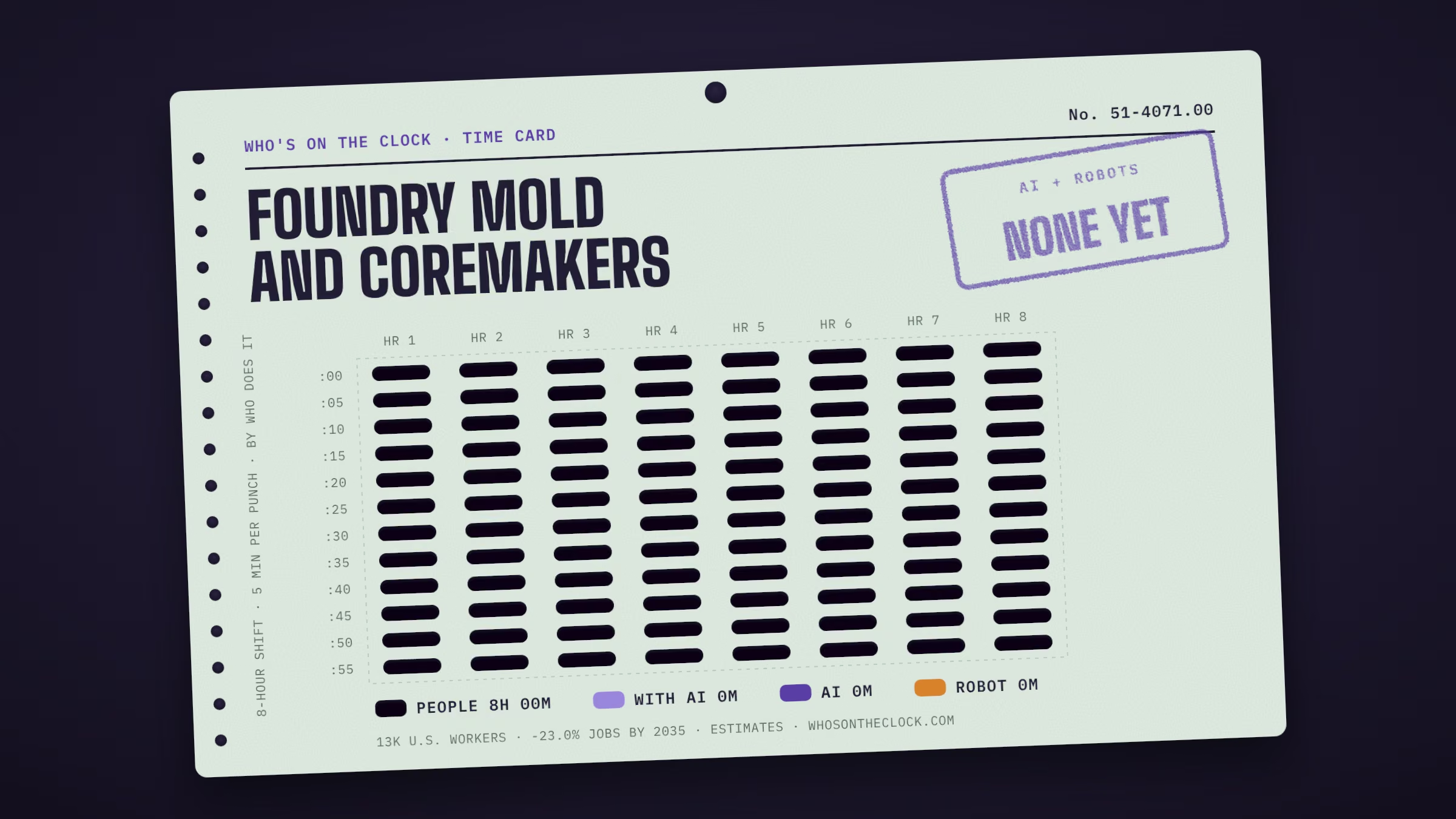
No AI use or robot deployment shows up yet for any of this job's tasks; the biggest part of the day, “Sift and pack sand into mold sections, core boxes”, is still entirely people's work. That's today's evidence, not a guarantee. BLS expects about 23% fewer of these jobs by 2035.

Time card for foundry mold and coremakers showing a typical 8-hour shift: 8h done by people.
Each mark is 5 minutes of a typical shift for foundry mold and coremakers, colored by who does that task today. Estimates from O*NET tasks and Anthropic Economic Index data. How it's made

Home / Production & factory / Foundry Mold and Coremakers

Make or form wax or sand cores or molds used in the production of metal castings in foundries.

Time card

Untick tasks you don't do, or set your own times.
MineTask, by time spentHumanWith AIAIRobot
Sift and pack sand into mold sections, core boxes, and pattern contours, using hand or pneumatic ramming tools.1h 51m a shift · Robots only in factory cells
Why this label?Robots have done this only in factory setups built around the machine, so it stays Human for foundry mold and coremakers. How labels work
Clean and smooth molds, cores, and core boxes, and repair surface imperfections.1h 2m a shift · Robots only in factory cells
Why this label?Robots have done this only in factory setups built around the machine, so it stays Human for foundry mold and coremakers. How labels work
Position patterns inside mold sections, and clamp sections together.49m a shift · Robots only in factory cells
Why this label?Robots have done this only in factory setups built around the machine, so it stays Human for foundry mold and coremakers. How labels work
Position cores into lower sections of molds, and reassemble molds for pouring.49m a shift · Robots only in factory cells
Why this label?Robots have done this only in factory setups built around the machine, so it stays Human for foundry mold and coremakers. How labels work
Move and position workpieces, such as mold sections, patterns, and bottom boards, using cranes, or signal others to move workpieces.43m a shift · Robots only in factory cells
Why this label?Robots have done this only in factory setups built around the machine, so it stays Human for foundry mold and coremakers. How labels work
Lift upper mold sections from lower sections, and remove molded patterns.37m a shift · Robots only in factory cells
Why this label?Robots have done this only in factory setups built around the machine, so it stays Human for foundry mold and coremakers. How labels work
Sprinkle or spray parting agents onto patterns and mold sections to facilitate removal of patterns from molds.25m a shift · Robots only in factory cells
Why this label?Robots have done this only in factory setups built around the machine, so it stays Human for foundry mold and coremakers. How labels work
Cut spouts, runner holes, and sprue holes into molds.25m a shift · Robots only in factory cells
Why this label?Robots have done this only in factory setups built around the machine, so it stays Human for foundry mold and coremakers. How labels work
Tend machines that bond cope and drag together to form completed shell molds.25m a shift · Robots only in factory cells
Why this label?Robots have done this only in factory setups built around the machine, so it stays Human for foundry mold and coremakers. How labels work
Form and assemble slab cores around patterns, and position wire in mold sections to reinforce molds, using hand tools and glue.18m a shift · Robots only in factory cells
Why this label?Robots have done this only in factory setups built around the machine, so it stays Human for foundry mold and coremakers. How labels work
Pour molten metal into molds, manually or with crane ladles.18m a shift · Robots only in factory cells
Why this label?Robots have done this only in factory setups built around the machine, so it stays Human for foundry mold and coremakers. How labels work
Operate ovens or furnaces to bake cores or to melt, skim, and flux metal.12m a shift · Robots only in factory cells
Why this label?Robots have done this only in factory setups built around the machine, so it stays Human for foundry mold and coremakers. How labels work
Rotate sweep boards around spindles to make symmetrical molds for convex impressions.6m a shift · Robots only in factory cells
Why this label?Robots have done this only in factory setups built around the machine, so it stays Human for foundry mold and coremakers. How labels work

Clock history

  1. 0m touchedFirst published: O*NET 30.1, Anthropic Economic Index (2025 usage and September 2026 robot study), BLS May 2025

When new data changes this clock, the date, the new numbers and the reason are logged here. Company news alone never moves the clock.

On the floor

No company news tracked for this job yet. New stories are added as they happen.

Ask the clock

Will AI replace foundry mold and coremakers?

Not on current evidence. Less than 30 minutes of a typical shift goes to tasks that AI or robots are doing today. The other 8h (100%) stays with people. Separately, BLS expects about 23% fewer of these jobs by 2035 (all jobs: +3.5%).

What can AI already do for foundry mold and coremakers?

None of this job's tasks show regular AI use yet. That can mean the work is hands-on or in person, or simply that it rarely comes up in AI usage data.

Where do robots fit in?

Not in workplaces like this one, based on a 2026 review of robot deployments. 13 more tasks have only been done in factory setups built around the machine, so they stay with people here.

What still needs a person?

8h of a typical shift, or 100%, goes to tasks with no AI or robot evidence yet. No AI usage or robot deployment has shown up for these so far. The biggest:

  • Sift and pack sand into mold sections, core boxes, and pattern contours, using hand or pneumatic ramming tools. (1h 51m a shift)
  • Clean and smooth molds, cores, and core boxes, and repair surface imperfections. (1h 2m a shift)
  • Position patterns inside mold sections, and clamp sections together. (49m a shift)
  • Position cores into lower sections of molds, and reassemble molds for pouring. (49m a shift)
  • Move and position workpieces, such as mold sections, patterns, and bottom boards, using cranes, or signal others to move workpieces. (43m a shift)
Why is that work hard to automate?

Much of it comes down to where and how the work happens. In-person, hands-on and high-stakes work is where AI and robots have made the least headway so far. In the official O*NET survey of people in this job:

  • 97% work in very hot or cold conditions at least weekly
  • 90% spend more than half the day on their feet
  • 83% use their hands on tools, objects or controls more than half the time
Are employers still hiring foundry mold and coremakers?

On Indeed, job postings in the Production & Manufacturing sector are at 124% of their February 2020 level (all U.S. postings: 104%), up 12.6% from a year earlier, as of Oct 9, 2026. BLS separately expects about 800 openings a year in this job through 2035. Across all U.S. postings, 7.3% now mention AI skills. Sector postings cover more than this one job and move for many reasons besides AI.

How much do foundry mold and coremakers make?

The median pay is about $48,110 a year ($23.13 an hour), 6% below the median for all U.S. jobs ($50,980). Most people in this job earn between $37,160 and $62,640 a year; that range covers the middle 80%. Pay figures are from BLS, May 2025, and vary a lot by state and employer. Pick a state to compare:

Is this job growing or shrinking?

BLS projects a decline of 23% from 2025 to 2035, compared with 3.5% growth for all jobs. That's about 9,800 jobs in 2035. Even so, it expects about 800 openings a year, mostly from people retiring or changing careers. These projections don't single out AI as a cause.

How many foundry mold and coremakers are there in the U.S.?

About 13,000 people in the U.S., roughly 0.01% of all workers (BLS, May 2025). That makes it the 628th largest of the 796 jobs on this site. BLS expects about 9,800 in 2035.

What training do foundry mold and coremakers need?

The most common requirement is a high school diploma: about 64% of people in the job said so in the official O*NET survey. O*NET rates the job at level 2 of 5 for preparation, which usually means: high school diploma, some training. Requirements vary by state and employer, especially for licensed work.

What should I learn to stay ahead of AI?

These come from the job's official skill ratings and from the tasks that AI and robots touch least today. Building them keeps you strong in the parts of the work that still need a person:

  • Skills that matter more here than in most jobs: Operations Monitoring, Monitoring
  • Get strong at the parts of the job that stay with people (listed above), which take 8h of a typical shift
  • Tools employers list: Autodesk AutoCAD, Dassault Systemes SolidWorks
What other jobs could foundry mold and coremakers move into?

These use similar skills. Matches come from 109 official ratings of skills, knowledge and work activities, and each needs the same or less preparation unless the official list relates the jobs directly:

  • Quarry Rock Splitters (0m touched, $49k median pay)
  • Coil Winders, Tapers, and Finishers (18m touched, $48k median pay)
  • Welders, Cutters, Solderers, and Brazers (29m touched, $54k median pay)
  • Molders, Shapers, and Casters (6m touched, $46k median pay)
  • Textile Winding, Twisting, and Drawing Out Machine Setters, Operators, and Tenders (3h 43m touched, $39k median pay)
How solid are these numbers?

Each task carries its own evidence label. For this job: 13 with no AI or robot evidence found. The minutes per task are estimates, not measured hours, and "no evidence" doesn't prove a task is safe.

Tools in demand

  • Autodesk AutoCAD
  • Dassault Systemes SolidWorks

Also called

Airset Caster, Airset Molder, Bond Runner, Core Baker, Core Drier, Core Machine Operator, Core Maker, Core Microarchitect, Core Oven Tender, Core Paster, Core Piler, Core Rescuer, Core Setter, Core Stacker