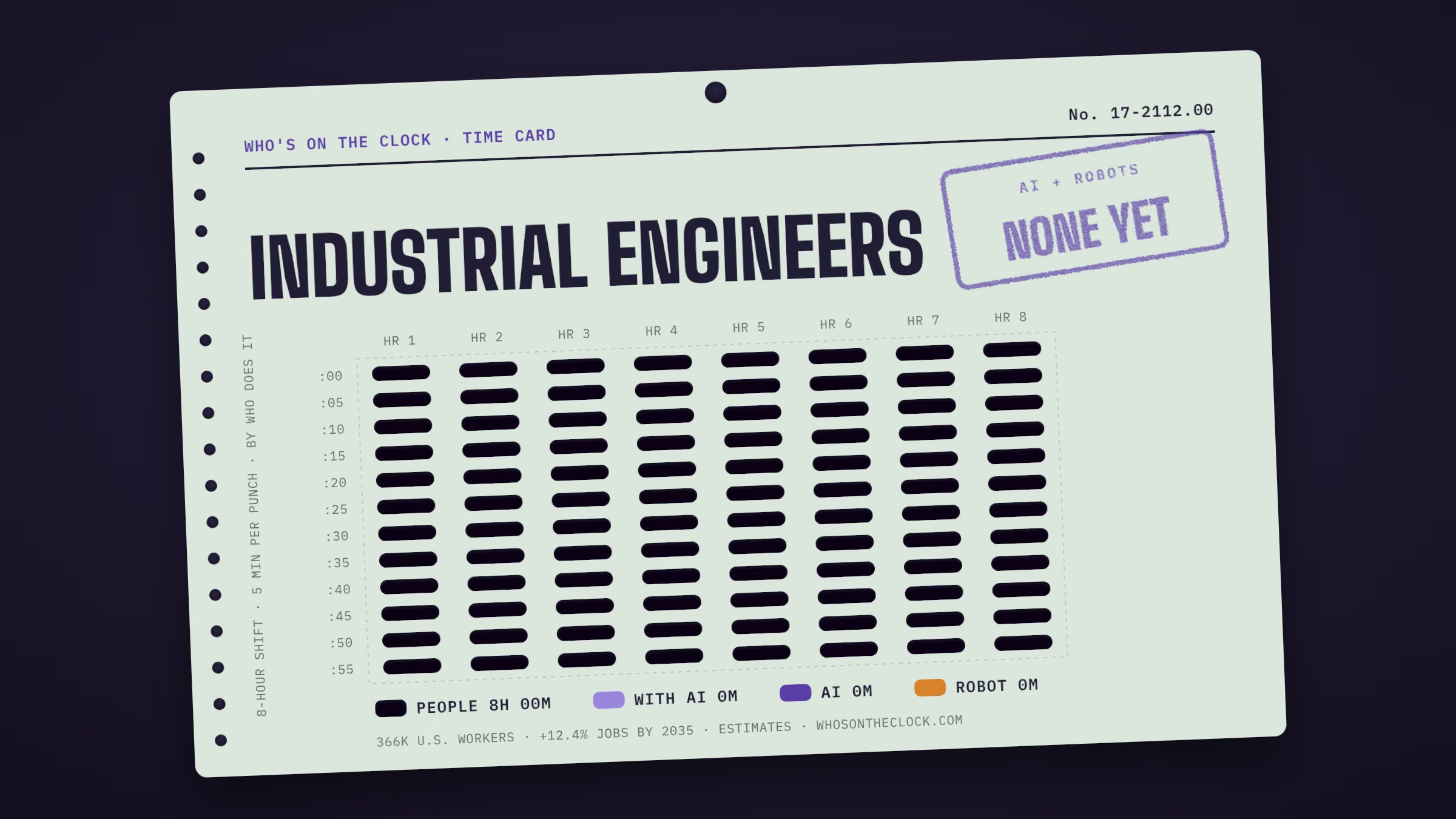
Design, develop, test, and evaluate integrated systems for managing industrial production processes, including human work factors, quality control, inventory control, logistics and material flow, cost analysis, and production coordination.
Time card
Untick tasks you don't do, or set your own times.
| Mine | Task, by time spent | Human | With AI | AI | Robot |
|---|---|---|---|---|---|
Confer with clients, vendors, staff, and management personnel regarding purchases, product and production specifications, manufacturing capabilities, or project status.56m a shift · No AI or robot evidence foundWhy this label?No AI use or robot deployment showed up for this task in our data. That isn't proof it's safe; it may just be rare in the data. How labels work | |||||
Estimate production costs, cost saving methods, and the effects of product design changes on expenditures for management review, action, and control.34m a shift · No AI or robot evidence foundWhy this label?No AI use or robot deployment showed up for this task in our data. That isn't proof it's safe; it may just be rare in the data. How labels work | |||||
Develop manufacturing methods, labor utilization standards, and cost analysis systems to promote efficient staff and facility utilization.34m a shift · No AI or robot evidence foundWhy this label?No AI use or robot deployment showed up for this task in our data. That isn't proof it's safe; it may just be rare in the data. How labels work | |||||
Plan and establish sequence of operations to fabricate and assemble parts or products and to promote efficient utilization.28m a shift · No AI or robot evidence foundWhy this label?No AI use or robot deployment showed up for this task in our data. That isn't proof it's safe; it may just be rare in the data. How labels work | |||||
Analyze statistical data and product specifications to determine standards and establish quality and reliability objectives of finished product.28m a shift · No AI or robot evidence foundWhy this label?No AI use or robot deployment showed up for this task in our data. That isn't proof it's safe; it may just be rare in the data. How labels work | |||||
Recommend methods for improving utilization of personnel, material, and utilities.28m a shift · No AI or robot evidence foundWhy this label?No AI use or robot deployment showed up for this task in our data. That isn't proof it's safe; it may just be rare in the data. How labels work | |||||
Draft and design layout of equipment, materials, and workspace to illustrate maximum efficiency using drafting tools and computer.28m a shift · No AI or robot evidence foundWhy this label?No AI use or robot deployment showed up for this task in our data. That isn't proof it's safe; it may just be rare in the data. How labels work | |||||
Review production schedules, engineering specifications, orders, and related information to obtain knowledge of manufacturing methods, procedures, and activities.28m a shift · No AI or robot evidence foundWhy this label?No AI use or robot deployment showed up for this task in our data. That isn't proof it's safe; it may just be rare in the data. How labels work | |||||
Coordinate and implement quality control objectives, activities, or procedures to resolve production problems, maximize product reliability, or minimize costs.28m a shift · No AI or robot evidence foundWhy this label?No AI use or robot deployment showed up for this task in our data. That isn't proof it's safe; it may just be rare in the data. How labels work | |||||
Apply statistical methods and perform mathematical calculations to determine manufacturing processes, staff requirements, and production standards.28m a shift · No AI or robot evidence foundWhy this label?No AI use or robot deployment showed up for this task in our data. That isn't proof it's safe; it may just be rare in the data. How labels work | |||||
Communicate with management and user personnel to develop production and design standards.23m a shift · No AI or robot evidence foundWhy this label?No AI use or robot deployment showed up for this task in our data. That isn't proof it's safe; it may just be rare in the data. How labels work | |||||
Record or oversee recording of information to ensure currency of engineering drawings and documentation of production problems.23m a shift · No AI or robot evidence foundWhy this label?No AI use or robot deployment showed up for this task in our data. That isn't proof it's safe; it may just be rare in the data. How labels work | |||||
Complete production reports, purchase orders, and material, tool, and equipment lists.23m a shift · No AI or robot evidence foundWhy this label?No AI use or robot deployment showed up for this task in our data. That isn't proof it's safe; it may just be rare in the data. How labels work | |||||
Study operations sequence, material flow, functional statements, organization charts, and project information to determine worker functions and responsibilities.23m a shift · No AI or robot evidence foundWhy this label?No AI use or robot deployment showed up for this task in our data. That isn't proof it's safe; it may just be rare in the data. How labels work | |||||
Evaluate precision and accuracy of production and testing equipment and engineering drawings to formulate corrective action plan.17m a shift · No AI or robot evidence foundWhy this label?No AI use or robot deployment showed up for this task in our data. That isn't proof it's safe; it may just be rare in the data. How labels work | |||||
Direct workers engaged in product measurement, inspection, and testing activities to ensure quality control and reliability.11m a shift · No AI or robot evidence foundWhy this label?No AI use or robot deployment showed up for this task in our data. That isn't proof it's safe; it may just be rare in the data. How labels work | |||||
Implement methods and procedures for disposition of discrepant material and defective or damaged parts, and assess cost and responsibility.11m a shift · No AI or robot evidence foundWhy this label?No AI use or robot deployment showed up for this task in our data. That isn't proof it's safe; it may just be rare in the data. How labels work | |||||
Formulate sampling procedures and designs and develop forms and instructions for recording, evaluating, and reporting quality and reliability data.11m a shift · No AI or robot evidence foundWhy this label?No AI use or robot deployment showed up for this task in our data. That isn't proof it's safe; it may just be rare in the data. How labels work | |||||
Regulate and alter workflow schedules according to established manufacturing sequences and lead times to expedite production operations.11m a shift · No AI or robot evidence foundWhy this label?No AI use or robot deployment showed up for this task in our data. That isn't proof it's safe; it may just be rare in the data. How labels work | |||||
Schedule deliveries based on production forecasts, material substitutions, storage and handling facilities, and maintenance requirements.6m a shift · No AI or robot evidence foundWhy this label?No AI use or robot deployment showed up for this task in our data. That isn't proof it's safe; it may just be rare in the data. How labels work |