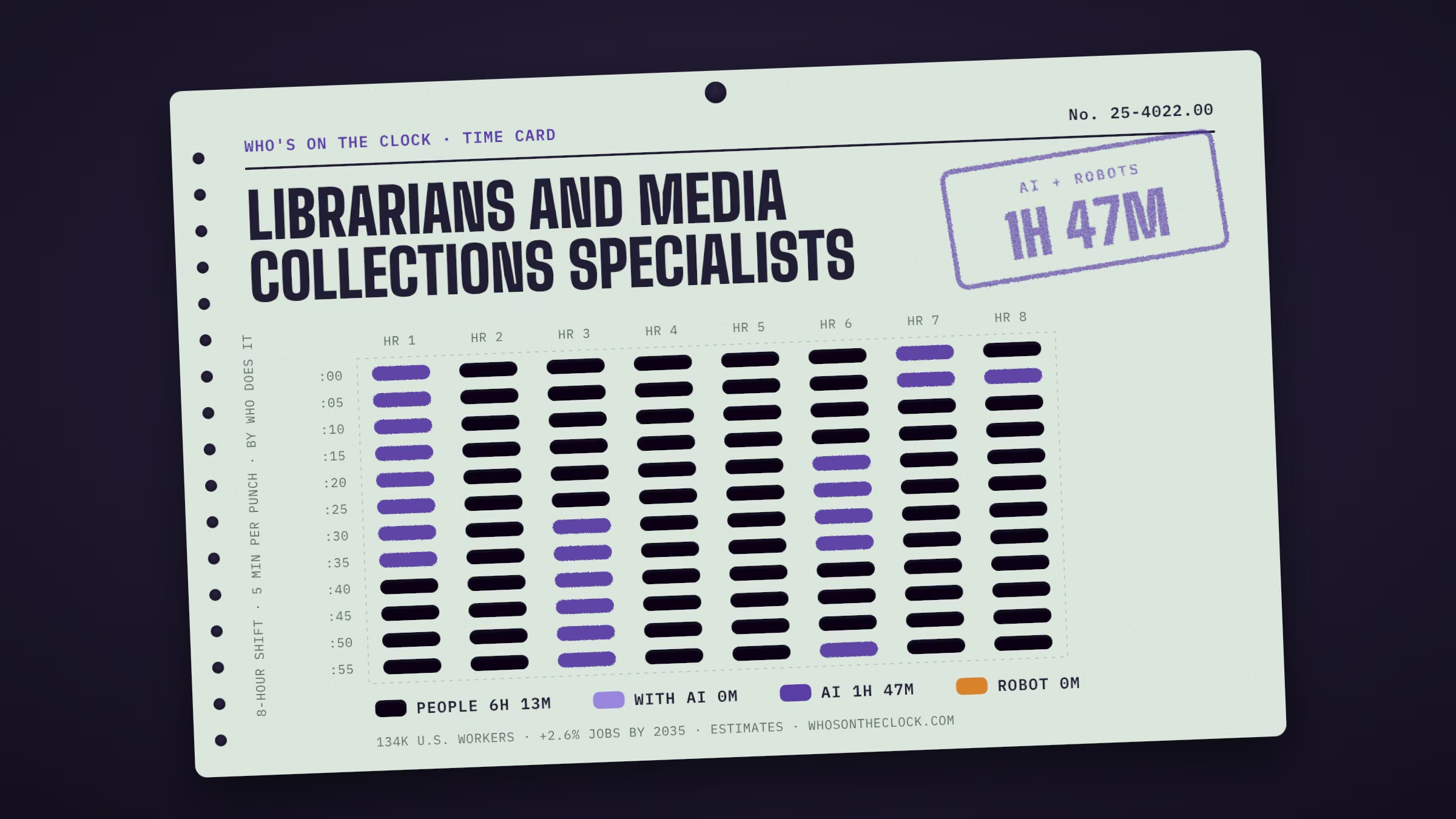
Administer and maintain libraries or collections of information, for public or private access through reference or borrowing. Work in a variety of settings, such as educational institutions, museums, and corporations, and with various types of informational materials, such as books, periodicals, recordings, films, and databases. Tasks may include acquiring, cataloging, and circulating library materials, and user services such as locating and organizing information, providing instruction on how to access information, and setting up and operating a library's media equipment.
Time card
Untick tasks you don't do, or set your own times.
| Mine | Task, by time spent | Human | With AI | AI | Robot |
|---|---|---|---|---|---|
Analyze patrons' requests to determine needed information and assist in furnishing or locating that information.38m a shift · Observed in AI useWhy this label?Marked AI because this task shows up regularly in real AI conversations (Anthropic Economic Index, 2025 usage), and in most of them AI does the task on its own rather than helping a person. Many workplaces may not use AI for it at all. How labels work | |||||
Supervise daily library operations, budgeting, planning, and personnel activities, such as hiring, training, scheduling, and performance evaluations.38m a shift · No AI or robot evidence foundWhy this label?No AI use or robot deployment showed up for this task in our data. That isn't proof it's safe; it may just be rare in the data. How labels work | |||||
Plan and teach classes on topics such as information literacy, library instruction, and technology use.38m a shift · No AI or robot evidence foundWhy this label?No AI use or robot deployment showed up for this task in our data. That isn't proof it's safe; it may just be rare in the data. How labels work | |||||
Review and evaluate materials, using book reviews, catalogs, faculty recommendations, and current holdings to select and order print, audio-visual, and electronic resources.32m a shift · No AI or robot evidence foundWhy this label?No AI use or robot deployment showed up for this task in our data. That isn't proof it's safe; it may just be rare in the data. How labels work | |||||
Search standard reference materials, including online sources and the Internet, to answer patrons' reference questions.32m a shift · Observed in AI useTypical AI request: about 2h 5m alone, 18m with AIWhy this label?Marked AI because this task shows up regularly in real AI conversations (Anthropic Economic Index, 2025 usage), and in most of them AI does the task on its own rather than helping a person. Many workplaces may not use AI for it at all. How labels work | |||||
Plan and deliver client-centered programs and services, such as special services for corporate clients, storytelling for children, newsletters, or programs for special groups.32m a shift · No AI or robot evidence foundWhy this label?No AI use or robot deployment showed up for this task in our data. That isn't proof it's safe; it may just be rare in the data. How labels work | |||||
Confer with colleagues, faculty, and community members and organizations to conduct informational programs, make collection decisions, and determine library services to offer.25m a shift · No AI or robot evidence foundWhy this label?No AI use or robot deployment showed up for this task in our data. That isn't proof it's safe; it may just be rare in the data. How labels work | |||||
Code, classify, and catalog books, publications, films, audio-visual aids, and other library materials, based on subject matter or standard library classification systems.25m a shift · No AI or robot evidence foundWhy this label?No AI use or robot deployment showed up for this task in our data. That isn't proof it's safe; it may just be rare in the data. How labels work | |||||
Check books in and out of the library.19m a shift · Robots only in factory cellsWhy this label?Robots have done this only in factory setups built around the machine, so it stays Human for librarians and media collections specialists. How labels work | |||||
Keep up-to-date records of circulation and materials, maintain inventory, and correct cataloging errors.19m a shift · No AI or robot evidence foundWhy this label?No AI use or robot deployment showed up for this task in our data. That isn't proof it's safe; it may just be rare in the data. How labels work | |||||
Explain use of library facilities, resources, equipment, and services, and provide information about library policies.19m a shift · No AI or robot evidence foundWhy this label?No AI use or robot deployment showed up for this task in our data. That isn't proof it's safe; it may just be rare in the data. How labels work | |||||
Develop, maintain, and troubleshoot information access aids, such as databases, annotated bibliographies, Web pages, electronic pathfinders, software programs, and online tutorials.19m a shift · Observed in AI useWhy this label?Marked AI because this task shows up regularly in real AI conversations (Anthropic Economic Index, 2025 usage), and in most of them AI does the task on its own rather than helping a person. Many workplaces may not use AI for it at all. How labels work | |||||
Teach library patrons basic computer skills, such as searching computerized databases.13m a shift · No AI or robot evidence foundWhy this label?No AI use or robot deployment showed up for this task in our data. That isn't proof it's safe; it may just be rare in the data. How labels work | |||||
Locate unusual or unique information in response to specific requests.13m a shift · Observed in AI useTypical AI request: about 4h 40m alone, 31m with AIWhy this label?Marked AI because this task shows up regularly in real AI conversations (Anthropic Economic Index, 2025 usage), and in most of them AI does the task on its own rather than helping a person. Many workplaces may not use AI for it at all. How labels work | |||||
Evaluate materials to determine outdated or unused items to be discarded.13m a shift · No AI or robot evidence foundWhy this label?No AI use or robot deployment showed up for this task in our data. That isn't proof it's safe; it may just be rare in the data. How labels work | |||||
Direct and train library staff in duties, such as receiving, shelving, researching, cataloging, and equipment use.13m a shift · No AI or robot evidence foundWhy this label?No AI use or robot deployment showed up for this task in our data. That isn't proof it's safe; it may just be rare in the data. How labels work | |||||
Engage in professional development activities, such as taking continuing education classes and attending or participating in conferences, workshops, professional meetings, and associations.13m a shift · No AI or robot evidence foundWhy this label?No AI use or robot deployment showed up for this task in our data. That isn't proof it's safe; it may just be rare in the data. How labels work | |||||
Represent library or institution on internal and external committees.13m a shift · No AI or robot evidence foundWhy this label?No AI use or robot deployment showed up for this task in our data. That isn't proof it's safe; it may just be rare in the data. How labels work | |||||
Respond to customer complaints, taking action as necessary.6m a shift · Observed in AI useWhy this label?Marked AI because this task shows up regularly in real AI conversations (Anthropic Economic Index, 2025 usage), and in most of them AI does the task on its own rather than helping a person. Many workplaces may not use AI for it at all. How labels work | |||||
Troubleshoot problems with audio-visual equipment.6m a shift · No AI or robot evidence foundWhy this label?This is physical work, and no robot has been shown doing it yet. How labels work | |||||
Develop library policies and procedures.6m a shift · No AI or robot evidence foundWhy this label?No AI use or robot deployment showed up for this task in our data. That isn't proof it's safe; it may just be rare in the data. How labels work | |||||
Compile lists of books, periodicals, articles, and audio-visual materials on particular subjects.6m a shift · No AI or robot evidence foundWhy this label?No AI use or robot deployment showed up for this task in our data. That isn't proof it's safe; it may just be rare in the data. How labels work | |||||
Confer with teachers to select course materials and to determine which training aids are best suited to particular grade levels.6m a shift · No AI or robot evidence foundWhy this label?No AI use or robot deployment showed up for this task in our data. That isn't proof it's safe; it may just be rare in the data. How labels work | |||||
Evaluate vendor products and performance, negotiate contracts, and place orders.6m a shift · No AI or robot evidence foundWhy this label?No AI use or robot deployment showed up for this task in our data. That isn't proof it's safe; it may just be rare in the data. How labels work | |||||
Arrange for interlibrary loans of materials not available in a particular library.6m a shift · No AI or robot evidence foundWhy this label?No AI use or robot deployment showed up for this task in our data. That isn't proof it's safe; it may just be rare in the data. How labels work | |||||
Set up, adjust, and operate audio-visual equipment, such as cameras, film and slide projectors, and recording equipment, for meetings, events, classes, seminars, and video conferences.6m a shift · No AI or robot evidence foundWhy this label?This is physical work, and no robot has been shown doing it yet. How labels work | |||||
Assemble and arrange display materials.6m a shift · Robots only in factory cellsWhy this label?Robots have done this only in factory setups built around the machine, so it stays Human for librarians and media collections specialists. How labels work | |||||
Maintain hardware and software, including computers, media equipment, scanners, color copiers, and color laser printers.6m a shift · No AI or robot evidence foundWhy this label?This is physical work, and no robot has been shown doing it yet. How labels work | |||||
Train faculty and media staff on the use of software and audio-visual equipment.6m a shift · No AI or robot evidence foundWhy this label?No AI use or robot deployment showed up for this task in our data. That isn't proof it's safe; it may just be rare in the data. How labels work | |||||
Maintain inventory of audio-visual equipment.time not estimated · Robots only in factory cellsWhy this label?Robots have done this only in factory setups built around the machine, so it stays Human for librarians and media collections specialists. How labels work |