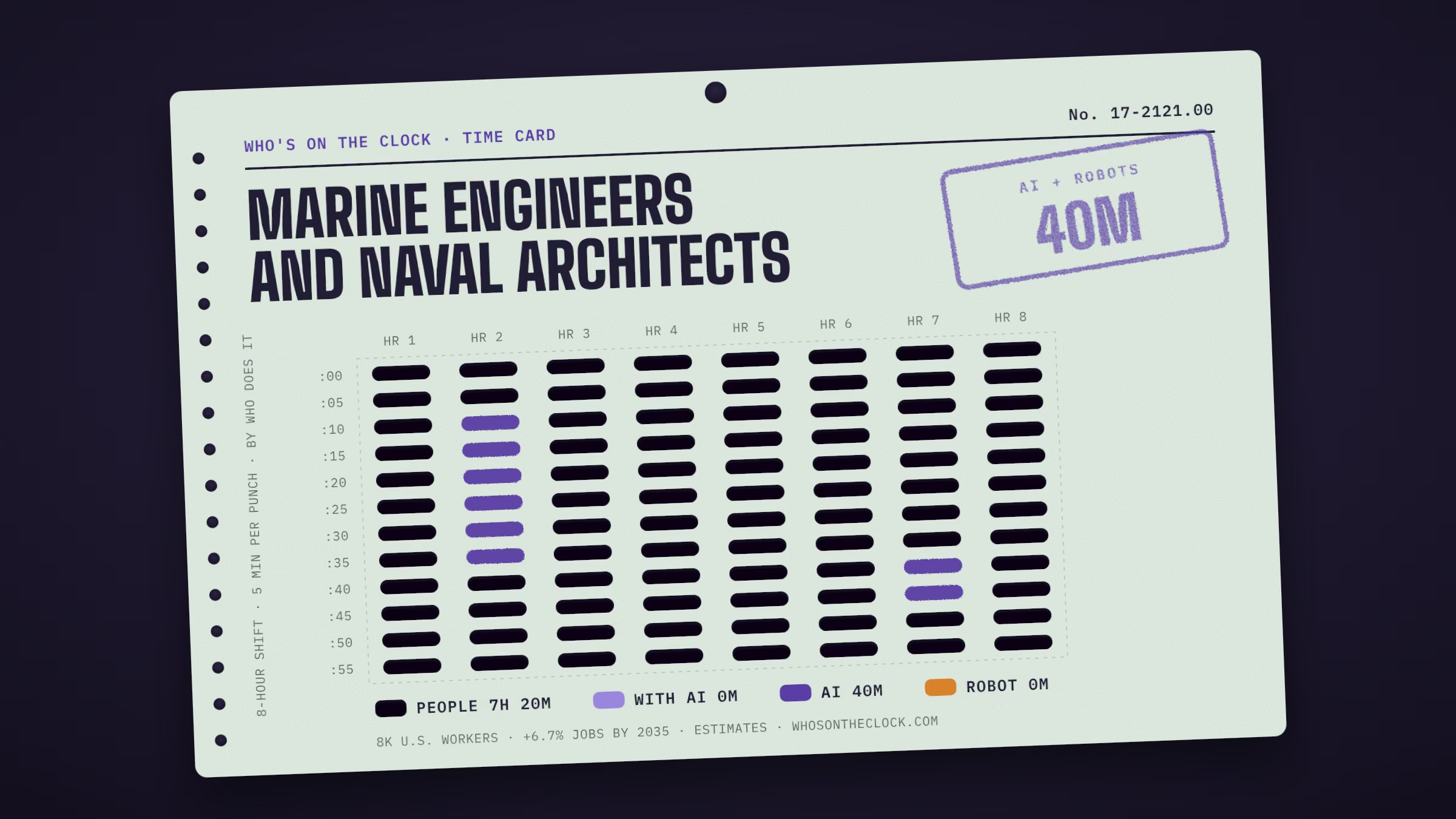
Design, develop, and evaluate the operation of marine vessels, ship machinery, and related equipment, such as power supply and propulsion systems.
Time card
Untick tasks you don't do, or set your own times.
| Mine | Task, by time spent | Human | With AI | AI | Robot |
|---|---|---|---|---|---|
Prepare, or direct the preparation of, product or system layouts and detailed drawings and schematics.40m a shift · No AI or robot evidence foundWhy this label?No AI use or robot deployment showed up for this task in our data. That isn't proof it's safe; it may just be rare in the data. How labels work | |||||
Conduct analyses of ships, such as stability, structural, weight, and vibration analyses.29m a shift · No AI or robot evidence foundWhy this label?No AI use or robot deployment showed up for this task in our data. That isn't proof it's safe; it may just be rare in the data. How labels work | |||||
Prepare plans, estimates, design and construction schedules, and contract specifications, including any special provisions.29m a shift · Observed in AI useTypical AI request: about 6h 17m alone, 34m with AIWhy this label?Marked AI because this task shows up regularly in real AI conversations (Anthropic Economic Index, 2025 usage), and in most of them AI does the task on its own rather than helping a person. Many workplaces may not use AI for it at all. How labels work | |||||
Design complete hull and superstructure according to specifications and test data, in conformity with standards of safety, efficiency, and economy.23m a shift · No AI or robot evidence foundWhy this label?No AI use or robot deployment showed up for this task in our data. That isn't proof it's safe; it may just be rare in the data. How labels work | |||||
Study design proposals and specifications to establish basic characteristics of craft, such as size, weight, speed, propulsion, displacement, and draft.23m a shift · No AI or robot evidence foundWhy this label?No AI use or robot deployment showed up for this task in our data. That isn't proof it's safe; it may just be rare in the data. How labels work | |||||
Maintain contact with, and formulate reports for, contractors and clients to ensure completion of work at minimum cost.23m a shift · No AI or robot evidence foundWhy this label?No AI use or robot deployment showed up for this task in our data. That isn't proof it's safe; it may just be rare in the data. How labels work | |||||
Prepare technical reports for use by engineering, management, or sales personnel.23m a shift · No AI or robot evidence foundWhy this label?No AI use or robot deployment showed up for this task in our data. That isn't proof it's safe; it may just be rare in the data. How labels work | |||||
Conduct analytical, environmental, operational, or performance studies to develop designs for products, such as marine engines, equipment, and structures.23m a shift · No AI or robot evidence foundWhy this label?No AI use or robot deployment showed up for this task in our data. That isn't proof it's safe; it may just be rare in the data. How labels work | |||||
Design and oversee testing, installation, and repair of marine apparatus and equipment.23m a shift · No AI or robot evidence foundWhy this label?No AI use or robot deployment showed up for this task in our data. That isn't proof it's safe; it may just be rare in the data. How labels work | |||||
Inspect marine equipment and machinery to draw up work requests and job specifications.17m a shift · No AI or robot evidence foundWhy this label?This is physical work, and no robot has been shown doing it yet. How labels work | |||||
Establish arrangement of boiler room equipment and propulsion machinery, heating and ventilating systems, refrigeration equipment, piping, and other functional equipment.17m a shift · No AI or robot evidence foundWhy this label?No AI use or robot deployment showed up for this task in our data. That isn't proof it's safe; it may just be rare in the data. How labels work | |||||
Supervise other engineers and crew members and train them for routine and emergency duties.17m a shift · No AI or robot evidence foundWhy this label?No AI use or robot deployment showed up for this task in our data. That isn't proof it's safe; it may just be rare in the data. How labels work | |||||
Maintain records of engineering department activities, including expense records and details of equipment maintenance and repairs.17m a shift · No AI or robot evidence foundWhy this label?No AI use or robot deployment showed up for this task in our data. That isn't proof it's safe; it may just be rare in the data. How labels work | |||||
Maintain and coordinate repair of marine machinery and equipment for installation on vessels.17m a shift · No AI or robot evidence foundWhy this label?No AI use or robot deployment showed up for this task in our data. That isn't proof it's safe; it may just be rare in the data. How labels work | |||||
Perform monitoring activities to ensure that ships comply with international regulations and standards for life-saving equipment and pollution preventatives.11m a shift · No AI or robot evidence foundWhy this label?This is physical work, and no robot has been shown doing it yet. How labels work | |||||
Coordinate activities with regulatory bodies to ensure repairs and alterations are at minimum cost and consistent with safety.11m a shift · No AI or robot evidence foundWhy this label?No AI use or robot deployment showed up for this task in our data. That isn't proof it's safe; it may just be rare in the data. How labels work | |||||
Design layout of craft interior, including cargo space, passenger compartments, ladder wells, and elevators.11m a shift · No AI or robot evidence foundWhy this label?No AI use or robot deployment showed up for this task in our data. That isn't proof it's safe; it may just be rare in the data. How labels work | |||||
Evaluate performance of craft during dock and sea trials to determine design changes and conformance with national and international standards.11m a shift · No AI or robot evidence foundWhy this label?No AI use or robot deployment showed up for this task in our data. That isn't proof it's safe; it may just be rare in the data. How labels work | |||||
Investigate and observe tests on machinery and equipment for compliance with standards.11m a shift · No AI or robot evidence foundWhy this label?No AI use or robot deployment showed up for this task in our data. That isn't proof it's safe; it may just be rare in the data. How labels work | |||||
Conduct environmental, operational, or performance tests on marine machinery and equipment.11m a shift · No AI or robot evidence foundWhy this label?No AI use or robot deployment showed up for this task in our data. That isn't proof it's safe; it may just be rare in the data. How labels work | |||||
Analyze data to determine feasibility of product proposals.11m a shift · Observed in AI useTypical AI request: about 4h 32m alone, 1h 6m with AIWhy this label?Marked AI because this task shows up regularly in real AI conversations (Anthropic Economic Index, 2025 usage), and in most of them AI does the task on its own rather than helping a person. Many workplaces may not use AI for it at all. How labels work | |||||
Confer with research personnel to clarify or resolve problems and to develop or modify designs.11m a shift · No AI or robot evidence foundWhy this label?No AI use or robot deployment showed up for this task in our data. That isn't proof it's safe; it may just be rare in the data. How labels work | |||||
Review work requests and compare them with previous work completed on ships to ensure that costs are economically sound.11m a shift · No AI or robot evidence foundWhy this label?No AI use or robot deployment showed up for this task in our data. That isn't proof it's safe; it may just be rare in the data. How labels work | |||||
Act as liaisons between ships' captains and shore personnel to ensure that schedules and budgets are maintained, and that ships are operated safely and efficiently.11m a shift · No AI or robot evidence foundWhy this label?No AI use or robot deployment showed up for this task in our data. That isn't proof it's safe; it may just be rare in the data. How labels work | |||||
Procure materials needed to repair marine equipment and machinery.11m a shift · No AI or robot evidence foundWhy this label?No AI use or robot deployment showed up for this task in our data. That isn't proof it's safe; it may just be rare in the data. How labels work | |||||
Schedule machine overhauls and the servicing of electrical, heating, ventilation, refrigeration, water, and sewage systems.11m a shift · No AI or robot evidence foundWhy this label?No AI use or robot deployment showed up for this task in our data. That isn't proof it's safe; it may just be rare in the data. How labels work | |||||
Check, test, and maintain automatic controls and alarm systems.6m a shift · No AI or robot evidence foundWhy this label?This is physical work, and no robot has been shown doing it yet. How labels work | |||||
Evaluate operation of marine equipment during acceptance testing and shakedown cruises.6m a shift · No AI or robot evidence foundWhy this label?This is physical work, and no robot has been shown doing it yet. How labels work | |||||
Determine conditions under which tests are to be conducted, as well as sequences and phases of test operations.6m a shift · No AI or robot evidence foundWhy this label?No AI use or robot deployment showed up for this task in our data. That isn't proof it's safe; it may just be rare in the data. How labels work | |||||
Oversee construction and testing of prototype in model basin and develop sectional and waterline curves of hull to establish center of gravity, ideal hull form, and buoyancy and stability data.6m a shift · No AI or robot evidence foundWhy this label?No AI use or robot deployment showed up for this task in our data. That isn't proof it's safe; it may just be rare in the data. How labels work |