Will AI replace medical assistants?

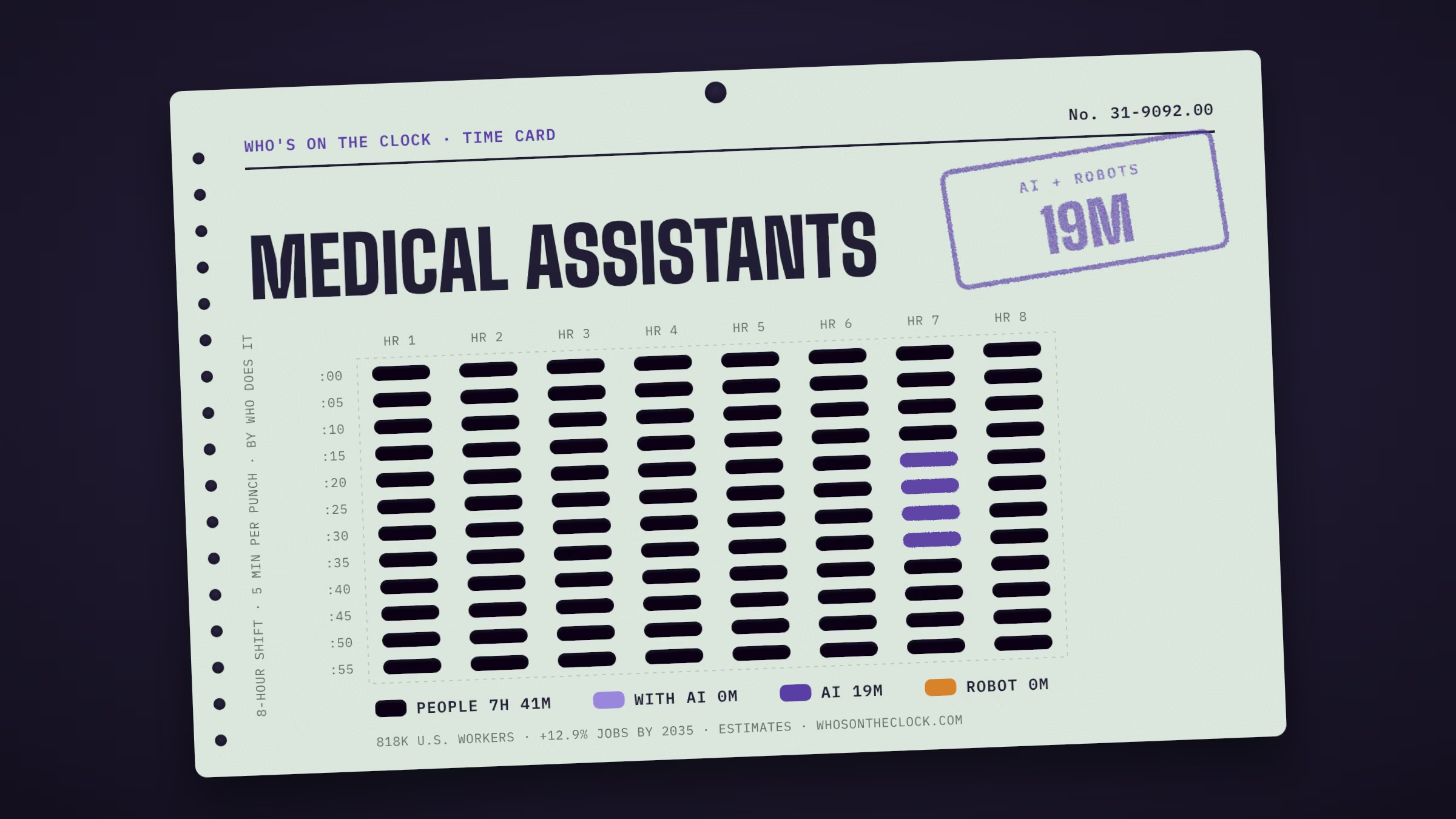
AI already handles some of this work on its own in real use, for tasks like “Schedule appointments for patients”. That's 19m of a typical shift; 7h 41m still has no AI or robot evidence. BLS expects about 12.9% more of these jobs by 2035.

Time card for medical assistants showing a typical 8-hour shift: 7h 41m done by people, 19m by AI.
Each mark is 5 minutes of a typical shift for medical assistants, colored by who does that task today. Estimates from O*NET tasks and Anthropic Economic Index data. How it's made

Home / Healthcare support / Medical Assistants

Perform administrative and certain clinical duties under the direction of a physician. Administrative duties may include scheduling appointments, maintaining medical records, billing, and coding information for insurance purposes. Clinical duties may include taking and recording vital signs and medical histories, preparing patients for examination, drawing blood, and administering medications as directed by physician.

Time card

Untick tasks you don't do, or set your own times.
MineTask, by time spentHumanWith AIAIRobot
Interview patients to obtain medical information and measure their vital signs, weight, and height.1h 17m a shift · Robots only in factory cells
Why this label?Robots have done this only in factory setups built around the machine, so it stays Human for medical assistants. How labels work
Record patients' medical history, vital statistics, or information such as test results in medical records.58m a shift · No AI or robot evidence found
Why this label?No AI use or robot deployment showed up for this task in our data. That isn't proof it's safe; it may just be rare in the data. How labels work
Help physicians examine and treat patients, handing them instruments or materials or performing such tasks as giving injections or removing sutures.38m a shift · No AI or robot evidence found
Why this label?This is physical work, and no robot has been shown doing it yet. How labels work
Prepare treatment rooms for patient examinations, keeping the rooms neat and clean.32m a shift · No AI or robot evidence found
Why this label?This is physical work, and no robot has been shown doing it yet. How labels work
Collect blood, tissue, or other laboratory specimens, log the specimens, and prepare them for testing.32m a shift · Robots only in factory cells
Why this label?Robots have done this only in factory setups built around the machine, so it stays Human for medical assistants. How labels work
Perform general office duties, such as answering telephones, taking dictation, or completing insurance forms.32m a shift · No AI or robot evidence found
Why this label?No AI use or robot deployment showed up for this task in our data. That isn't proof it's safe; it may just be rare in the data. How labels work
Clean and sterilize instruments and dispose of contaminated supplies.26m a shift · Robots only in factory cells
Why this label?Robots have done this only in factory setups built around the machine, so it stays Human for medical assistants. How labels work
Explain treatment procedures, medications, diets, or physicians' instructions to patients.26m a shift · No AI or robot evidence found
Why this label?No AI use or robot deployment showed up for this task in our data. That isn't proof it's safe; it may just be rare in the data. How labels work
Show patients to examination rooms and prepare them for the physician.26m a shift · No AI or robot evidence found
Why this label?This is physical work, and no robot has been shown doing it yet. How labels work
Greet and log in patients arriving at office or clinic.19m a shift · No AI or robot evidence found
Why this label?No AI use or robot deployment showed up for this task in our data. That isn't proof it's safe; it may just be rare in the data. How labels work
Prepare and administer medications as directed by a physician.19m a shift · Robots only in factory cells
Why this label?Robots have done this only in factory setups built around the machine, so it stays Human for medical assistants. How labels work
Schedule appointments for patients.19m a shift · Observed in AI useTypical AI request: about 53m alone, 28m with AI
Why this label?Marked AI because this task shows up regularly in real AI conversations (Anthropic Economic Index, 2025 usage), and in most of them AI does the task on its own rather than helping a person. Many workplaces may not use AI for it at all. How labels work
Perform routine laboratory tests and sample analyses.13m a shift · Robots only in factory cells
Why this label?Robots have done this only in factory setups built around the machine, so it stays Human for medical assistants. How labels work
Authorize drug refills and provide prescription information to pharmacies.13m a shift · No AI or robot evidence found
Why this label?No AI use or robot deployment showed up for this task in our data. That isn't proof it's safe; it may just be rare in the data. How labels work
Inventory and order medical, lab, or office supplies or equipment.13m a shift · Robots only in factory cells
Why this label?Robots have done this only in factory setups built around the machine, so it stays Human for medical assistants. How labels work
Contact medical facilities or departments to schedule patients for tests or admission.13m a shift · No AI or robot evidence found
Why this label?No AI use or robot deployment showed up for this task in our data. That isn't proof it's safe; it may just be rare in the data. How labels work
Change dressings on wounds.6m a shift · No AI or robot evidence found
Why this label?This is physical work, and no robot has been shown doing it yet. How labels work
Operate x-ray, electrocardiogram (EKG), or other equipment to administer routine diagnostic tests.6m a shift · No AI or robot evidence found
Why this label?This is physical work, and no robot has been shown doing it yet. How labels work
Set up medical laboratory equipment.6m a shift · Robots only in factory cells
Why this label?Robots have done this only in factory setups built around the machine, so it stays Human for medical assistants. How labels work
Keep financial records or perform other bookkeeping duties, such as handling credit or collections or mailing monthly statements to patients.6m a shift · No AI or robot evidence found
Why this label?No AI use or robot deployment showed up for this task in our data. That isn't proof it's safe; it may just be rare in the data. How labels work

Clock history

  1. 19m touchedFirst published: O*NET 30.1, Anthropic Economic Index (2025 usage and September 2026 robot study), BLS May 2025

When new data changes this clock, the date, the new numbers and the reason are logged here. Company news alone never moves the clock.

On the floor

  1. VA expands AI scribes after use in over 986,000 appointments

    VA first deployed ambient AI scribes at 10 medical centers in October 2025, and over 986,000 primary care appointments have used them. Abridge is deployed at 70 VA sites.

    Nextgov/FCW

Ask the clock

Will AI replace medical assistants?

Not on current evidence. Less than 30 minutes of a typical shift goes to tasks that AI or robots are doing today. The other 7h 41m (96%) stays with people. Separately, BLS expects about 12.9% more of these jobs by 2035 (all jobs: +3.5%).

What can AI already do for medical assistants?

AI shows up regularly in 1 of 20 tasks, about 19m of a typical shift. The biggest ones:

  • Schedule appointments for patients. (19m a shift, AI mostly does it alone)
Where do robots fit in?

Not in workplaces like this one, based on a 2026 review of robot deployments. 7 more tasks have only been done in factory setups built around the machine, so they stay with people here. For 5 physical tasks, no robot has shown it can do the work yet.

What still needs a person?

7h 41m of a typical shift, or 96%, goes to tasks with no AI or robot evidence yet. No AI usage or robot deployment has shown up for these so far. The biggest:

  • Interview patients to obtain medical information and measure their vital signs, weight, and height. (1h 17m a shift)
  • Record patients' medical history, vital statistics, or information such as test results in medical records. (58m a shift)
  • Help physicians examine and treat patients, handing them instruments or materials or performing such tasks as giving injections or removing sutures. (38m a shift)
  • Prepare treatment rooms for patient examinations, keeping the rooms neat and clean. (32m a shift)
  • Collect blood, tissue, or other laboratory specimens, log the specimens, and prepare them for testing. (32m a shift)
Why is that work hard to automate?

Much of it comes down to where and how the work happens. In-person, hands-on and high-stakes work is where AI and robots have made the least headway so far. In the official O*NET survey of people in this job:

  • 100% are in constant contact with other people
  • 68% are exposed to disease or infection every day
What are companies actually doing?

We track 1 sourced company move that affects this job. Most recent:

  • Sep 14, 2026: VA expands AI scribes after use in over 986,000 appointments (Rolling out)
How much time does AI save on these tasks?

For the 1 task in this job where AI shows up and timing data exists, a typical request takes about 53m for a person alone and about 28m with AI. These are Claude's own estimates from real conversations in April and May 2026 (Anthropic Economic Index). They describe single requests, not whole workdays, and time saved on a task doesn't mean jobs are cut. The biggest gaps:

  • Schedule appointments for patients (about 53m alone, 28m with AI)
Are employers still hiring medical assistants?

On Indeed, job postings in the Medical Technician sector are at 125% of their February 2020 level (all U.S. postings: 104%), down 2.6% from a year earlier, as of Oct 9, 2026. BLS separately expects about 110,000 openings a year in this job through 2035. Across all U.S. postings, 7.3% now mention AI skills. Sector postings cover more than this one job and move for many reasons besides AI.

How much do medical assistants make?

The median pay is about $45,690 a year ($21.97 an hour), 10% below the median for all U.S. jobs ($50,980). Most people in this job earn between $36,050 and $59,310 a year; that range covers the middle 80%. Pay figures are from BLS, May 2025, and vary a lot by state and employer. Pick a state to compare:

Is this job growing or shrinking?

BLS projects growth of 12.9% from 2025 to 2035, compared with 3.5% growth for all jobs. That's about 942,000 jobs in 2035. It expects about 110,000 openings a year, mostly from people retiring or changing careers. These projections don't single out AI as a cause.

How many medical assistants are there in the U.S.?

About 818,000 people in the U.S., roughly 0.53% of all workers (BLS, May 2025). That makes it the 48th largest of the 796 jobs on this site. BLS expects about 942,000 in 2035.

What training do medical assistants need?

The most common requirement is a post-secondary certificate: about 45% of people in the job said so in the official O*NET survey. O*NET rates the job at level 3 of 5 for preparation, which usually means: vocational school or associate's degree. Requirements vary by state and employer, especially for licensed work.

What should I learn to stay ahead of AI?

These come from the job's official skill ratings and from the tasks that AI and robots touch least today. Building them keeps you strong in the parts of the work that still need a person:

  • Skills that matter more here than in most jobs: Social Perceptiveness, Service Orientation, Coordination, Speaking
  • Get strong at the parts of the job that stay with people (listed above), which take 7h 41m of a typical shift
  • Tools employers list: Microsoft Office software, Epic Systems, eClinicalWorks EHR software, Intuit QuickBooks, MEDITECH software
  • Learn to use AI well on the tasks where it already shows up in this job (listed above)
What other jobs could medical assistants move into?

These use similar skills. Matches come from 109 official ratings of skills, knowledge and work activities, and each needs the same or less preparation unless the official list relates the jobs directly:

  • Registered Nurses (53m touched, $98k median pay)
  • Licensed Practical and Licensed Vocational Nurses (0m touched, $64k median pay)
How solid are these numbers?

Each task carries its own evidence label. For this job: 1 observed in real AI use, 19 with no AI or robot evidence found. The minutes per task are estimates, not measured hours, and "no evidence" doesn't prove a task is safe.

Tools in demand

  • Epic Systems
  • eClinicalWorks EHR software
  • Intuit QuickBooks
  • MEDITECH software
  • Microsoft Access

Plus everyday office tools: Microsoft Office software, Microsoft Excel, Microsoft Outlook.

Also called

Autopsy Assistant, Bilingual Medical Assistant, Certified Medical Assistant (CMA), Chiropractic Assistant, Chiropractor Assistant, Client Services Coordinator, Clinic Assistant, Clinic Medical Assistant, Clinical Medical Assistant, Dermatology Medical Assistant, Doctor Assistant, Doctor's Assistant, Family Medicine Medical Assistant, Health Assistant