Will AI replace medical transcriptionists?

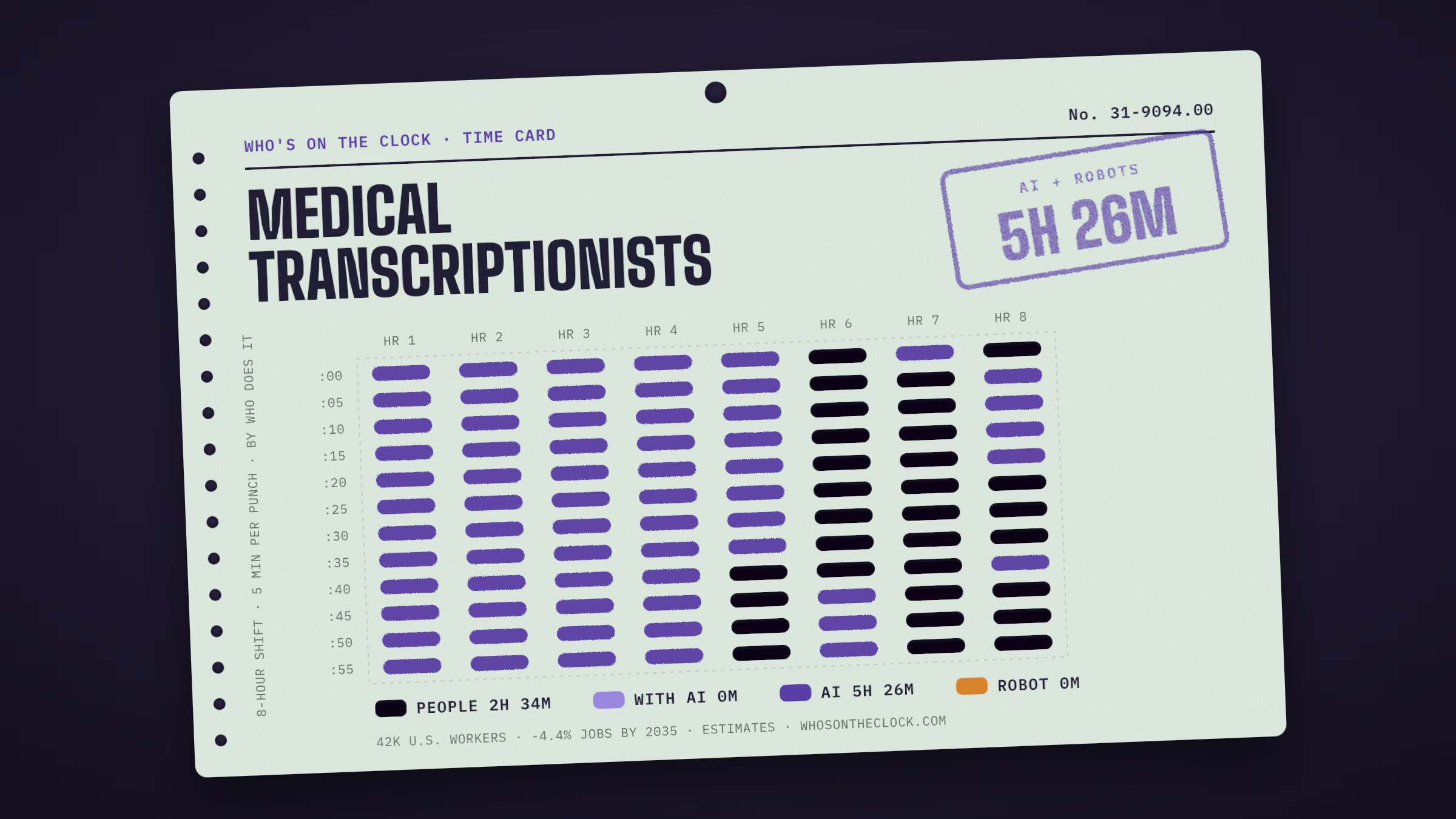
AI already handles some of this work on its own in real use, for tasks like “Transcribe dictation for a variety of medical reports”. That's 5h 26m of a typical shift; 2h 34m still has no AI or robot evidence. BLS expects about 4.4% fewer of these jobs by 2035.

Time card for medical transcriptionists showing a typical 8-hour shift: 2h 34m done by people, 5h 26m by AI.
Each mark is 5 minutes of a typical shift for medical transcriptionists, colored by who does that task today. Estimates from O*NET tasks and Anthropic Economic Index data. How it's made

Home / Healthcare support / Medical Transcriptionists

Transcribe medical reports recorded by physicians and other healthcare practitioners using various electronic devices, covering office visits, emergency room visits, diagnostic imaging studies, operations, chart reviews, and final summaries. Transcribe dictated reports and translate abbreviations into fully understandable form. Edit as necessary and return reports in either printed or electronic form for review and signature, or correction.

Time card

Untick tasks you don't do, or set your own times.
MineTask, by time spentHumanWith AIAIRobot
Transcribe dictation for a variety of medical reports, such as patient histories, physical examinations, emergency room visits, operations, chart reviews, consultation, or discharge summaries.2h 40m a shift · Observed in AI use
Why this label?Marked AI because this task shows up regularly in real AI conversations (Anthropic Economic Index, 2025 usage), and in most of them AI does the task on its own rather than helping a person. Many workplaces may not use AI for it at all. How labels work
Review and edit transcribed reports or dictated material for spelling, grammar, clarity, consistency, and proper medical terminology.2h a shift · Observed in AI use
Why this label?Marked AI because this task shows up regularly in real AI conversations (Anthropic Economic Index, 2025 usage), and in most of them AI does the task on its own rather than helping a person. Many workplaces may not use AI for it at all. How labels work
Distinguish between homonyms and recognize inconsistencies and mistakes in medical terms, referring to dictionaries, drug references, and other sources on anatomy, physiology, and medicine.33m a shift · No AI or robot evidence found
Why this label?No AI use or robot deployment showed up for this task in our data. That isn't proof it's safe; it may just be rare in the data. How labels work
Return dictated reports in printed or electronic form for physician's review, signature, and corrections and for inclusion in patients' medical records.27m a shift · No AI or robot evidence found
Why this label?No AI use or robot deployment showed up for this task in our data. That isn't proof it's safe; it may just be rare in the data. How labels work
Produce medical reports, correspondence, records, patient-care information, statistics, medical research, and administrative material.20m a shift · Observed in AI use
Why this label?Marked AI because this task shows up regularly in real AI conversations (Anthropic Economic Index, 2025 usage), and in most of them AI does the task on its own rather than helping a person. Many workplaces may not use AI for it at all. How labels work
Identify mistakes in reports and check with doctors to obtain the correct information.20m a shift · No AI or robot evidence found
Why this label?No AI use or robot deployment showed up for this task in our data. That isn't proof it's safe; it may just be rare in the data. How labels work
Set up and maintain medical files and databases, including records such as x-ray, lab, and procedure reports, medical histories, diagnostic workups, admission and discharge summaries, and clinical resumes.20m a shift · No AI or robot evidence found
Why this label?No AI use or robot deployment showed up for this task in our data. That isn't proof it's safe; it may just be rare in the data. How labels work
Translate medical jargon and abbreviations into their expanded forms to ensure the accuracy of patient and health care facility records.20m a shift · No AI or robot evidence found
Why this label?No AI use or robot deployment showed up for this task in our data. That isn't proof it's safe; it may just be rare in the data. How labels work
Perform data entry and data retrieval services, providing data for inclusion in medical records and for transmission to physicians.20m a shift · Observed in AI use
Why this label?Marked AI because this task shows up regularly in real AI conversations (Anthropic Economic Index, 2025 usage), and in most of them AI does the task on its own rather than helping a person. Many workplaces may not use AI for it at all. How labels work
Perform a variety of clerical and office tasks, such as handling incoming and outgoing mail, completing and submitting insurance claims, typing, filing, or operating office machines.13m a shift · Robots only in factory cells
Why this label?Robots have done this only in factory setups built around the machine, so it stays Human for medical transcriptionists. How labels work
Take dictation using shorthand, a stenotype machine, or headsets and transcribing machines.7m a shift · Observed in AI use
Why this label?Marked AI because this task shows up regularly in real AI conversations (Anthropic Economic Index, 2025 usage), and in most of them AI does the task on its own rather than helping a person. Many workplaces may not use AI for it at all. How labels work
Decide which information should be included or excluded in reports.7m a shift · No AI or robot evidence found
Why this label?No AI use or robot deployment showed up for this task in our data. That isn't proof it's safe; it may just be rare in the data. How labels work
Receive and screen telephone calls and visitors.7m a shift · No AI or robot evidence found
Why this label?No AI use or robot deployment showed up for this task in our data. That isn't proof it's safe; it may just be rare in the data. How labels work
Answer inquiries concerning the progress of medical cases, within the limits of confidentiality laws.7m a shift · No AI or robot evidence found
Why this label?No AI use or robot deployment showed up for this task in our data. That isn't proof it's safe; it may just be rare in the data. How labels work
Receive patients, schedule appointments, and maintain patient records.time not estimated · Observed in AI use
Why this label?Marked AI because this task shows up regularly in real AI conversations (Anthropic Economic Index, 2025 usage), and in most of them AI does the task on its own rather than helping a person. Many workplaces may not use AI for it at all. How labels work

Clock history

  1. 5h 26m touchedFirst published: O*NET 30.1, Anthropic Economic Index (2025 usage and September 2026 robot study), BLS May 2025

When new data changes this clock, the date, the new numbers and the reason are logged here. Company news alone never moves the clock.

On the floor

  1. BLS projects 4% drop in medical transcriptionist jobs through 2035

    BLS projects employment of medical transcriptionists to fall 4% from 2025 to 2035, about 1,900 jobs. It cites speech recognition and natural language processing that let physicians document visits in real time.

    BLS Occupational Outlook Handbook

Ask the clock

Will AI replace medical transcriptionists?

Some tasks are already being done by AI or machines; the rest still needs a person. About 5h 26m of a typical shift is made up of tasks that AI or robots have done on their own in real use somewhere. That doesn't mean those hours are automated in a typical workplace. The other 2h 34m (32%) stays with people. Separately, BLS expects about 4.4% fewer of these jobs by 2035 (all jobs: +3.5%).

What can AI already do for medical transcriptionists?

AI shows up regularly in 5 of 15 tasks, about 5h 26m of a typical shift. The biggest ones:

  • Transcribe dictation for a variety of medical reports, such as patient histories, physical examinations, emergency room visits, operations, chart reviews, consultation, or discharge summaries. (2h 40m a shift, AI mostly does it alone)
  • Review and edit transcribed reports or dictated material for spelling, grammar, clarity, consistency, and proper medical terminology. (2h a shift, AI mostly does it alone)
  • Produce medical reports, correspondence, records, patient-care information, statistics, medical research, and administrative material. (20m a shift, AI mostly does it alone)
  • Perform data entry and data retrieval services, providing data for inclusion in medical records and for transmission to physicians. (20m a shift, AI mostly does it alone)
  • Take dictation using shorthand, a stenotype machine, or headsets and transcribing machines. (7m a shift, AI mostly does it alone)
Where do robots fit in?

Not in workplaces like this one, based on a 2026 review of robot deployments. 1 more task has only been done in factory setups built around the machine, so it stays with people here.

What still needs a person?

2h 34m of a typical shift, or 32%, goes to tasks with no AI or robot evidence yet. No AI usage or robot deployment has shown up for these so far. The biggest:

  • Distinguish between homonyms and recognize inconsistencies and mistakes in medical terms, referring to dictionaries, drug references, and other sources on anatomy, physiology, and medicine. (33m a shift)
  • Return dictated reports in printed or electronic form for physician's review, signature, and corrections and for inclusion in patients' medical records. (27m a shift)
  • Identify mistakes in reports and check with doctors to obtain the correct information. (20m a shift)
  • Set up and maintain medical files and databases, including records such as x-ray, lab, and procedure reports, medical histories, diagnostic workups, admission and discharge summaries, and clinical resumes. (20m a shift)
  • Translate medical jargon and abbreviations into their expanded forms to ensure the accuracy of patient and health care facility records. (20m a shift)
Why is that work hard to automate?

Much of it comes down to where and how the work happens. In-person, hands-on and high-stakes work is where AI and robots have made the least headway so far. In the official O*NET survey of people in this job:

  • 96% talk face to face with others every day
  • 76% use their hands on tools, objects or controls more than half the time
  • 73% carry high or very high responsibility for other workers' safety
What are companies actually doing?

We track 1 sourced company move that affects this job. Most recent:

  • Aug 27, 2026: BLS projects 4% drop in medical transcriptionist jobs through 2035 (Forecast)
Are employers still hiring medical transcriptionists?

On Indeed, job postings in the Medical Technician sector are at 125% of their February 2020 level (all U.S. postings: 104%), down 2.6% from a year earlier, as of Oct 9, 2026. BLS separately expects about 6,200 openings a year in this job through 2035. Across all U.S. postings, 7.3% now mention AI skills. Sector postings cover more than this one job and move for many reasons besides AI.

How much do medical transcriptionists make?

The median pay is about $40,410 a year ($19.43 an hour), 21% below the median for all U.S. jobs ($50,980). Most people in this job earn between $28,250 and $55,950 a year; that range covers the middle 80%. Pay figures are from BLS, May 2025, and vary a lot by state and employer. Pick a state to compare:

Is this job growing or shrinking?

BLS projects a decline of 4.4% from 2025 to 2035, compared with 3.5% growth for all jobs. That's about 40,000 jobs in 2035. Even so, it expects about 6,200 openings a year, mostly from people retiring or changing careers. These projections don't single out AI as a cause.

How many medical transcriptionists are there in the U.S.?

About 42,000 people in the U.S., roughly 0.03% of all workers (BLS, May 2025). That makes it the 416th largest of the 796 jobs on this site. BLS expects about 40,000 in 2035.

What training do medical transcriptionists need?

The most common requirement is a post-secondary certificate: about 39% of people in the job said so in the official O*NET survey. O*NET rates the job at level 3 of 5 for preparation, which usually means: vocational school or associate's degree. Requirements vary by state and employer, especially for licensed work.

What should I learn to stay ahead of AI?

These come from the job's official skill ratings and from the tasks that AI and robots touch least today. Building them keeps you strong in the parts of the work that still need a person:

  • Skills that matter more here than in most jobs: Active Listening, Writing, Reading Comprehension, Time Management
  • Get strong at the parts of the job that stay with people (listed above), which take 2h 34m of a typical shift
  • Tools employers list: Microsoft Office software, eClinicalWorks EHR software, Microsoft Access, Microsoft ASP.NET, Microsoft Excel
  • Learn to use AI well on the tasks where it already shows up in this job (listed above)
What other jobs could medical transcriptionists move into?

These use similar skills. Matches come from 109 official ratings of skills, knowledge and work activities, and each needs the same or less preparation unless the official list relates the jobs directly:

  • Word Processors and Typists (2h 21m touched, $49k median pay)
How solid are these numbers?

Each task carries its own evidence label. For this job: 6 observed in real AI use, 9 with no AI or robot evidence found. The minutes per task are estimates, not measured hours, and "no evidence" doesn't prove a task is safe.

Tools in demand

  • eClinicalWorks EHR software
  • Microsoft Access
  • Microsoft ASP.NET

Plus everyday office tools: Microsoft Office software, Microsoft Excel, Microsoft Outlook, Microsoft PowerPoint, Microsoft Windows.

Also called

Certified Medical Transcriptionist, Clinical Medical Transcriptionist, Clinical Scribe, Data Transcriber, Documentation Specialist, Emergency Medical Scribe, Medical Language Professional, Medical Language Specialist, Medical Record Transcriber, Medical Scribe, Medical Stenographer, Medical Transcriber, Medical Transcription Editor, Medical Transcriptionist