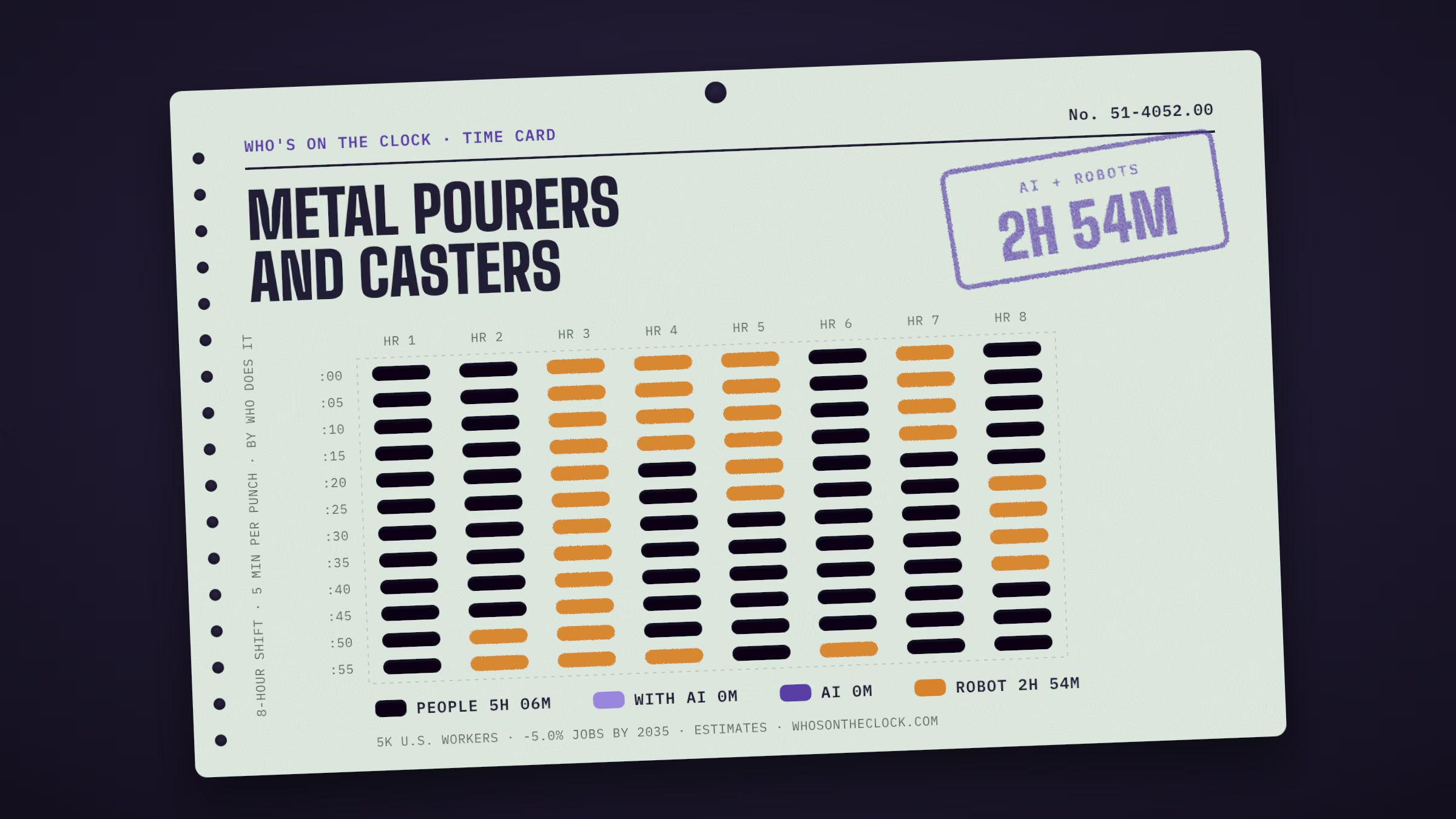
Operate hand-controlled mechanisms to pour and regulate the flow of molten metal into molds to produce castings or ingots.
Time card
Untick tasks you don't do, or set your own times.
| Mine | Task, by time spent | Human | With AI | AI | Robot |
|---|---|---|---|---|---|
Pour and regulate the flow of molten metal into molds and forms to produce ingots or other castings, using ladles or hand-controlled mechanisms.1h 48m a shift · Robots only in factory cellsWhy this label?Robots have done this only in factory setups built around the machine, so it stays Human for metal pourers and casters. How labels work | |||||
Read temperature gauges and observe color changes, adjusting furnace flames, torches, or electrical heating units as necessary to melt metal to specifications.48m a shift · Robots deployed · e.g. Q-Melt automatic EAF (Melt Model, Q-Reg, LINDARC)Why this label?Marked Robot because Q-Melt automatic EAF (Melt Model, Q-Reg, LINDARC) (in real use) has done this task in a real workplace. It shows a robot can do it somewhere, not that most metal pourers and casters work alongside one. How labels work | |||||
Load specified amounts of metal and flux into furnaces or clay crucibles.42m a shift · Robots deployed · e.g. RiA rail-mounted autonomous furnace charging machine (with Fioscope smart cameras)Why this label?Marked Robot because RiA rail-mounted autonomous furnace charging machine (with Fioscope smart cameras) (in real use) has done this task in a real workplace. It shows a robot can do it somewhere, not that most metal pourers and casters work alongside one. How labels work | |||||
Position equipment such as ladles, grinding wheels, pouring nozzles, or crucibles, or signal other workers to position equipment.36m a shift · Robots only in factory cellsWhy this label?Robots have done this only in factory setups built around the machine, so it stays Human for metal pourers and casters. How labels work | |||||
Skim slag or remove excess metal from ingots or equipment, using hand tools, strainers, rakes, or burners, collecting scrap for recycling.36m a shift · Robots deployed · e.g. RIA autonomous furnace charging and skimming machinesWhy this label?Marked Robot because RIA autonomous furnace charging and skimming machines (in real use) has done this task in a real workplace. It shows a robot can do it somewhere, not that most metal pourers and casters work alongside one. How labels work | |||||
Examine molds to ensure they are clean, smooth, and properly coated.30m a shift · Robots only in factory cellsWhy this label?Robots have done this only in factory setups built around the machine, so it stays Human for metal pourers and casters. How labels work | |||||
Remove metal ingots or cores from molds, using hand tools, cranes, and chain hoists.30m a shift · Robots only in factory cellsWhy this label?Robots have done this only in factory setups built around the machine, so it stays Human for metal pourers and casters. How labels work | |||||
Remove solidified steel or slag from pouring nozzles, using long bars or oxygen burners.24m a shift · Robots only in factory cellsWhy this label?Robots have done this only in factory setups built around the machine, so it stays Human for metal pourers and casters. How labels work | |||||
Transport metal ingots to storage areas, using forklifts.24m a shift · Robots deployed · e.g. Seegrid Palion / Lift RS1 autonomous mobile robotsWhy this label?Marked Robot because Seegrid Palion / Lift RS1 autonomous mobile robots (in real use) has done this task in a real workplace. It shows a robot can do it somewhere, not that most metal pourers and casters work alongside one. How labels work | |||||
Repair and maintain metal forms and equipment, using hand tools, sledges, and bars.24m a shift · No AI or robot evidence foundWhy this label?This is physical work, and no robot has been shown doing it yet. How labels work | |||||
Assemble and embed cores in casting frames, using hand tools and equipment.18m a shift · Robots only in factory cellsWhy this label?Robots have done this only in factory setups built around the machine, so it stays Human for metal pourers and casters. How labels work | |||||
Pull levers to lift ladle stoppers and to allow molten steel to flow into ingot molds to specified heights.18m a shift · Robots only in factory cellsWhy this label?Robots have done this only in factory setups built around the machine, so it stays Human for metal pourers and casters. How labels work | |||||
Collect samples, or signal workers to sample metal for analysis.12m a shift · Robots deployed · e.g. Danieli Q-Robot (Q-Robot MELT SAMPLE)Why this label?Marked Robot because Danieli Q-Robot (Q-Robot MELT SAMPLE) (in real use) has done this task in a real workplace. It shows a robot can do it somewhere, not that most metal pourers and casters work alongside one. How labels work | |||||
Turn valves to circulate water through cores, or spray water on filled molds to cool and solidify metal.12m a shift · Robots deployed · e.g. DynaJet Flex spray cooling + Dynacs 3D secondary-cooling modelWhy this label?Marked Robot because DynaJet Flex spray cooling + Dynacs 3D secondary-cooling model (in real use) has done this task in a real workplace. It shows a robot can do it somewhere, not that most metal pourers and casters work alongside one. How labels work | |||||
Add metal to molds to compensate for shrinkage.12m a shift · Robots only in factory cellsWhy this label?Robots have done this only in factory setups built around the machine, so it stays Human for metal pourers and casters. How labels work | |||||
Stencil identifying information on ingots and pigs, using special hand tools.6m a shift · Robots only in factory cellsWhy this label?Robots have done this only in factory setups built around the machine, so it stays Human for metal pourers and casters. How labels work |