Will AI replace mobile heavy equipment mechanics?

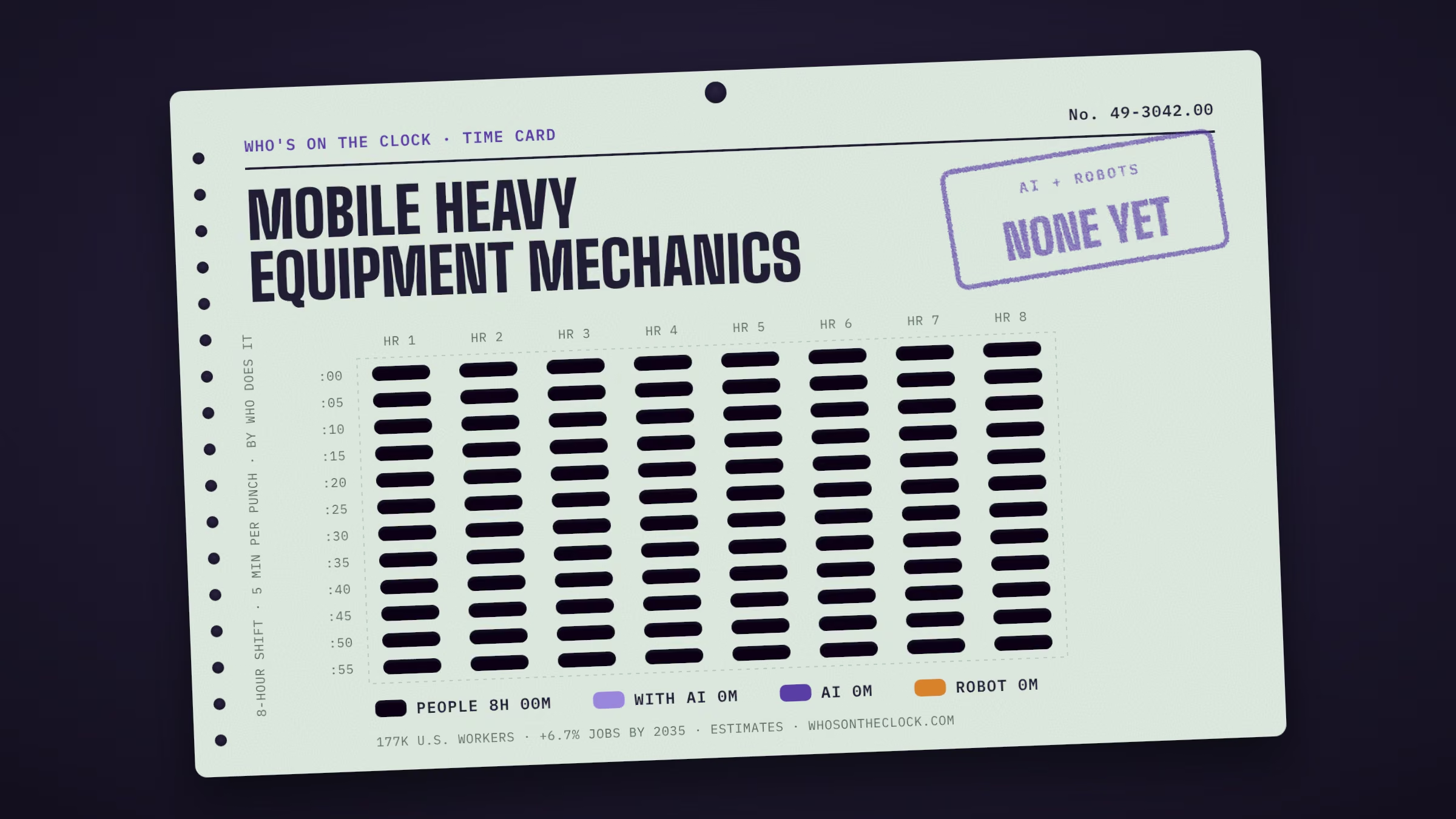
No AI use or robot deployment shows up yet for any of this job's tasks; the biggest part of the day, “Repair and replace damaged or worn parts”, is still entirely people's work. That's today's evidence, not a guarantee. BLS expects about 6.7% more of these jobs by 2035.

Time card for mobile heavy equipment mechanics showing a typical 8-hour shift: 8h done by people.
Each mark is 5 minutes of a typical shift for mobile heavy equipment mechanics, colored by who does that task today. Estimates from O*NET tasks and Anthropic Economic Index data. How it's made

Home / Repair & maintenance / Mobile Heavy Equipment Mechanics

Diagnose, adjust, repair, or overhaul mobile mechanical, hydraulic, and pneumatic equipment, such as cranes, bulldozers, graders, and conveyors, used in construction, logging, and mining.

Time card

Untick tasks you don't do, or set your own times.
MineTask, by time spentHumanWith AIAIRobot
Repair and replace damaged or worn parts.1h 26m a shift · No AI or robot evidence found
Why this label?This is physical work, and no robot has been shown doing it yet. How labels work
Dismantle and reassemble heavy equipment using hoists and hand tools.40m a shift · No AI or robot evidence found
Why this label?This is physical work, and no robot has been shown doing it yet. How labels work
Diagnose faults or malfunctions to determine required repairs, using engine diagnostic equipment such as computerized test equipment and calibration devices.40m a shift · No AI or robot evidence found
Why this label?This is physical work, and no robot has been shown doing it yet. How labels work
Adjust, maintain, and repair or replace subassemblies, such as transmissions and crawler heads, using hand tools, jacks, and cranes.34m a shift · No AI or robot evidence found
Why this label?This is physical work, and no robot has been shown doing it yet. How labels work
Test mechanical products and equipment after repair or assembly to ensure proper performance and compliance with manufacturers' specifications.29m a shift · Robots only in factory cells
Why this label?Robots have done this only in factory setups built around the machine, so it stays Human for mobile heavy equipment mechanics. How labels work
Operate and inspect machines or heavy equipment to diagnose defects.29m a shift · No AI or robot evidence found
Why this label?This is physical work, and no robot has been shown doing it yet. How labels work
Repair, rewire, and troubleshoot electrical systems.29m a shift · No AI or robot evidence found
Why this label?This is physical work, and no robot has been shown doing it yet. How labels work
Clean, lubricate, and perform other routine maintenance work on equipment and vehicles.29m a shift · No AI or robot evidence found
Why this label?This is physical work, and no robot has been shown doing it yet. How labels work
Read and understand operating manuals, blueprints, and technical drawings.23m a shift · No AI or robot evidence found
Why this label?No AI use or robot deployment showed up for this task in our data. That isn't proof it's safe; it may just be rare in the data. How labels work
Overhaul and test machines or equipment to ensure operating efficiency.23m a shift · No AI or robot evidence found
Why this label?This is physical work, and no robot has been shown doing it yet. How labels work
Research, order, and maintain parts inventory for services and repairs.23m a shift · No AI or robot evidence found
Why this label?No AI use or robot deployment showed up for this task in our data. That isn't proof it's safe; it may just be rare in the data. How labels work
Examine parts for damage or excessive wear, using micrometers and gauges.17m a shift · Robots only in factory cells
Why this label?Robots have done this only in factory setups built around the machine, so it stays Human for mobile heavy equipment mechanics. How labels work
Weld or solder broken parts and structural members, using electric or gas welders and soldering tools.17m a shift · Robots only in factory cells
Why this label?Robots have done this only in factory setups built around the machine, so it stays Human for mobile heavy equipment mechanics. How labels work
Schedule maintenance for industrial machines and equipment, and keep equipment service records.17m a shift · No AI or robot evidence found
Why this label?No AI use or robot deployment showed up for this task in our data. That isn't proof it's safe; it may just be rare in the data. How labels work
Fit bearings to adjust, repair, or overhaul mobile mechanical, hydraulic, and pneumatic equipment.11m a shift · Robots only in factory cells
Why this label?Robots have done this only in factory setups built around the machine, so it stays Human for mobile heavy equipment mechanics. How labels work
Clean parts by spraying them with grease solvent or immersing them in tanks of solvent.11m a shift · Robots only in factory cells
Why this label?Robots have done this only in factory setups built around the machine, so it stays Human for mobile heavy equipment mechanics. How labels work
Assemble gear systems, and align frames and gears.6m a shift · Robots only in factory cells
Why this label?Robots have done this only in factory setups built around the machine, so it stays Human for mobile heavy equipment mechanics. How labels work
Adjust and maintain industrial machinery, using control and regulating devices.6m a shift · No AI or robot evidence found
Why this label?This is physical work, and no robot has been shown doing it yet. How labels work
Fabricate needed parts or items from sheet metal.6m a shift · Robots only in factory cells
Why this label?Robots have done this only in factory setups built around the machine, so it stays Human for mobile heavy equipment mechanics. How labels work
Direct workers who are assembling or disassembling equipment or cleaning parts.6m a shift · No AI or robot evidence found
Why this label?No AI use or robot deployment showed up for this task in our data. That isn't proof it's safe; it may just be rare in the data. How labels work

Clock history

  1. 0m touchedFirst published: O*NET 30.1, Anthropic Economic Index (2025 usage and September 2026 robot study), BLS May 2025

When new data changes this clock, the date, the new numbers and the reason are logged here. Company news alone never moves the clock.

On the floor

  1. AnnouncedCaterpillar
    Caterpillar unveils Cat AI Assistant for troubleshooting and service

    The Cat AI Assistant will give troubleshooting guidance, book service and show machine diagnostics, drawing on maintenance manuals, parts catalogs and purchase history. Caterpillar said it would launch in Q1 2026.

    Caterpillar

Ask the clock

Will AI replace mobile heavy equipment mechanics?

Not on current evidence. Less than 30 minutes of a typical shift goes to tasks that AI or robots are doing today. The other 8h (100%) stays with people. Separately, BLS expects about 6.7% more of these jobs by 2035 (all jobs: +3.5%).

What can AI already do for mobile heavy equipment mechanics?

None of this job's tasks show regular AI use yet. That can mean the work is hands-on or in person, or simply that it rarely comes up in AI usage data.

Where do robots fit in?

Not in workplaces like this one, based on a 2026 review of robot deployments. 7 more tasks have only been done in factory setups built around the machine, so they stay with people here. For 9 physical tasks, no robot has shown it can do the work yet.

What still needs a person?

8h of a typical shift, or 100%, goes to tasks with no AI or robot evidence yet. No AI usage or robot deployment has shown up for these so far. The biggest:

  • Repair and replace damaged or worn parts. (1h 26m a shift)
  • Dismantle and reassemble heavy equipment using hoists and hand tools. (40m a shift)
  • Diagnose faults or malfunctions to determine required repairs, using engine diagnostic equipment such as computerized test equipment and calibration devices. (40m a shift)
  • Adjust, maintain, and repair or replace subassemblies, such as transmissions and crawler heads, using hand tools, jacks, and cranes. (34m a shift)
  • Test mechanical products and equipment after repair or assembly to ensure proper performance and compliance with manufacturers' specifications. (29m a shift)
Why is that work hard to automate?

Much of it comes down to where and how the work happens. In-person, hands-on and high-stakes work is where AI and robots have made the least headway so far. In the official O*NET survey of people in this job:

  • 90% use their hands on tools, objects or controls more than half the time
  • 87% work in very hot or cold conditions at least weekly
  • 85% spend more than half the day on their feet
What are companies actually doing?

We track 1 sourced company move that affects this job. Most recent:

  • Jan 6, 2026: Caterpillar unveils Cat AI Assistant for troubleshooting and service (Announced)
Are employers still hiring mobile heavy equipment mechanics?

On Indeed, job postings in the Installation & Maintenance sector are at 118% of their February 2020 level (all U.S. postings: 104%), up 4.1% from a year earlier, as of Oct 9, 2026. BLS separately expects about 15,000 openings a year in this job through 2035. Across all U.S. postings, 7.3% now mention AI skills. Sector postings cover more than this one job and move for many reasons besides AI.

How much do mobile heavy equipment mechanics make?

The median pay is about $65,510 a year ($31.50 an hour), 29% above the median for all U.S. jobs ($50,980). Most people in this job earn between $46,820 and $94,460 a year; that range covers the middle 80%. Pay figures are from BLS, May 2025, and vary a lot by state and employer. Pick a state to compare:

Is this job growing or shrinking?

BLS projects growth of 6.7% from 2025 to 2035, compared with 3.5% growth for all jobs. That's about 193,000 jobs in 2035. It expects about 15,000 openings a year, mostly from people retiring or changing careers. These projections don't single out AI as a cause.

How many mobile heavy equipment mechanics are there in the U.S.?

About 177,000 people in the U.S., roughly 0.11% of all workers (BLS, May 2025). That makes it the 187th largest of the 796 jobs on this site. BLS expects about 193,000 in 2035.

What training do mobile heavy equipment mechanics need?

The most common requirement is a post-secondary certificate: about 55% of people in the job said so in the official O*NET survey. O*NET rates the job at level 3 of 5 for preparation, which usually means: vocational school or associate's degree. Requirements vary by state and employer, especially for licensed work.

What should I learn to stay ahead of AI?

These come from the job's official skill ratings and from the tasks that AI and robots touch least today. Building them keeps you strong in the parts of the work that still need a person:

  • Skills that matter more here than in most jobs: Repairing, Equipment Maintenance, Troubleshooting, Equipment Selection
  • Get strong at the parts of the job that stay with people (listed above), which take 8h of a typical shift
  • Tools employers list: Microsoft Office software, Microsoft Excel, Microsoft Outlook, Microsoft Word
What other jobs could mobile heavy equipment mechanics move into?

These use similar skills. Matches come from 109 official ratings of skills, knowledge and work activities, and each needs the same or less preparation unless the official list relates the jobs directly:

  • Maintenance and Repair Workers, General (11m touched, $50k median pay)
  • Electric Motor, Power Tool, and Related Repairers (0m touched, $56k median pay)
  • Motorcycle Mechanics (0m touched, $49k median pay)
  • Farm Equipment Mechanics and Service Technicians (34m touched, $57k median pay)
  • Automotive Service Technicians and Mechanics (0m touched, $51k median pay)
How solid are these numbers?

Each task carries its own evidence label. For this job: 20 with no AI or robot evidence found. The minutes per task are estimates, not measured hours, and "no evidence" doesn't prove a task is safe.

Tools in demand

Mostly everyday office tools: Microsoft Office software, Microsoft Excel, Microsoft Outlook, Microsoft Word. The job's skills matter more than any specific software.

Also called

Brake Mechanic, Bulldozer Mechanic, Caterpillar Mechanic, Clutch Mechanic, Construction Equipment Mechanic, Construction Equipment Overhauler, Crane Mechanic, Crane Technician, Dinkey Engine Mechanic, Dinkey Mechanic, Dragline Mechanic, Dredge Mechanic, Drop Hammer Mechanic, Endless Track Vehicle Mechanic