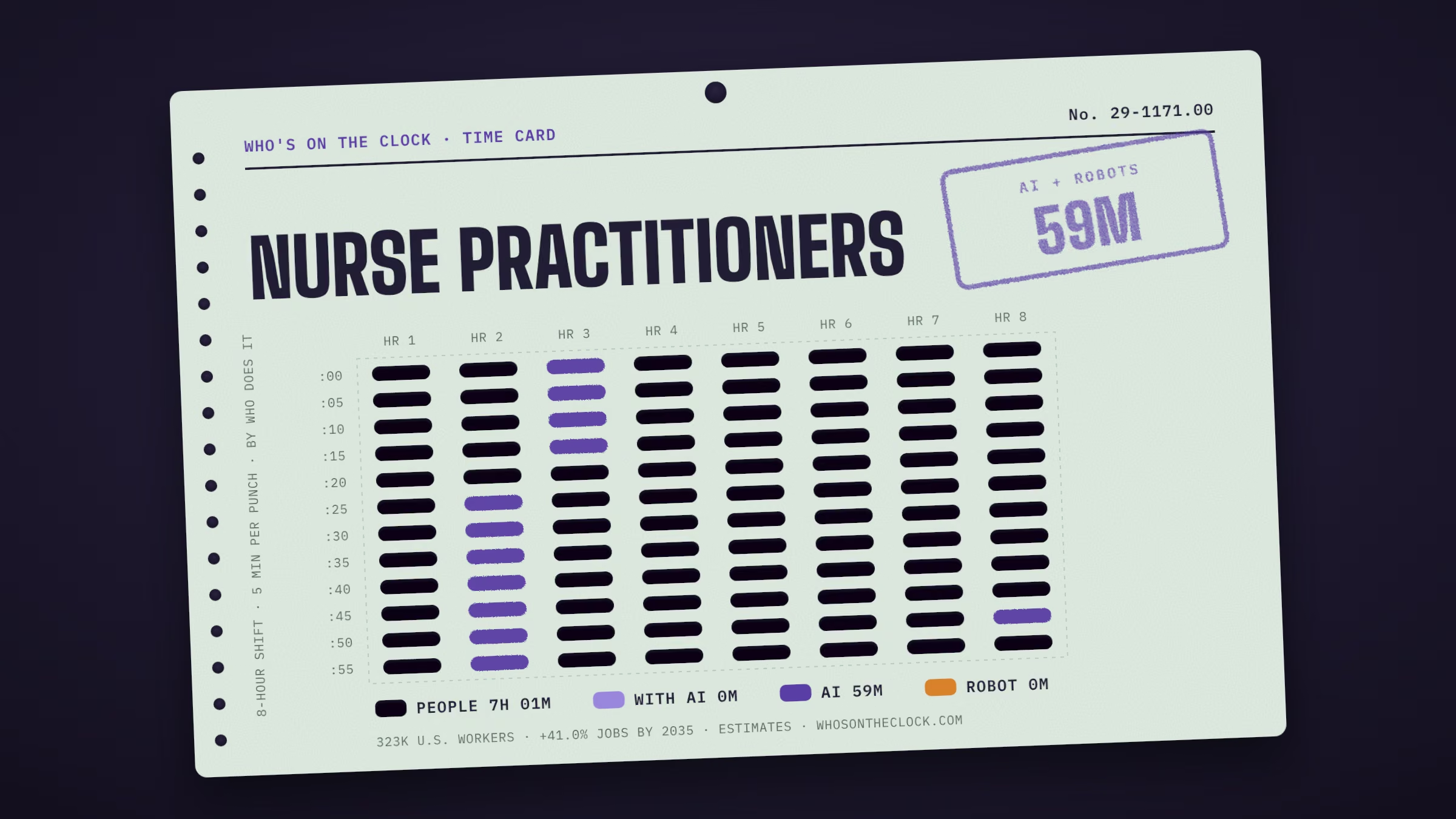
Diagnose and treat acute, episodic, or chronic illness, independently or as part of a healthcare team. May focus on health promotion and disease prevention. May order, perform, or interpret diagnostic tests such as lab work and x rays. May prescribe medication. Must be registered nurses who have specialized graduate education.
Time card
Untick tasks you don't do, or set your own times.
| Mine | Task, by time spent | Human | With AI | AI | Robot |
|---|---|---|---|---|---|
Maintain complete and detailed records of patients' health care plans and prognoses.1h 22m a shift · No AI or robot evidence foundWhy this label?No AI use or robot deployment showed up for this task in our data. That isn't proof it's safe; it may just be rare in the data. How labels work | |||||
Analyze and interpret patients' histories, symptoms, physical findings, or diagnostic information to develop appropriate diagnoses.53m a shift · Observed in AI useTypical AI request: about 2h 43m alone, 46m with AIWhy this label?Marked AI because this task shows up regularly in real AI conversations (Anthropic Economic Index, 2025 usage), and in most of them AI does the task on its own rather than helping a person. Many workplaces may not use AI for it at all. How labels work | |||||
Diagnose or treat chronic health care problems, such as high blood pressure and diabetes.35m a shift · No AI or robot evidence foundWhy this label?No AI use or robot deployment showed up for this task in our data. That isn't proof it's safe; it may just be rare in the data. How labels work | |||||
Develop treatment plans, based on scientific rationale, standards of care, and professional practice guidelines.29m a shift · No AI or robot evidence foundWhy this label?No AI use or robot deployment showed up for this task in our data. That isn't proof it's safe; it may just be rare in the data. How labels work | |||||
Diagnose or treat acute health care problems, such as illnesses, infections, or injuries.29m a shift · No AI or robot evidence foundWhy this label?This is physical work, and no robot has been shown doing it yet. How labels work | |||||
Order, perform, or interpret the results of diagnostic tests, such as complete blood counts (CBCs), electrocardiograms (EKGs), and radiographs (x-rays).29m a shift · No AI or robot evidence foundWhy this label?No AI use or robot deployment showed up for this task in our data. That isn't proof it's safe; it may just be rare in the data. How labels work | |||||
Provide patients with information needed to promote health, reduce risk factors, or prevent disease or disability.18m a shift · No AI or robot evidence foundWhy this label?No AI use or robot deployment showed up for this task in our data. That isn't proof it's safe; it may just be rare in the data. How labels work | |||||
Diagnose or treat complex, unstable, comorbid, episodic, or emergency conditions in collaboration with other health care providers as necessary.18m a shift · No AI or robot evidence foundWhy this label?This is physical work, and no robot has been shown doing it yet. How labels work | |||||
Educate patients about self-management of acute or chronic illnesses, tailoring instructions to patients' individual circumstances.18m a shift · No AI or robot evidence foundWhy this label?No AI use or robot deployment showed up for this task in our data. That isn't proof it's safe; it may just be rare in the data. How labels work | |||||
Treat or refer patients for primary care conditions, such as headaches, hypertension, urinary tract infections, upper respiratory infections, and dermatological conditions.18m a shift · No AI or robot evidence foundWhy this label?This is physical work, and no robot has been shown doing it yet. How labels work | |||||
Perform routine or annual physical examinations.18m a shift · No AI or robot evidence foundWhy this label?This is physical work, and no robot has been shown doing it yet. How labels work | |||||
Prescribe medication dosages, routes, and frequencies, based on such patient characteristics as age and gender.12m a shift · No AI or robot evidence foundWhy this label?No AI use or robot deployment showed up for this task in our data. That isn't proof it's safe; it may just be rare in the data. How labels work | |||||
Prescribe medications based on efficacy, safety, and cost as legally authorized.12m a shift · No AI or robot evidence foundWhy this label?No AI use or robot deployment showed up for this task in our data. That isn't proof it's safe; it may just be rare in the data. How labels work | |||||
Recommend diagnostic or therapeutic interventions with attention to safety, cost, invasiveness, simplicity, acceptability, adherence, and efficacy.12m a shift · No AI or robot evidence foundWhy this label?No AI use or robot deployment showed up for this task in our data. That isn't proof it's safe; it may just be rare in the data. How labels work | |||||
Counsel patients about drug regimens and possible side effects or interactions with other substances, such as food supplements, over-the-counter (OTC) medications, or herbal remedies.12m a shift · No AI or robot evidence foundWhy this label?No AI use or robot deployment showed up for this task in our data. That isn't proof it's safe; it may just be rare in the data. How labels work | |||||
Consult with, or refer patients to, appropriate specialists when conditions exceed the scope of practice or expertise.12m a shift · No AI or robot evidence foundWhy this label?No AI use or robot deployment showed up for this task in our data. That isn't proof it's safe; it may just be rare in the data. How labels work | |||||
Read current literature, talk with colleagues, or participate in professional organizations or conferences to keep abreast of developments in nursing.12m a shift · No AI or robot evidence foundWhy this label?No AI use or robot deployment showed up for this task in our data. That isn't proof it's safe; it may just be rare in the data. How labels work | |||||
Perform primary care procedures such as suturing, splinting, administering immunizations, taking cultures, and debriding wounds.12m a shift · No AI or robot evidence foundWhy this label?This is physical work, and no robot has been shown doing it yet. How labels work | |||||
Supervise or coordinate patient care or support staff activities.12m a shift · No AI or robot evidence foundWhy this label?No AI use or robot deployment showed up for this task in our data. That isn't proof it's safe; it may just be rare in the data. How labels work | |||||
Detect and respond to adverse drug reactions, with special attention to vulnerable populations such as infants, children, pregnant and lactating women, or older adults.6m a shift · No AI or robot evidence foundWhy this label?No AI use or robot deployment showed up for this task in our data. That isn't proof it's safe; it may just be rare in the data. How labels work | |||||
Maintain current knowledge of state legal regulations for nurse practitioner practice, including reimbursement of services.6m a shift · No AI or robot evidence foundWhy this label?No AI use or robot deployment showed up for this task in our data. That isn't proof it's safe; it may just be rare in the data. How labels work | |||||
Recommend interventions to modify behavior associated with health risks.6m a shift · No AI or robot evidence foundWhy this label?No AI use or robot deployment showed up for this task in our data. That isn't proof it's safe; it may just be rare in the data. How labels work | |||||
Schedule follow-up visits to monitor patients or evaluate health or illness care.6m a shift · No AI or robot evidence foundWhy this label?No AI use or robot deployment showed up for this task in our data. That isn't proof it's safe; it may just be rare in the data. How labels work | |||||
Maintain departmental policies and procedures in areas such as safety and infection control.6m a shift · No AI or robot evidence foundWhy this label?No AI use or robot deployment showed up for this task in our data. That isn't proof it's safe; it may just be rare in the data. How labels work | |||||
Provide patients or caregivers with assistance in locating health care resources.6m a shift · Observed in AI useTypical AI request: about 1h 19m alone, 21m with AIWhy this label?Marked AI because this task shows up regularly in real AI conversations (Anthropic Economic Index, 2025 usage), and in most of them AI does the task on its own rather than helping a person. Many workplaces may not use AI for it at all. How labels work | |||||
Keep abreast of regulatory processes and payer systems, such as Medicare, Medicaid, managed care, and private sources.6m a shift · No AI or robot evidence foundWhy this label?No AI use or robot deployment showed up for this task in our data. That isn't proof it's safe; it may just be rare in the data. How labels work | |||||
Advocate for accessible health care that minimizes environmental health risks.time not estimated · No AI or robot evidence foundWhy this label?No AI use or robot deployment showed up for this task in our data. That isn't proof it's safe; it may just be rare in the data. How labels work |