Will AI replace park naturalists?

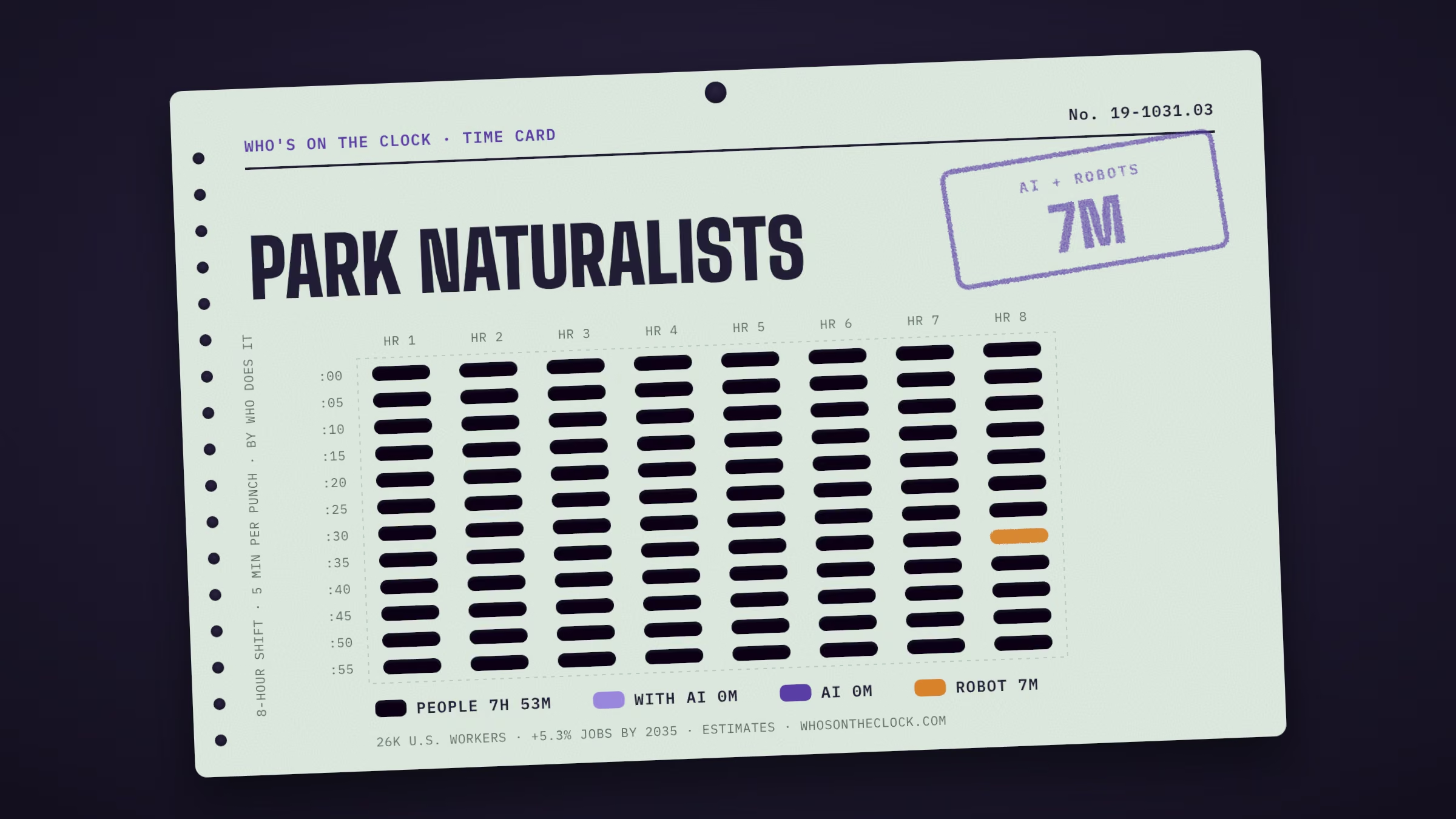
The biggest change here is physical: systems like DJI Dock 3 with Matrice 4D have done tasks such as “Take photographs and motion pictures for use in lectures and publications and to develop displays” in real workplaces, about 7m of a typical shift. Most of the rest, 7h 53m, has no AI or robot evidence. BLS expects about 5.3% more of these jobs by 2035.

Time card for park naturalists showing a typical 8-hour shift: 7h 53m done by people, 7m by robots.
Each mark is 5 minutes of a typical shift for park naturalists, colored by who does that task today. Estimates from O*NET tasks and Anthropic Economic Index data. How it's made

Home / Science / Park Naturalists

Plan, develop, and conduct programs to inform public of historical, natural, and scientific features of national, state, or local park.

Time card

Untick tasks you don't do, or set your own times.
MineTask, by time spentHumanWith AIAIRobot
Provide visitor services, such as explaining regulations, answering visitor requests, needs and complaints, and providing information about the park and surrounding areas.1h 24m a shift · No AI or robot evidence found
Why this label?No AI use or robot deployment showed up for this task in our data. That isn't proof it's safe; it may just be rare in the data. How labels work
Prepare and present illustrated lectures and interpretive talks about park features.1h 11m a shift · No AI or robot evidence found
Why this label?No AI use or robot deployment showed up for this task in our data. That isn't proof it's safe; it may just be rare in the data. How labels work
Conduct field trips to point out scientific, historic, and natural features of parks, forests, historic sites, or other attractions.58m a shift · No AI or robot evidence found
Why this label?No AI use or robot deployment showed up for this task in our data. That isn't proof it's safe; it may just be rare in the data. How labels work
Assist with operations of general facilities, such as visitor centers.45m a shift · No AI or robot evidence found
Why this label?This is physical work, and no robot has been shown doing it yet. How labels work
Plan and organize public events at the park.26m a shift · No AI or robot evidence found
Why this label?No AI use or robot deployment showed up for this task in our data. That isn't proof it's safe; it may just be rare in the data. How labels work
Develop environmental educational programs and curricula for schools.26m a shift · No AI or robot evidence found
Why this label?No AI use or robot deployment showed up for this task in our data. That isn't proof it's safe; it may just be rare in the data. How labels work
Confer with park staff to determine subjects and schedules for park programs.19m a shift · No AI or robot evidence found
Why this label?No AI use or robot deployment showed up for this task in our data. That isn't proof it's safe; it may just be rare in the data. How labels work
Plan, organize and direct activities of seasonal staff members.19m a shift · No AI or robot evidence found
Why this label?No AI use or robot deployment showed up for this task in our data. That isn't proof it's safe; it may just be rare in the data. How labels work
Research stories regarding the area's natural history or environment.19m a shift · No AI or robot evidence found
Why this label?No AI use or robot deployment showed up for this task in our data. That isn't proof it's safe; it may just be rare in the data. How labels work
Prepare brochures and write newspaper articles.19m a shift · No AI or robot evidence found
Why this label?No AI use or robot deployment showed up for this task in our data. That isn't proof it's safe; it may just be rare in the data. How labels work
Train staff on park programs.13m a shift · No AI or robot evidence found
Why this label?No AI use or robot deployment showed up for this task in our data. That isn't proof it's safe; it may just be rare in the data. How labels work
Construct historical, scientific, and nature visitor-center displays.13m a shift · No AI or robot evidence found
Why this label?This is physical work, and no robot has been shown doing it yet. How labels work
Compile and maintain official park photographic and information files.13m a shift · No AI or robot evidence found
Why this label?No AI use or robot deployment showed up for this task in our data. That isn't proof it's safe; it may just be rare in the data. How labels work
Perform routine maintenance on park structures.13m a shift · Robots only in factory cells
Why this label?Robots have done this only in factory setups built around the machine, so it stays Human for park naturalists. How labels work
Perform emergency duties to protect human life, government property, and natural features of park.6m a shift · No AI or robot evidence found
Why this label?This is physical work, and no robot has been shown doing it yet. How labels work
Take photographs and motion pictures for use in lectures and publications and to develop displays.6m a shift · Robots deployed · e.g. DJI Dock 3 with Matrice 4D
Why this label?Marked Robot because DJI Dock 3 with Matrice 4D (in real use) has done this task in a real workplace. It shows a robot can do it somewhere, not that most park naturalists work alongside one. How labels work
Plan and develop audio-visual devices for public programs.6m a shift · No AI or robot evidence found
Why this label?No AI use or robot deployment showed up for this task in our data. That isn't proof it's safe; it may just be rare in the data. How labels work
Provide care for park program animals.6m a shift · No AI or robot evidence found
Why this label?This is physical work, and no robot has been shown doing it yet. How labels work
Interview specialists in desired fields to obtain and develop data for park information programs.6m a shift · No AI or robot evidence found
Why this label?No AI use or robot deployment showed up for this task in our data. That isn't proof it's safe; it may just be rare in the data. How labels work
Survey park to determine forest conditions and distribution and abundance of fauna and flora.6m a shift · No AI or robot evidence found
Why this label?This is physical work, and no robot has been shown doing it yet. How labels work

Clock history

  1. 7m touchedFirst published: O*NET 30.1, Anthropic Economic Index (2025 usage and September 2026 robot study), BLS May 2025

When new data changes this clock, the date, the new numbers and the reason are logged here. Company news alone never moves the clock.

On the floor

No company news tracked for this job yet. New stories are added as they happen.

Ask the clock

Will AI replace park naturalists?

Not on current evidence. Less than 30 minutes of a typical shift goes to tasks that AI or robots are doing today. The other 7h 53m (99%) stays with people. Separately, BLS expects about 5.3% more of these jobs by 2035 (all jobs: +3.5%).

What can AI already do for park naturalists?

None of this job's tasks show regular AI use yet. That can mean the work is hands-on or in person, or simply that it rarely comes up in AI usage data.

Where do robots fit in?

For some tasks, yes. Robots have done 1 of this job's tasks in workplaces like this one, about 7m of a typical shift. 1 more task has only been done in factory setups built around the machine, so it stays with people here. For 5 physical tasks, no robot has shown it can do the work yet.

  • Take photographs and motion pictures for use in lectures and publications and to develop displays. (6m a shift; e.g. DJI Dock 3 with Matrice 4D, in use)
What still needs a person?

7h 53m of a typical shift, or 99%, goes to tasks with no AI or robot evidence yet. No AI usage or robot deployment has shown up for these so far. The biggest:

  • Provide visitor services, such as explaining regulations, answering visitor requests, needs and complaints, and providing information about the park and surrounding areas. (1h 24m a shift)
  • Prepare and present illustrated lectures and interpretive talks about park features. (1h 11m a shift)
  • Conduct field trips to point out scientific, historic, and natural features of parks, forests, historic sites, or other attractions. (58m a shift)
  • Assist with operations of general facilities, such as visitor centers. (45m a shift)
  • Plan and organize public events at the park. (26m a shift)
Why is that work hard to automate?

Much of it comes down to where and how the work happens. In-person, hands-on and high-stakes work is where AI and robots have made the least headway so far. In the official O*NET survey of people in this job:

  • 99% say dealing with the public is very or extremely important
  • 65% talk face to face with others every day
  • 60% work at arm's length or closer to other people
Are employers still hiring park naturalists?

On Indeed, job postings in the Scientific Research & Development sector are at 84% of their February 2020 level (all U.S. postings: 104%), up 19.9% from a year earlier, as of Oct 9, 2026. BLS separately expects about 2,100 openings a year in this job through 2035. Across all U.S. postings, 7.3% now mention AI skills. Sector postings cover more than this one job and move for many reasons besides AI.

How much do park naturalists make?

The median pay is about $73,010 a year ($35.10 an hour), 43% above the median for all U.S. jobs ($50,980). Most people in this job earn between $47,550 and $110,410 a year; that range covers the middle 80%. Pay figures are from BLS, May 2025, and vary a lot by state and employer. Pick a state to compare:

Is this job growing or shrinking?

BLS projects growth of 5.3% from 2025 to 2035, compared with 3.5% growth for all jobs. That's about 29,000 jobs in 2035. It expects about 2,100 openings a year, mostly from people retiring or changing careers. These projections don't single out AI as a cause.

How many park naturalists are there in the U.S.?

About 26,000 people in the U.S., roughly 0.02% of all workers (BLS, May 2025). That makes it the 503rd largest of the 796 jobs on this site. BLS expects about 29,000 in 2035.

What training do park naturalists need?

The most common requirement is a bachelor's degree: about 50% of people in the job said so in the official O*NET survey. O*NET rates the job at level 4 of 5 for preparation, which usually means: bachelor's degree. Requirements vary by state and employer, especially for licensed work.

What should I learn to stay ahead of AI?

These come from the job's official skill ratings and from the tasks that AI and robots touch least today. Building them keeps you strong in the parts of the work that still need a person:

  • Skills that matter more here than in most jobs: Social Perceptiveness, Speaking, Service Orientation, Writing
  • Get strong at the parts of the job that stay with people (listed above), which take 7h 53m of a typical shift
  • Tools employers list: Microsoft Office software, Adobe Acrobat, Facebook, Microsoft Active Server Pages ASP, Microsoft Excel
What other jobs could park naturalists move into?

These use similar skills. Matches come from 109 official ratings of skills, knowledge and work activities, and each needs the same or less preparation unless the official list relates the jobs directly:

  • Recreation Workers (0m touched, $37k median pay)
How solid are these numbers?

Each task carries its own evidence label. For this job: 1 with robots in real deployments, 19 with no AI or robot evidence found. The minutes per task are estimates, not measured hours, and "no evidence" doesn't prove a task is safe.

Tools in demand

  • Adobe Acrobat
  • Facebook
  • Microsoft Active Server Pages ASP

Plus everyday office tools: Microsoft Office software, Microsoft Excel, Microsoft Outlook, Microsoft PowerPoint, Microsoft Word.

Also called

Camp Ranger, Environmental Education Specialist, Environmental Educator, Interpretation Park Ranger, Interpretive Naturalist, National Park Ranger, Natural Resource Educator, Naturalist, Park Activities Coordinator, Park Guide, Park Interpretive Ranger, Park Interpretive Specialist, Park Naturalist, Park Protection Ranger