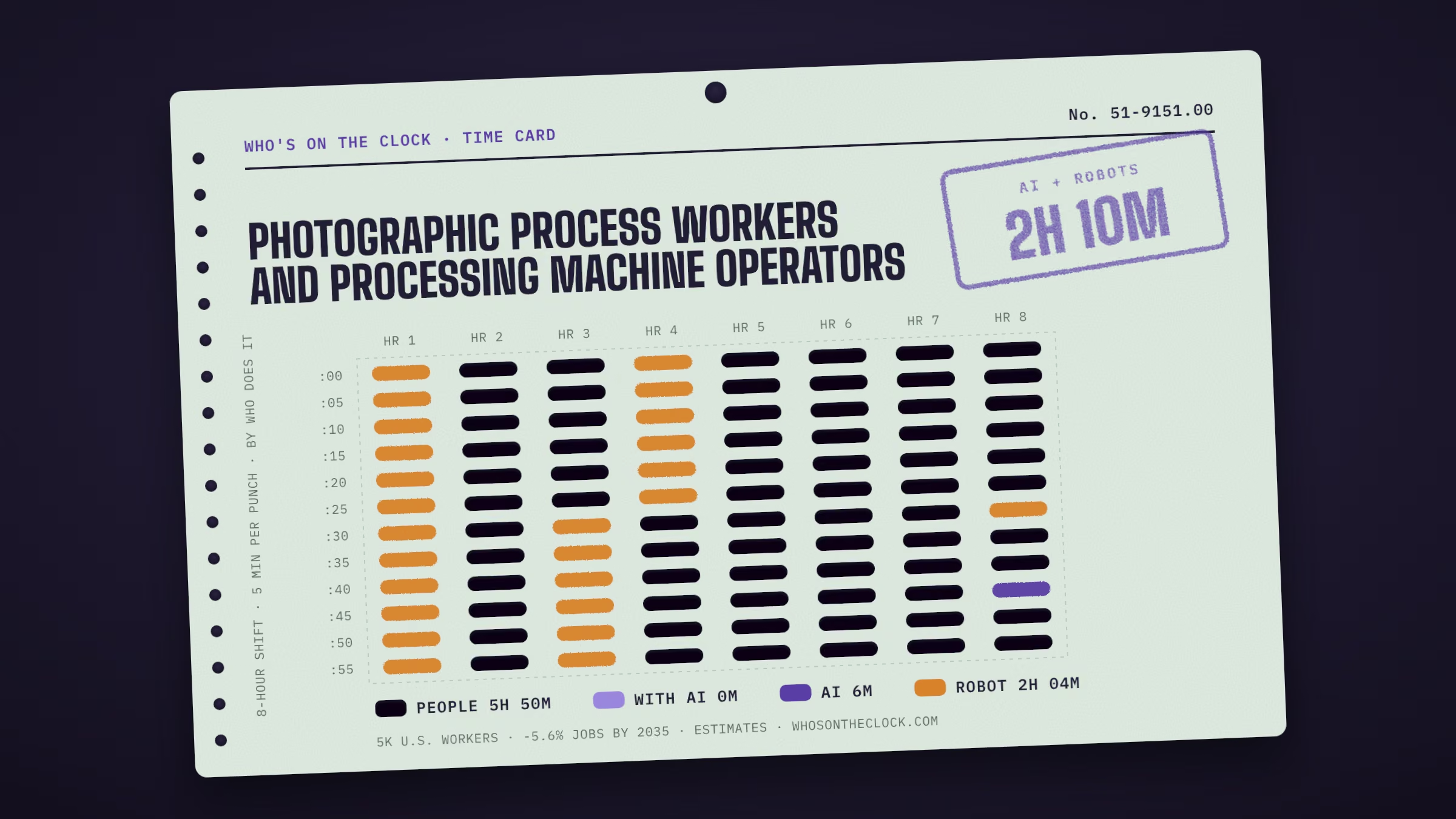
Perform work involved in developing and processing photographic images from film or digital media. May perform precision tasks such as editing photographic negatives and prints.
Time card
Untick tasks you don't do, or set your own times.
| Mine | Task, by time spent | Human | With AI | AI | Robot |
|---|---|---|---|---|---|
Create prints according to customer specifications and laboratory protocols.1h 2m a shift · Robots deployed · e.g. Kodak Moments self-service photo kiosks / APEX dry labWhy this label?Marked Robot because Kodak Moments self-service photo kiosks / APEX dry lab (in real use) has done this task in a real workplace. It shows a robot can do it somewhere, not that most photographic process workers and processing machine operators work alongside one. How labels work | |||||
Select digital images for printing, specify number of images to be printed, and direct to printer, using computer software.55m a shift · No AI or robot evidence foundWhy this label?No AI use or robot deployment showed up for this task in our data. That isn't proof it's safe; it may just be rare in the data. How labels work | |||||
Review computer-processed digital images for quality.34m a shift · No AI or robot evidence foundWhy this label?No AI use or robot deployment showed up for this task in our data. That isn't proof it's safe; it may just be rare in the data. How labels work | |||||
Produce color or black-and-white photographs, negatives, or slides, applying standard photographic reproduction techniques and procedures.27m a shift · Robots deployed · e.g. Kodak Moments Kiosk / Self-Service Print Station (SPS)Why this label?Marked Robot because Kodak Moments Kiosk / Self-Service Print Station (SPS) (in real use) has done this task in a real workplace. It shows a robot can do it somewhere, not that most photographic process workers and processing machine operators work alongside one. How labels work | |||||
Set or adjust machine controls, according to specifications, type of operation, or material requirements.27m a shift · Robots deployed · e.g. HP Latex 820/850 with HP Embedded Spectrophotometer (Closed-Loop Color Calibration)Why this label?Marked Robot because HP Latex 820/850 with HP Embedded Spectrophotometer (Closed-Loop Color Calibration) (in real use) has done this task in a real workplace. It shows a robot can do it somewhere, not that most photographic process workers and processing machine operators work alongside one. How labels work | |||||
Operate scanners or related computer equipment to digitize negatives, photographic prints, or other images.27m a shift · Robots only in factory cellsWhy this label?Robots have done this only in factory setups built around the machine, so it stays Human for photographic process workers and processing machine operators. How labels work | |||||
Load digital images onto computers directly from cameras or from storage devices, such as flash memory cards or universal serial bus (USB) devices.27m a shift · Robots only in factory cellsWhy this label?Robots have done this only in factory setups built around the machine, so it stays Human for photographic process workers and processing machine operators. How labels work | |||||
Examine developed prints for defects, such as broken lines, spots, or blurs.21m a shift · Robots only in factory cellsWhy this label?Robots have done this only in factory setups built around the machine, so it stays Human for photographic process workers and processing machine operators. How labels work | |||||
Read work orders to determine required processes, techniques, materials, or equipment.21m a shift · No AI or robot evidence foundWhy this label?No AI use or robot deployment showed up for this task in our data. That isn't proof it's safe; it may just be rare in the data. How labels work | |||||
Load circuit boards, racks or rolls of film, negatives, or printing paper into processing or printing machines.21m a shift · Robots only in factory cellsWhy this label?Robots have done this only in factory setups built around the machine, so it stays Human for photographic process workers and processing machine operators. How labels work | |||||
Insert processed negatives and prints into envelopes for delivery to customers.21m a shift · Robots only in factory cellsWhy this label?Robots have done this only in factory setups built around the machine, so it stays Human for photographic process workers and processing machine operators. How labels work | |||||
Clean or maintain photoprocessing or darkroom equipment, using ultrasonic equipment or cleaning and rinsing solutions.21m a shift · Robots only in factory cellsWhy this label?Robots have done this only in factory setups built around the machine, so it stays Human for photographic process workers and processing machine operators. How labels work | |||||
Monitor equipment operation to detect malfunctions.21m a shift · Robots only in factory cellsWhy this label?Robots have done this only in factory setups built around the machine, so it stays Human for photographic process workers and processing machine operators. How labels work | |||||
Operate special equipment to perform tasks such as transferring film to videotape or producing photographic enlargements.14m a shift · Robots only in factory cellsWhy this label?Robots have done this only in factory setups built around the machine, so it stays Human for photographic process workers and processing machine operators. How labels work | |||||
Maintain records, such as quantities or types of processing completed, materials used, or customer charges.14m a shift · No AI or robot evidence foundWhy this label?No AI use or robot deployment showed up for this task in our data. That isn't proof it's safe; it may just be rare in the data. How labels work | |||||
Retouch photographic negatives or original prints to correct defects.14m a shift · No AI or robot evidence foundWhy this label?This is physical work, and no robot has been shown doing it yet. How labels work | |||||
Fill tanks of processing machines with solutions such as developer, dyes, stop-baths, fixers, bleaches, or washes.7m a shift · Robots only in factory cellsWhy this label?Robots have done this only in factory setups built around the machine, so it stays Human for photographic process workers and processing machine operators. How labels work | |||||
Measure and mix chemicals to prepare solutions for processing, according to formulas.7m a shift · Robots only in factory cellsWhy this label?Robots have done this only in factory setups built around the machine, so it stays Human for photographic process workers and processing machine operators. How labels work | |||||
Reprint originals for enlargement or in sections to be pieced together.7m a shift · Robots deployed · e.g. KODAK Picture Kiosk G20 (Kodak Moments kiosk with print scanner and 6850/8810 printers)Why this label?Marked Robot because KODAK Picture Kiosk G20 (Kodak Moments kiosk with print scanner and 6850/8810 printers) (in real use) has done this task in a real workplace. It shows a robot can do it somewhere, not that most photographic process workers and processing machine operators work alongside one. How labels work | |||||
Immerse film, negatives, paper, or prints in developing solutions, fixing solutions, and water to complete photographic development processes.7m a shift · Robots only in factory cellsWhy this label?Robots have done this only in factory setups built around the machine, so it stays Human for photographic process workers and processing machine operators. How labels work | |||||
Examine quality of film fades or dissolves for potential color corrections, using color analyzers.7m a shift · Robots only in factory cellsWhy this label?Robots have done this only in factory setups built around the machine, so it stays Human for photographic process workers and processing machine operators. How labels work | |||||
Examine drawings, negatives, or photographic prints to determine coloring, shading, accenting, or other changes required for retouching or restoration.7m a shift · Observed in AI useWhy this label?Marked AI because this task shows up regularly in real AI conversations (Anthropic Economic Index, 2025 usage), and in most of them AI does the task on its own rather than helping a person. Many workplaces may not use AI for it at all. How labels work | |||||
Place sensitized paper in frames of projection printers, photostats, or other reproduction machines.7m a shift · Robots only in factory cellsWhy this label?Robots have done this only in factory setups built around the machine, so it stays Human for photographic process workers and processing machine operators. How labels work | |||||
Upload digital images onto Web sites for customers.7m a shift · No AI or robot evidence foundWhy this label?No AI use or robot deployment showed up for this task in our data. That isn't proof it's safe; it may just be rare in the data. How labels work | |||||
Thread filmstrips through densitometers or sensitometers and expose film to light to determine density of film, necessary color corrections, or light sensitivity.time not estimated · Robots only in factory cellsWhy this label?Robots have done this only in factory setups built around the machine, so it stays Human for photographic process workers and processing machine operators. How labels work | |||||
Produce timed prints with separate densities or color settings for each scene of a production.time not estimated · Robots deployed · e.g. Noritsu QSS-3704G high-volume minilabWhy this label?Marked Robot because Noritsu QSS-3704G high-volume minilab (in real use) has done this task in a real workplace. It shows a robot can do it somewhere, not that most photographic process workers and processing machine operators work alongside one. How labels work | |||||
Splice broken or separated film and mount film on reels.time not estimated · Robots only in factory cellsWhy this label?Robots have done this only in factory setups built around the machine, so it stays Human for photographic process workers and processing machine operators. How labels work |