Will AI replace plasterers and stucco masons?

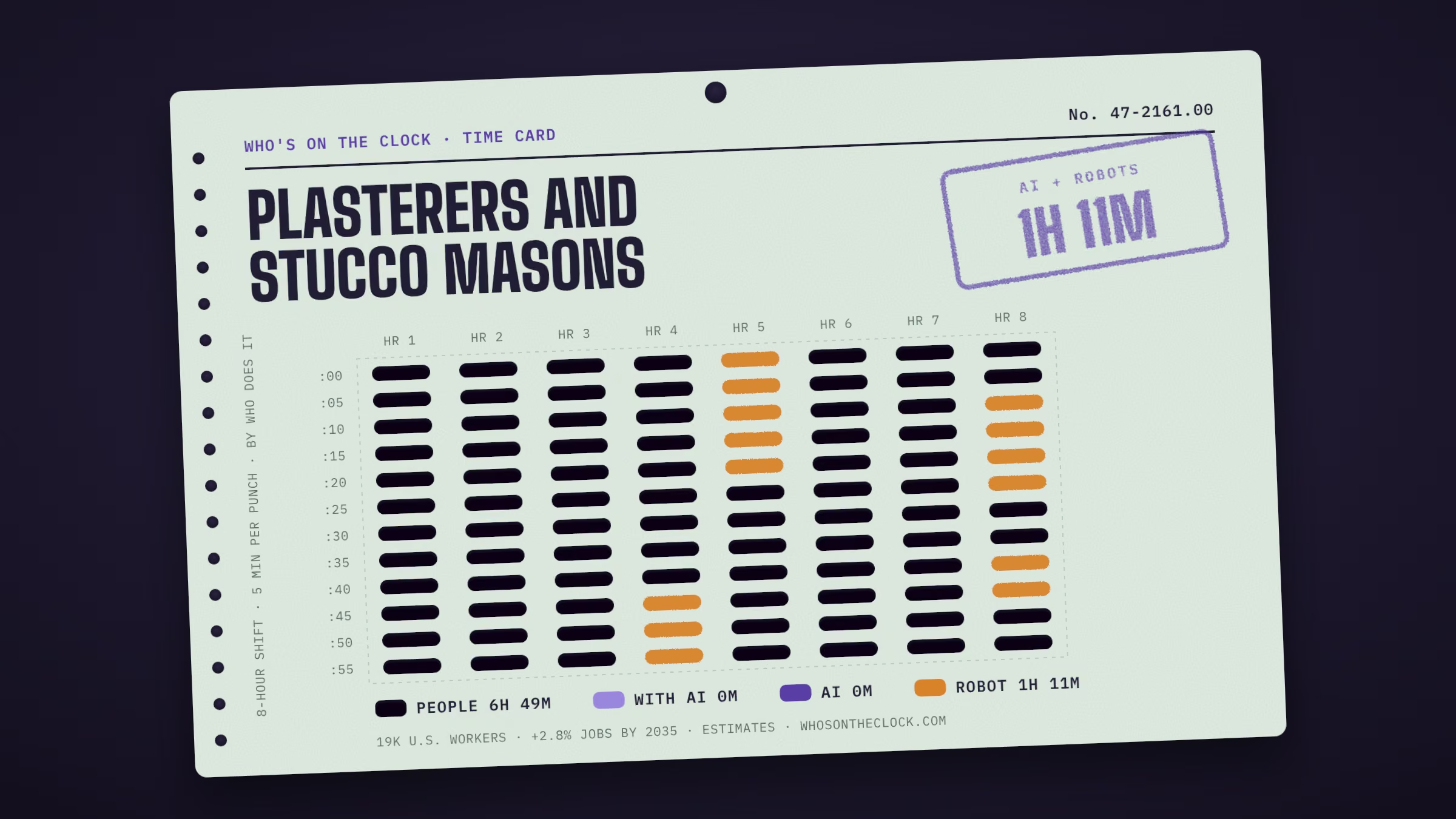
The biggest change here is physical: systems like Knauf PFT G 4 mixing pump have done tasks such as “Mix mortar and plaster to desired consistency or direct workers who perform mixing” in real workplaces, about 1h 11m of a typical shift. Most of the rest, 6h 49m, has no AI or robot evidence. BLS expects about 2.8% more of these jobs by 2035.

Time card for plasterers and stucco masons showing a typical 8-hour shift: 6h 49m done by people, 1h 11m by robots.
Each mark is 5 minutes of a typical shift for plasterers and stucco masons, colored by who does that task today. Estimates from O*NET tasks and Anthropic Economic Index data. How it's made

Home / Construction / Plasterers and Stucco Masons

Apply interior or exterior plaster, cement, stucco, or similar materials. May also set ornamental plaster.

Time card

Untick tasks you don't do, or set your own times.
MineTask, by time spentHumanWith AIAIRobot
Apply coats of plaster or stucco to walls, ceilings, or partitions of buildings, using trowels, brushes, or spray guns.1h 35m a shift · Robots only in factory cells
Why this label?Robots have done this only in factory setups built around the machine, so it stays Human for plasterers and stucco masons. How labels work
Apply weatherproof, decorative coverings to exterior surfaces of buildings, such as by troweling or spraying on coats of stucco.1h 23m a shift · Robots only in factory cells
Why this label?Robots have done this only in factory setups built around the machine, so it stays Human for plasterers and stucco masons. How labels work
Clean and prepare surfaces for applications of plaster, cement, stucco, or similar materials, such as by drywall taping.47m a shift · Robots only in factory cells
Why this label?Robots have done this only in factory setups built around the machine, so it stays Human for plasterers and stucco masons. How labels work
Mix mortar and plaster to desired consistency or direct workers who perform mixing.41m a shift · Robots deployed · e.g. Knauf PFT G 4 mixing pump (and silo/SILOMAT feed)
Why this label?Marked Robot because Knauf PFT G 4 mixing pump (and silo/SILOMAT feed) (in real use) has done this task in a real workplace. It shows a robot can do it somewhere, not that most plasterers and stucco masons work alongside one. How labels work
Clean job sites.30m a shift · Robots only in factory cells
Why this label?Robots have done this only in factory setups built around the machine, so it stays Human for plasterers and stucco masons. How labels work
Create decorative textures in finish coat, using brushes or trowels, sand, pebbles, or stones.30m a shift · Robots only in factory cells
Why this label?Robots have done this only in factory setups built around the machine, so it stays Human for plasterers and stucco masons. How labels work
Apply insulation to building exteriors by installing prefabricated insulation systems over existing walls or by covering the outer wall with insulation board, reinforcing mesh, and a base coat.30m a shift · No AI or robot evidence found
Why this label?This is physical work, and no robot has been shown doing it yet. How labels work
Install guide wires on exterior surfaces of buildings to indicate thickness of plaster or stucco and nail wire mesh, lath, or similar materials to the outside surface to hold stucco in place.30m a shift · No AI or robot evidence found
Why this label?This is physical work, and no robot has been shown doing it yet. How labels work
Set up scaffolds.24m a shift · Robots only in factory cells
Why this label?Robots have done this only in factory setups built around the machine, so it stays Human for plasterers and stucco masons. How labels work
Cover surfaces such as windows, doors, or sidewalks to protect from splashing.18m a shift · Robots only in factory cells
Why this label?Robots have done this only in factory setups built around the machine, so it stays Human for plasterers and stucco masons. How labels work
Spray acoustic materials or texture finish over walls or ceilings.18m a shift · Robots deployed · e.g. Okibo EG7
Why this label?Marked Robot because Okibo EG7 (in real use) has done this task in a real workplace. It shows a robot can do it somewhere, not that most plasterers and stucco masons work alongside one. How labels work
Determine materials needed to complete the job and place orders accordingly.12m a shift · No AI or robot evidence found
Why this label?No AI use or robot deployment showed up for this task in our data. That isn't proof it's safe; it may just be rare in the data. How labels work
Rough the undercoat surface with a scratcher so the finish coat will adhere.12m a shift · Robots deployed · e.g. Okibo EG7 (and earlier EP-1000) autonomous finishing robot
Why this label?Marked Robot because Okibo EG7 (and earlier EP-1000) autonomous finishing robot (in real use) has done this task in a real workplace. It shows a robot can do it somewhere, not that most plasterers and stucco masons work alongside one. How labels work
Cure freshly plastered surfaces.6m a shift · Robots only in factory cells
Why this label?Robots have done this only in factory setups built around the machine, so it stays Human for plasterers and stucco masons. How labels work
Mold or install ornamental plaster pieces, panels, or trim.6m a shift · No AI or robot evidence found
Why this label?This is physical work, and no robot has been shown doing it yet. How labels work

Clock history

  1. 1h 11m touchedFirst published: O*NET 30.1, Anthropic Economic Index (2025 usage and September 2026 robot study), BLS May 2025

When new data changes this clock, the date, the new numbers and the reason are logged here. Company news alone never moves the clock.

On the floor

No company news tracked for this job yet. New stories are added as they happen.

Ask the clock

Will AI replace plasterers and stucco masons?

Unlikely, though parts of the work are changing. About 1h 11m of an 8-hour shift goes to tasks touched by robots. The other 6h 49m (85%) stays with people. Separately, BLS expects about 2.8% more of these jobs by 2035 (all jobs: +3.5%).

What can AI already do for plasterers and stucco masons?

None of this job's tasks show regular AI use yet. That can mean the work is hands-on or in person, or simply that it rarely comes up in AI usage data.

Where do robots fit in?

For some tasks, yes. Robots have done 3 of this job's tasks in workplaces like this one, about 1h 11m of a typical shift. 8 more tasks have only been done in factory setups built around the machine, so they stay with people here. For 3 physical tasks, no robot has shown it can do the work yet.

  • Mix mortar and plaster to desired consistency or direct workers who perform mixing. (41m a shift; e.g. Knauf PFT G 4 mixing pump (and silo/SILOMAT feed), in use)
  • Spray acoustic materials or texture finish over walls or ceilings. (18m a shift; e.g. Okibo EG7, in use)
  • Rough the undercoat surface with a scratcher so the finish coat will adhere. (12m a shift; e.g. Okibo EG7 (and earlier EP-1000) autonomous finishing robot, in use)
What still needs a person?

6h 49m of a typical shift, or 85%, goes to tasks with no AI or robot evidence yet. No AI usage or robot deployment has shown up for these so far. The biggest:

  • Apply coats of plaster or stucco to walls, ceilings, or partitions of buildings, using trowels, brushes, or spray guns. (1h 35m a shift)
  • Apply weatherproof, decorative coverings to exterior surfaces of buildings, such as by troweling or spraying on coats of stucco. (1h 23m a shift)
  • Clean and prepare surfaces for applications of plaster, cement, stucco, or similar materials, such as by drywall taping. (47m a shift)
  • Clean job sites. (30m a shift)
  • Create decorative textures in finish coat, using brushes or trowels, sand, pebbles, or stones. (30m a shift)
Why is that work hard to automate?

Much of it comes down to where and how the work happens. In-person, hands-on and high-stakes work is where AI and robots have made the least headway so far. In the official O*NET survey of people in this job:

  • 100% spend more than half the day on their feet
  • 99% use their hands on tools, objects or controls more than half the time
  • 78% work at arm's length or closer to other people
Are employers still hiring plasterers and stucco masons?

On Indeed, job postings in the Construction sector are at 129% of their February 2020 level (all U.S. postings: 104%), up 6.4% from a year earlier, as of Oct 9, 2026. BLS separately expects about 1,500 openings a year in this job through 2035. Across all U.S. postings, 7.3% now mention AI skills. Sector postings cover more than this one job and move for many reasons besides AI.

How much do plasterers and stucco masons make?

The median pay is about $57,660 a year ($27.72 an hour), 13% above the median for all U.S. jobs ($50,980). Most people in this job earn between $39,560 and $96,710 a year; that range covers the middle 80%. Pay figures are from BLS, May 2025, and vary a lot by state and employer. Pick a state to compare:

Is this job growing or shrinking?

BLS projects growth of 2.8% from 2025 to 2035, compared with 3.5% growth for all jobs. That's about 24,000 jobs in 2035. It expects about 1,500 openings a year, mostly from people retiring or changing careers. These projections don't single out AI as a cause.

How many plasterers and stucco masons are there in the U.S.?

About 19,000 people in the U.S., roughly 0.01% of all workers (BLS, May 2025). That makes it the 558th largest of the 796 jobs on this site. BLS expects about 24,000 in 2035.

What training do plasterers and stucco masons need?

The most common requirement is less than a high school diploma: about 68% of people in the job said so in the official O*NET survey. O*NET rates the job at level 1 of 5 for preparation, which usually means: little or no preparation. Requirements vary by state and employer, especially for licensed work.

What should I learn to stay ahead of AI?

These come from the job's official skill ratings and from the tasks that AI and robots touch least today. Building them keeps you strong in the parts of the work that still need a person:

  • Skills that matter more here than in most jobs: Quality Control Analysis, Time Management, Active Listening
  • Get strong at the parts of the job that stay with people (listed above), which take 6h 49m of a typical shift
  • Tools employers list: Linux, Microsoft Excel, Microsoft Office software, Microsoft Word, Oracle Database
What other jobs could plasterers and stucco masons move into?

These use similar skills, with less of a typical shift touched by AI or robots. Matches come from 109 official ratings of skills, knowledge and work activities, and each needs the same or less preparation unless the official list relates the jobs directly:

  • Insulation Workers, Floor, Ceiling, and Wall (0m touched, $49k median pay)
  • Roofers (35m touched, $55k median pay)
  • Floor Sanders and Finishers (0m touched, $50k median pay)
  • Cement Masons and Concrete Finishers (41m touched, $57k median pay)
How solid are these numbers?

Each task carries its own evidence label. For this job: 3 with robots in real deployments, 12 with no AI or robot evidence found. The minutes per task are estimates, not measured hours, and "no evidence" doesn't prove a task is safe.

Tools in demand

  • Linux
  • Oracle Database
  • Salesforce software

Plus everyday office tools: Microsoft Excel, Microsoft Office software, Microsoft Word.

Also called

Applicator, Artisan, Artisan Plasterer, Decorative Plasterer, Dry Plasterer, Hard Surface Plasterer, Mason, Mason Plasterer, Modeler, Molding Plasterer, Ornamental Plasterer, Plaster Applicator, Plaster Mechanic, Plaster Molder