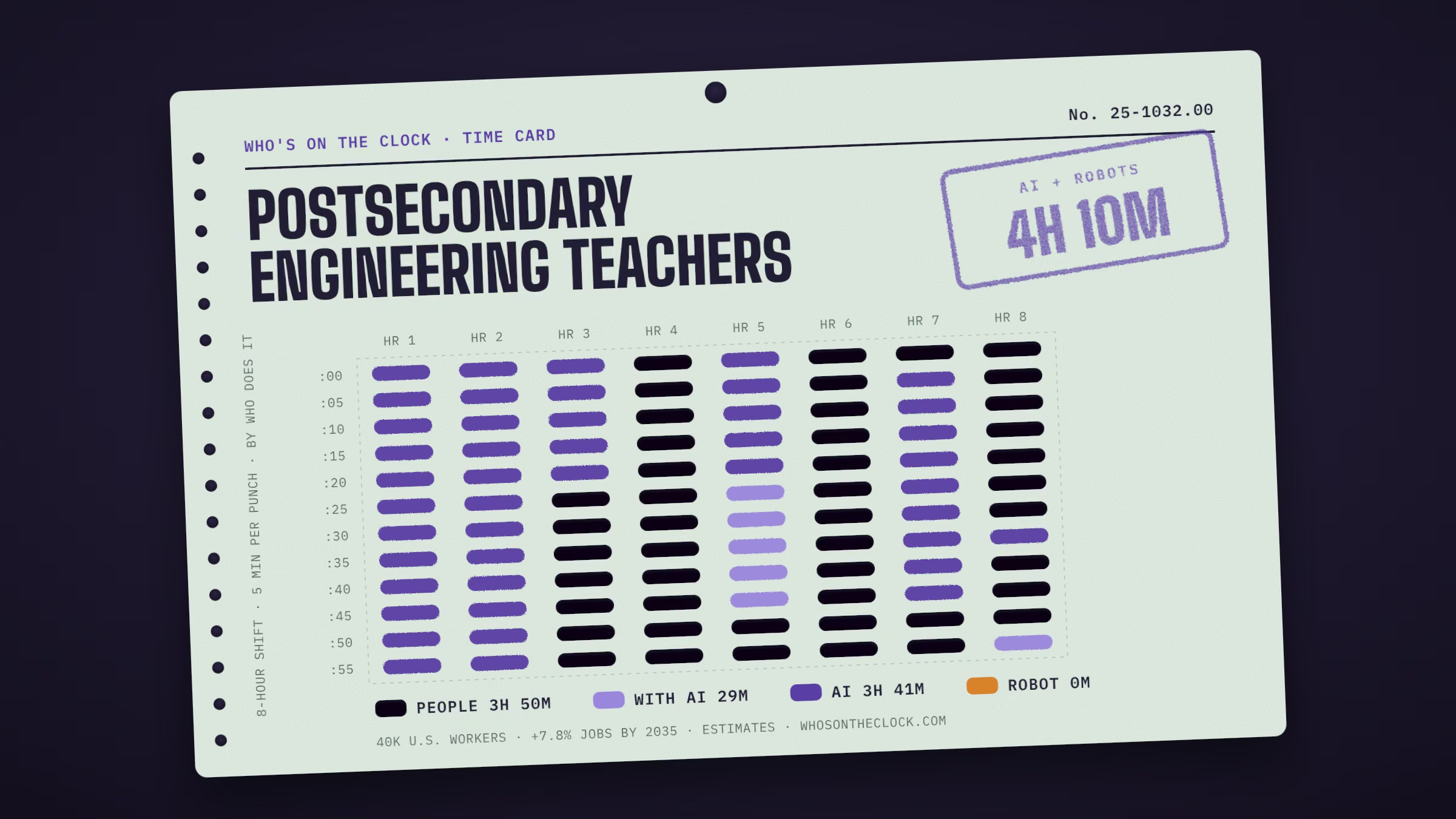
Teach courses pertaining to the application of physical laws and principles of engineering for the development of machines, materials, instruments, processes, and services. Includes teachers of subjects such as chemical, civil, electrical, industrial, mechanical, mineral, and petroleum engineering. Includes both teachers primarily engaged in teaching and those who do a combination of teaching and research.
Time card
Untick tasks you don't do, or set your own times.
| Mine | Task, by time spent | Human | With AI | AI | Robot |
|---|---|---|---|---|---|
Conduct research in a particular field of knowledge and publish findings in professional journals, books, or electronic media.1h 36m a shift · Observed in AI useTypical AI request: about 8h 34m alone, 31m with AIWhy this label?Marked AI because this task shows up regularly in real AI conversations (Anthropic Economic Index, 2025 usage), and in most of them AI does the task on its own rather than helping a person. Many workplaces may not use AI for it at all. How labels work | |||||
Prepare and deliver lectures to undergraduate or graduate students on topics such as mechanics, hydraulics, and robotics.53m a shift · Observed in AI useTypical AI request: about 1h 55m alone, 23m with AIWhy this label?Marked AI because this task shows up regularly in real AI conversations (Anthropic Economic Index, 2025 usage), and in most of them AI does the task on its own rather than helping a person. Many workplaces may not use AI for it at all. How labels work | |||||
Supervise undergraduate or graduate teaching, internship, and research work.38m a shift · No AI or robot evidence foundWhy this label?No AI use or robot deployment showed up for this task in our data. That isn't proof it's safe; it may just be rare in the data. How labels work | |||||
Prepare course materials, such as syllabi, homework assignments, and handouts.34m a shift · No AI or robot evidence foundWhy this label?No AI use or robot deployment showed up for this task in our data. That isn't proof it's safe; it may just be rare in the data. How labels work | |||||
Write grant proposals to procure external research funding.29m a shift · No AI or robot evidence foundWhy this label?No AI use or robot deployment showed up for this task in our data. That isn't proof it's safe; it may just be rare in the data. How labels work | |||||
Evaluate and grade students' class work, laboratory work, assignments, and papers.24m a shift · Observed in AI useTypical AI request: about 5h 29m alone, 43m with AIWhy this label?Marked AI because this task shows up regularly in real AI conversations (Anthropic Economic Index, 2025 usage), and in most of them AI does the task on its own rather than helping a person. Many workplaces may not use AI for it at all. How labels work | |||||
Keep abreast of developments in the field by reading current literature, talking with colleagues, and participating in professional conferences.24m a shift · Observed in AI useWhy this label?Marked With AI because people regularly use AI to help with this task in real conversations (Anthropic Economic Index, 2025 usage), but AI doesn't usually finish it alone. How labels work | |||||
Collaborate with colleagues to address teaching and research issues.19m a shift · No AI or robot evidence foundWhy this label?No AI use or robot deployment showed up for this task in our data. That isn't proof it's safe; it may just be rare in the data. How labels work | |||||
Maintain regularly scheduled office hours to advise and assist students.19m a shift · No AI or robot evidence foundWhy this label?No AI use or robot deployment showed up for this task in our data. That isn't proof it's safe; it may just be rare in the data. How labels work | |||||
Serve on academic or administrative committees that deal with institutional policies, departmental matters, and academic issues.19m a shift · No AI or robot evidence foundWhy this label?No AI use or robot deployment showed up for this task in our data. That isn't proof it's safe; it may just be rare in the data. How labels work | |||||
Supervise students' laboratory work.14m a shift · No AI or robot evidence foundWhy this label?No AI use or robot deployment showed up for this task in our data. That isn't proof it's safe; it may just be rare in the data. How labels work | |||||
Compile, administer, and grade examinations, or assign this work to others.14m a shift · Observed in AI useTypical AI request: about 8h 15m alone, 25m with AIWhy this label?Marked AI because this task shows up regularly in real AI conversations (Anthropic Economic Index, 2025 usage), and in most of them AI does the task on its own rather than helping a person. Many workplaces may not use AI for it at all. How labels work | |||||
Plan, evaluate, and revise curricula, course content, and course materials and methods of instruction.14m a shift · Observed in AI useTypical AI request: about 10h 13m alone, 1h 13m with AIWhy this label?Marked AI because this task shows up regularly in real AI conversations (Anthropic Economic Index, 2025 usage), and in most of them AI does the task on its own rather than helping a person. Many workplaces may not use AI for it at all. How labels work | |||||
Advise students on academic and vocational curricula and on career issues.14m a shift · Observed in AI useTypical AI request: about 4h 19m alone, 51m with AIWhy this label?Marked AI because this task shows up regularly in real AI conversations (Anthropic Economic Index, 2025 usage), and in most of them AI does the task on its own rather than helping a person. Many workplaces may not use AI for it at all. How labels work | |||||
Perform administrative duties, such as serving as department head.14m a shift · No AI or robot evidence foundWhy this label?No AI use or robot deployment showed up for this task in our data. That isn't proof it's safe; it may just be rare in the data. How labels work | |||||
Initiate, facilitate, and moderate class discussions.10m a shift · No AI or robot evidence foundWhy this label?No AI use or robot deployment showed up for this task in our data. That isn't proof it's safe; it may just be rare in the data. How labels work | |||||
Maintain student attendance records, grades, and other required records.10m a shift · No AI or robot evidence foundWhy this label?No AI use or robot deployment showed up for this task in our data. That isn't proof it's safe; it may just be rare in the data. How labels work | |||||
Review manuscripts for professional journals.10m a shift · No AI or robot evidence foundWhy this label?No AI use or robot deployment showed up for this task in our data. That isn't proof it's safe; it may just be rare in the data. How labels work | |||||
Participate in student recruitment, registration, and placement activities.5m a shift · Observed in AI useWhy this label?Marked AI because this task shows up regularly in real AI conversations (Anthropic Economic Index, 2025 usage), and in most of them AI does the task on its own rather than helping a person. Many workplaces may not use AI for it at all. How labels work | |||||
Select and obtain materials and supplies, such as textbooks and laboratory equipment.5m a shift · No AI or robot evidence foundWhy this label?No AI use or robot deployment showed up for this task in our data. That isn't proof it's safe; it may just be rare in the data. How labels work | |||||
Participate in campus and community events.5m a shift · No AI or robot evidence foundWhy this label?No AI use or robot deployment showed up for this task in our data. That isn't proof it's safe; it may just be rare in the data. How labels work | |||||
Act as advisers to student organizations.5m a shift · No AI or robot evidence foundWhy this label?No AI use or robot deployment showed up for this task in our data. That isn't proof it's safe; it may just be rare in the data. How labels work | |||||
Provide professional consulting services to government or industry.5m a shift · Observed in AI useWhy this label?Marked With AI because people regularly use AI to help with this task in real conversations (Anthropic Economic Index, 2025 usage), but AI doesn't usually finish it alone. How labels work | |||||
Compile bibliographies of specialized materials for outside reading assignments.time not estimated · Observed in AI useWhy this label?Marked AI because this task shows up regularly in real AI conversations (Anthropic Economic Index, 2025 usage), and in most of them AI does the task on its own rather than helping a person. Many workplaces may not use AI for it at all. How labels work |