Will AI replace restaurant cooks?

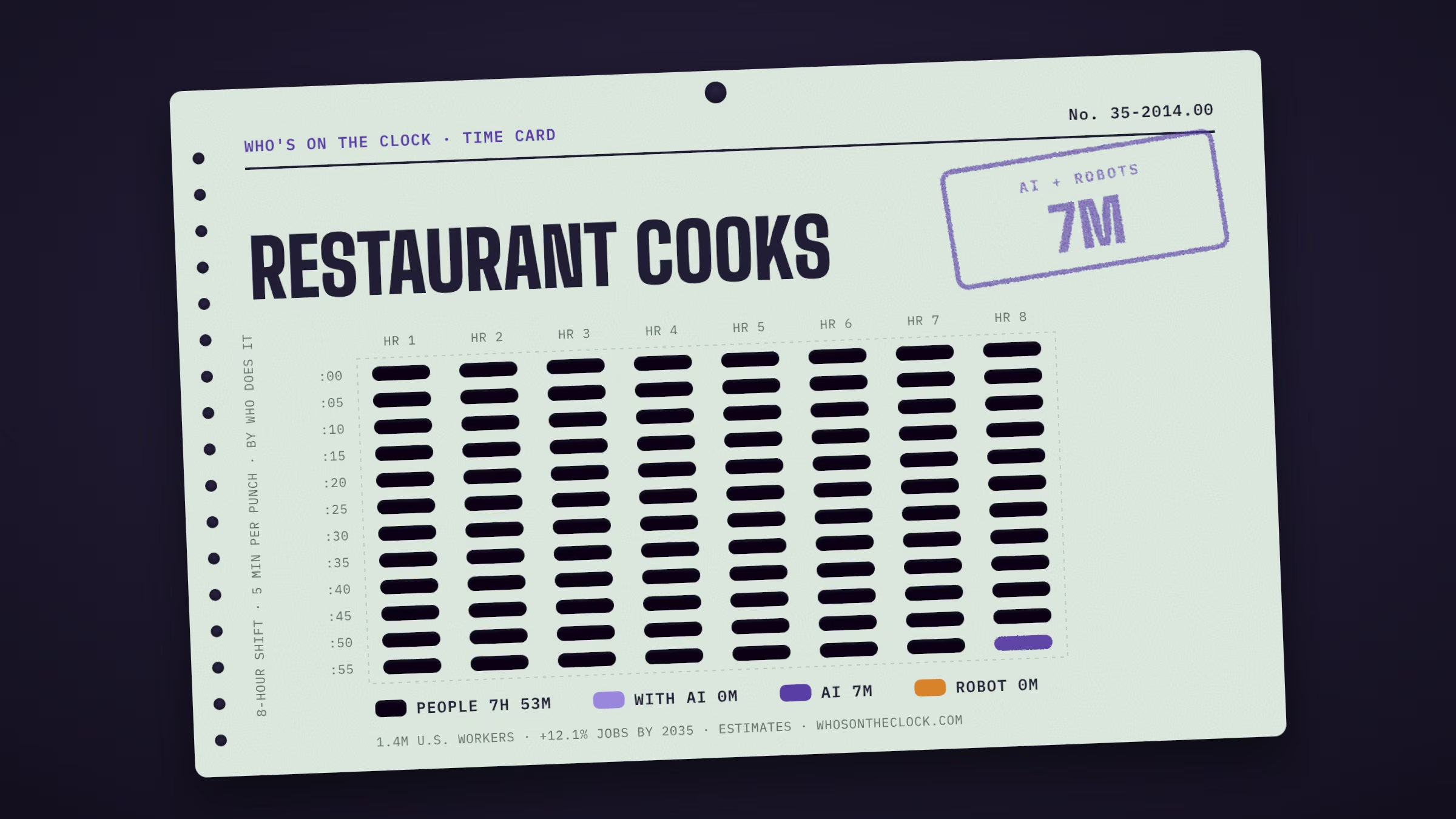
AI already handles some of this work on its own in real use, for tasks like “Plan and price menu items”. That's 7m of a typical shift; 7h 53m still has no AI or robot evidence. BLS expects about 12.1% more of these jobs by 2035.

Time card for restaurant cooks showing a typical 8-hour shift: 7h 53m done by people, 7m by AI.
Each mark is 5 minutes of a typical shift for restaurant cooks, colored by who does that task today. Estimates from O*NET tasks and Anthropic Economic Index data. How it's made

Home / Food service / Restaurant Cooks

Prepare, season, and cook dishes such as soups, meats, vegetables, or desserts in restaurants. May order supplies, keep records and accounts, price items on menu, or plan menu.

Time card

Untick tasks you don't do, or set your own times.
MineTask, by time spentHumanWith AIAIRobot
Season and cook food according to recipes or personal judgment and experience.1h 23m a shift · Robots only in factory cells
Why this label?Robots have done this only in factory setups built around the machine, so it stays Human for restaurant cooks. How labels work
Portion, arrange, and garnish food, and serve food to waiters or patrons.51m a shift · Robots only in factory cells
Why this label?Robots have done this only in factory setups built around the machine, so it stays Human for restaurant cooks. How labels work
Inspect and clean food preparation areas, such as equipment, work surfaces, and serving areas, to ensure safe and sanitary food-handling practices.45m a shift · Robots only in factory cells
Why this label?Robots have done this only in factory setups built around the machine, so it stays Human for restaurant cooks. How labels work
Bake, roast, broil, and steam meats, fish, vegetables, and other foods.45m a shift · Robots only in factory cells
Why this label?Robots have done this only in factory setups built around the machine, so it stays Human for restaurant cooks. How labels work
Weigh, measure, and mix ingredients according to recipes or personal judgment, using various kitchen utensils and equipment.38m a shift · Robots only in factory cells
Why this label?Robots have done this only in factory setups built around the machine, so it stays Human for restaurant cooks. How labels work
Wash, peel, cut, and seed fruits and vegetables to prepare them for consumption.38m a shift · Robots only in factory cells
Why this label?Robots have done this only in factory setups built around the machine, so it stays Human for restaurant cooks. How labels work
Turn or stir foods to ensure even cooking.26m a shift · Robots only in factory cells
Why this label?Robots have done this only in factory setups built around the machine, so it stays Human for restaurant cooks. How labels work
Ensure food is stored and cooked at correct temperature by regulating temperature of ovens, broilers, grills, and roasters.19m a shift · Robots only in factory cells
Why this label?Robots have done this only in factory setups built around the machine, so it stays Human for restaurant cooks. How labels work
Ensure freshness of food and ingredients by checking for quality, keeping track of old and new items, and rotating stock.19m a shift · Robots only in factory cells
Why this label?Robots have done this only in factory setups built around the machine, so it stays Human for restaurant cooks. How labels work
Coordinate and supervise work of kitchen staff.19m a shift · No AI or robot evidence found
Why this label?No AI use or robot deployment showed up for this task in our data. That isn't proof it's safe; it may just be rare in the data. How labels work
Observe and test foods to determine if they have been cooked sufficiently, using methods such as tasting, smelling, or piercing them with utensils.19m a shift · Robots only in factory cells
Why this label?Robots have done this only in factory setups built around the machine, so it stays Human for restaurant cooks. How labels work
Substitute for or assist other cooks during emergencies or rush periods.13m a shift · No AI or robot evidence found
Why this label?This is physical work, and no robot has been shown doing it yet. How labels work
Carve and trim meats such as beef, veal, ham, pork, and lamb for hot or cold service, or for sandwiches.13m a shift · Robots only in factory cells
Why this label?Robots have done this only in factory setups built around the machine, so it stays Human for restaurant cooks. How labels work
Estimate expected food consumption, requisition or purchase supplies, or procure food from storage.13m a shift · Robots only in factory cells
Why this label?Robots have done this only in factory setups built around the machine, so it stays Human for restaurant cooks. How labels work
Bake breads, rolls, cakes, and pastries.6m a shift · Robots only in factory cells
Why this label?Robots have done this only in factory setups built around the machine, so it stays Human for restaurant cooks. How labels work
Keep records and accounts.6m a shift · No AI or robot evidence found
Why this label?No AI use or robot deployment showed up for this task in our data. That isn't proof it's safe; it may just be rare in the data. How labels work
Prepare relishes and hors d'oeuvres.6m a shift · Robots only in factory cells
Why this label?Robots have done this only in factory setups built around the machine, so it stays Human for restaurant cooks. How labels work
Consult with supervisory staff to plan menus, taking into consideration factors such as costs and special event needs.6m a shift · No AI or robot evidence found
Why this label?No AI use or robot deployment showed up for this task in our data. That isn't proof it's safe; it may just be rare in the data. How labels work
Butcher and dress animals, fowl, or shellfish, or cut and bone meat prior to cooking.6m a shift · Robots only in factory cells
Why this label?Robots have done this only in factory setups built around the machine, so it stays Human for restaurant cooks. How labels work
Plan and price menu items.6m a shift · Observed in AI use
Why this label?Marked AI because this task shows up regularly in real AI conversations (Anthropic Economic Index, 2025 usage), and in most of them AI does the task on its own rather than helping a person. Many workplaces may not use AI for it at all. How labels work

Clock history

  1. 7m touchedFirst published: O*NET 30.1, Anthropic Economic Index (2025 usage and September 2026 robot study), BLS May 2025

When new data changes this clock, the date, the new numbers and the reason are logged here. Company news alone never moves the clock.

On the floor

  1. WidespreadSweetgreen
    Sweetgreen sells Spyce to Wonder and keeps its robot Infinite Kitchen

    Sweetgreen sold Spyce, the maker of its automated Infinite Kitchen, to Wonder and expects to keep using the system under a long-term supply agreement. Infinite Kitchen runs in more than 20 of Sweetgreen's more than 280 locations.

    Business Wire

  2. PlanSweetgreen
    Sweetgreen plans to add 25 more automated Infinite Kitchens in 2025

    Sweetgreen expects to add 25 more Infinite Kitchens by the end of 2025, after ending 2024 with 12. It says the automated stores deliver at least 7 percentage points in labor savings versus similar stores.

    NACS Daily

Ask the clock

Will AI replace restaurant cooks?

Not on current evidence. Less than 30 minutes of a typical shift goes to tasks that AI or robots are doing today. The other 7h 53m (99%) stays with people. Separately, BLS expects about 12.1% more of these jobs by 2035 (all jobs: +3.5%).

What can AI already do for restaurant cooks?

AI shows up regularly in 1 of 20 tasks, about 7m of a typical shift. The biggest ones:

  • Plan and price menu items. (6m a shift, AI mostly does it alone)
Where do robots fit in?

Not in workplaces like this one, based on a 2026 review of robot deployments. 15 more tasks have only been done in factory setups built around the machine, so they stay with people here. For 1 physical task, no robot has shown it can do the work yet.

What still needs a person?

7h 53m of a typical shift, or 99%, goes to tasks with no AI or robot evidence yet. No AI usage or robot deployment has shown up for these so far. The biggest:

  • Season and cook food according to recipes or personal judgment and experience. (1h 23m a shift)
  • Portion, arrange, and garnish food, and serve food to waiters or patrons. (51m a shift)
  • Inspect and clean food preparation areas, such as equipment, work surfaces, and serving areas, to ensure safe and sanitary food-handling practices. (45m a shift)
  • Bake, roast, broil, and steam meats, fish, vegetables, and other foods. (45m a shift)
  • Weigh, measure, and mix ingredients according to recipes or personal judgment, using various kitchen utensils and equipment. (38m a shift)
Why is that work hard to automate?

Much of it comes down to where and how the work happens. In-person, hands-on and high-stakes work is where AI and robots have made the least headway so far. In the official O*NET survey of people in this job:

  • 95% spend more than half the day on their feet
  • 93% use their hands on tools, objects or controls more than half the time
  • 86% work at arm's length or closer to other people
What are companies actually doing?

We track 2 sourced company moves that affect this job. Most recent:

  • Dec 26, 2025: Sweetgreen sells Spyce to Wonder and keeps its robot Infinite Kitchen (Widespread)
  • Apr 11, 2025: Sweetgreen plans to add 25 more automated Infinite Kitchens in 2025 (Plan)
Are employers still hiring restaurant cooks?

On Indeed, job postings in the Food Preparation & Service sector are at 96% of their February 2020 level (all U.S. postings: 104%), down 3.1% from a year earlier, as of Oct 9, 2026. BLS separately expects about 219,000 openings a year in this job through 2035. Across all U.S. postings, 7.3% now mention AI skills. Sector postings cover more than this one job and move for many reasons besides AI.

How much do restaurant cooks make?

The median pay is about $37,390 a year ($17.98 an hour), 27% below the median for all U.S. jobs ($50,980). Most people in this job earn between $28,700 and $47,900 a year; that range covers the middle 80%. Pay figures are from BLS, May 2025, and vary a lot by state and employer. Pick a state to compare:

Is this job growing or shrinking?

BLS projects growth of 12.1% from 2025 to 2035, compared with 3.5% growth for all jobs. That's about 1.6 million jobs in 2035. It expects about 219,000 openings a year, mostly from people retiring or changing careers. These projections don't single out AI as a cause.

How many restaurant cooks are there in the U.S.?

About 1.4 million people in the U.S., roughly 0.91% of all workers (BLS, May 2025). That makes it the 23rd largest of the 796 jobs on this site. BLS expects about 1.6 million in 2035.

What training do restaurant cooks need?

The most common requirement is a high school diploma: about 47% of people in the job said so in the official O*NET survey. O*NET rates the job at level 2 of 5 for preparation, which usually means: high school diploma, some training. Requirements vary by state and employer, especially for licensed work.

What should I learn to stay ahead of AI?

These come from the job's official skill ratings and from the tasks that AI and robots touch least today. Building them keeps you strong in the parts of the work that still need a person:

  • Skills that matter more here than in most jobs: Time Management, Monitoring, Speaking, Critical Thinking
  • Get strong at the parts of the job that stay with people (listed above), which take 7h 53m of a typical shift
  • Tools employers list: Facebook, Microsoft Excel, Microsoft Office software, Microsoft Outlook, Microsoft Word
  • Learn to use AI well on the tasks where it already shows up in this job (listed above)
What other jobs could restaurant cooks move into?

These use similar skills. Matches come from 109 official ratings of skills, knowledge and work activities, and each needs the same or less preparation unless the official list relates the jobs directly:

  • Dishwashers (3h 56m touched, $35k median pay)
  • Sewing Machine Operators (19m touched, $37k median pay)
  • Short Order Cooks (1h 36m touched, $36k median pay)
  • Tapers (3h 41m touched, $68k median pay)
  • Fast Food Cooks (2h 13m touched, $31k median pay)
How solid are these numbers?

Each task carries its own evidence label. For this job: 1 observed in real AI use, 19 with no AI or robot evidence found. The minutes per task are estimates, not measured hours, and "no evidence" doesn't prove a task is safe.

Tools in demand

  • Facebook

Plus everyday office tools: Microsoft Excel, Microsoft Office software, Microsoft Outlook, Microsoft Word.

Also called

Back Line Cook, Back of House Team Member (BOH Team Member), Banquet Cook, Breakfast Cook, Broiler Cook, Chef De Partie, Cook, Foreign Food Specialty Cook, Fry Cook, Grill Cook, Hotel and Restaurant Cook, Larder Cook, Line Cook, Pizza Maker