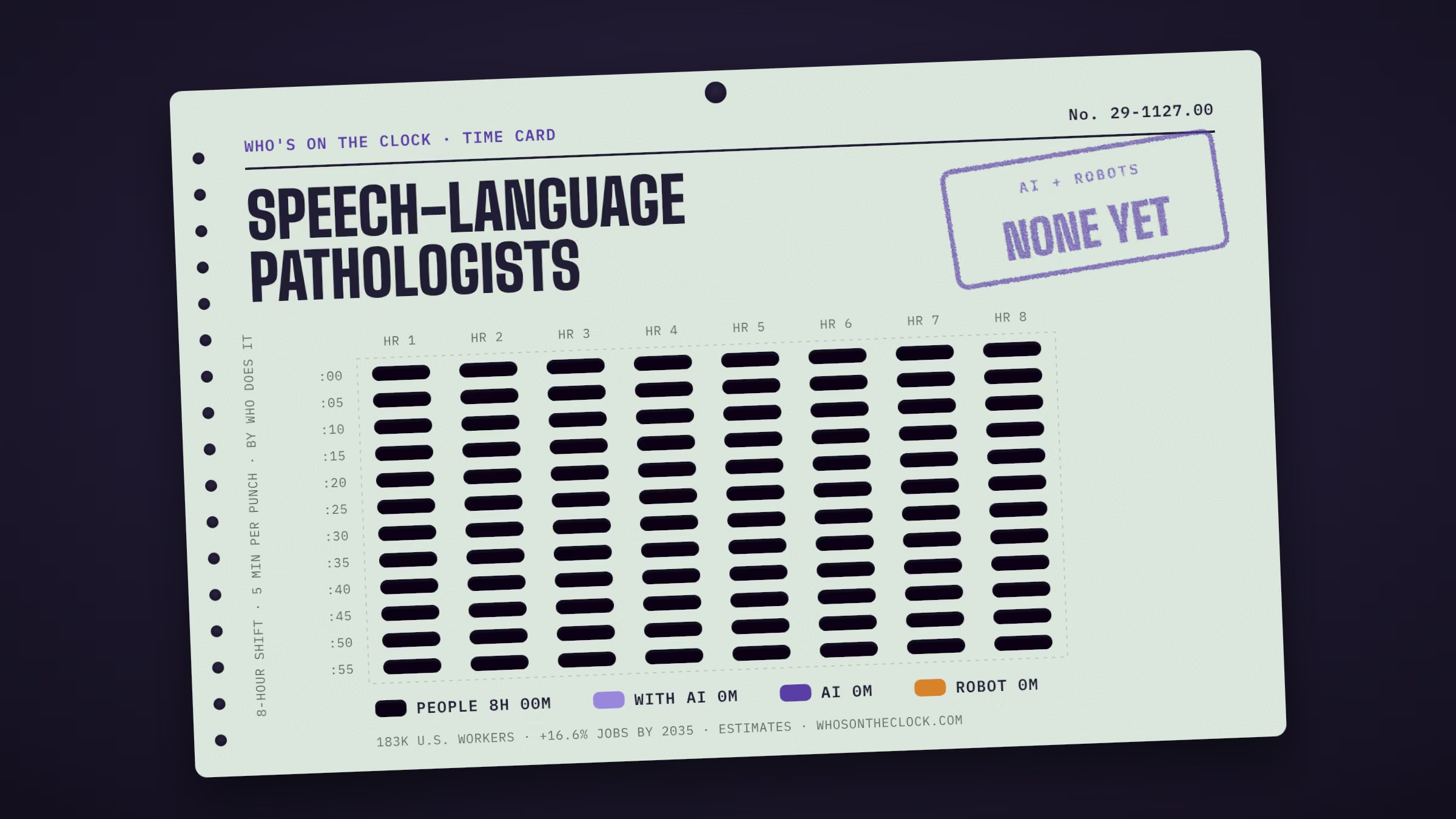
Assess and treat persons with speech, language, voice, and fluency disorders. May select alternative communication systems and teach their use. May perform research related to speech and language problems.
Time card
Untick tasks you don't do, or set your own times.
| Mine | Task, by time spent | Human | With AI | AI | Robot |
|---|---|---|---|---|---|
Write reports and maintain proper documentation of information, such as client Medicaid or billing records or caseload activities, including the initial evaluation, treatment, progress, and discharge of clients.1h 9m a shift · No AI or robot evidence foundWhy this label?No AI use or robot deployment showed up for this task in our data. That isn't proof it's safe; it may just be rare in the data. How labels work | |||||
Administer hearing or speech and language evaluations, tests, or examinations to patients to collect information on type and degree of impairments, using written or oral tests or special instruments.38m a shift · No AI or robot evidence foundWhy this label?No AI use or robot deployment showed up for this task in our data. That isn't proof it's safe; it may just be rare in the data. How labels work | |||||
Evaluate hearing or speech and language test results, barium swallow results, or medical or background information to diagnose and plan treatment for speech, language, fluency, voice, or swallowing disorders.32m a shift · No AI or robot evidence foundWhy this label?No AI use or robot deployment showed up for this task in our data. That isn't proof it's safe; it may just be rare in the data. How labels work | |||||
Develop or implement treatment plans for problems such as stuttering, delayed language, swallowing disorders, or inappropriate pitch or harsh voice problems, based on own assessments and recommendations of physicians, psychologists, or social workers.32m a shift · No AI or robot evidence foundWhy this label?No AI use or robot deployment showed up for this task in our data. That isn't proof it's safe; it may just be rare in the data. How labels work | |||||
Teach clients to control or strengthen tongue, jaw, face muscles, or breathing mechanisms.32m a shift · No AI or robot evidence foundWhy this label?No AI use or robot deployment showed up for this task in our data. That isn't proof it's safe; it may just be rare in the data. How labels work | |||||
Instruct clients in techniques for more effective communication, such as sign language, lip reading, or voice improvement.32m a shift · No AI or robot evidence foundWhy this label?No AI use or robot deployment showed up for this task in our data. That isn't proof it's safe; it may just be rare in the data. How labels work | |||||
Complete administrative responsibilities, such as coordinating paperwork, scheduling case management activities, or writing lesson plans.32m a shift · No AI or robot evidence foundWhy this label?No AI use or robot deployment showed up for this task in our data. That isn't proof it's safe; it may just be rare in the data. How labels work | |||||
Monitor patients' progress and adjust treatments accordingly.25m a shift · No AI or robot evidence foundWhy this label?No AI use or robot deployment showed up for this task in our data. That isn't proof it's safe; it may just be rare in the data. How labels work | |||||
Educate patients and family members about various topics, such as communication techniques or strategies to cope with or to avoid personal misunderstandings.25m a shift · No AI or robot evidence foundWhy this label?No AI use or robot deployment showed up for this task in our data. That isn't proof it's safe; it may just be rare in the data. How labels work | |||||
Participate in and write reports for meetings regarding patients' progress, such as individualized educational planning (IEP) meetings, in-service meetings, or intervention assistance team meetings.25m a shift · No AI or robot evidence foundWhy this label?No AI use or robot deployment showed up for this task in our data. That isn't proof it's safe; it may just be rare in the data. How labels work | |||||
Supervise or collaborate with therapy team.19m a shift · No AI or robot evidence foundWhy this label?No AI use or robot deployment showed up for this task in our data. That isn't proof it's safe; it may just be rare in the data. How labels work | |||||
Consult with and advise educators or medical staff on speech or hearing topics, such as communication strategies or speech and language stimulation.19m a shift · No AI or robot evidence foundWhy this label?No AI use or robot deployment showed up for this task in our data. That isn't proof it's safe; it may just be rare in the data. How labels work | |||||
Conduct lessons or direct educational or therapeutic games to assist teachers dealing with speech problems.19m a shift · No AI or robot evidence foundWhy this label?No AI use or robot deployment showed up for this task in our data. That isn't proof it's safe; it may just be rare in the data. How labels work | |||||
Develop speech exercise programs to reduce disabilities.13m a shift · No AI or robot evidence foundWhy this label?No AI use or robot deployment showed up for this task in our data. That isn't proof it's safe; it may just be rare in the data. How labels work | |||||
Design, develop, or employ alternative diagnostic or communication devices or strategies.13m a shift · No AI or robot evidence foundWhy this label?No AI use or robot deployment showed up for this task in our data. That isn't proof it's safe; it may just be rare in the data. How labels work | |||||
Participate in conferences, training, continuing education courses, or publish research results to share knowledge of new hearing or speech disorder treatment methods or technologies.13m a shift · No AI or robot evidence foundWhy this label?No AI use or robot deployment showed up for this task in our data. That isn't proof it's safe; it may just be rare in the data. How labels work | |||||
Develop individual or group activities or programs in schools to deal with behavior, speech, language, or swallowing problems.13m a shift · No AI or robot evidence foundWhy this label?No AI use or robot deployment showed up for this task in our data. That isn't proof it's safe; it may just be rare in the data. How labels work | |||||
Consult with and refer clients to additional medical or educational services.6m a shift · No AI or robot evidence foundWhy this label?No AI use or robot deployment showed up for this task in our data. That isn't proof it's safe; it may just be rare in the data. How labels work | |||||
Use computer applications to identify or assist with communication disabilities.6m a shift · No AI or robot evidence foundWhy this label?No AI use or robot deployment showed up for this task in our data. That isn't proof it's safe; it may just be rare in the data. How labels work | |||||
Provide communication instruction to dialect speakers or students with limited English proficiency.6m a shift · No AI or robot evidence foundWhy this label?No AI use or robot deployment showed up for this task in our data. That isn't proof it's safe; it may just be rare in the data. How labels work | |||||
Supervise students or assistants.6m a shift · No AI or robot evidence foundWhy this label?No AI use or robot deployment showed up for this task in our data. That isn't proof it's safe; it may just be rare in the data. How labels work | |||||
Communicate with students who use an alternative method of communications, using sign language or computer technology.6m a shift · No AI or robot evidence foundWhy this label?No AI use or robot deployment showed up for this task in our data. That isn't proof it's safe; it may just be rare in the data. How labels work | |||||
Conduct or direct research on speech or hearing topics and report findings for use in developing procedures, technologies, or treatments.time not estimated · No AI or robot evidence foundWhy this label?No AI use or robot deployment showed up for this task in our data. That isn't proof it's safe; it may just be rare in the data. How labels work |