Will AI replace team assemblers?

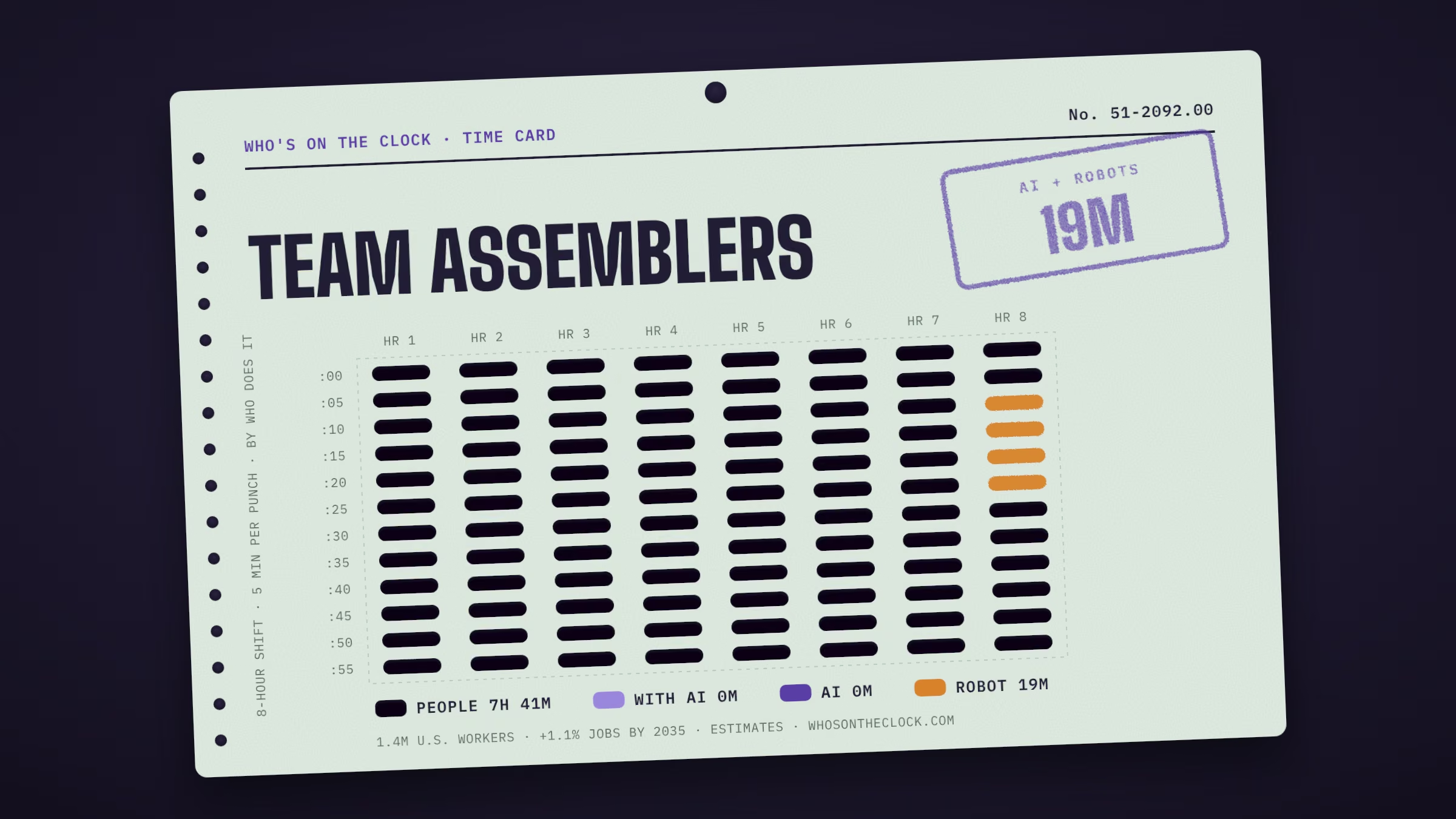
The biggest change here is physical: systems like Seegrid Palion AMRs have done tasks such as “Operate machinery and heavy equipment, such as forklifts” in real workplaces, about 19m of a typical shift. Most of the rest, 7h 41m, has no AI or robot evidence. BLS expects about 1.1% more of these jobs by 2035.

Time card for team assemblers showing a typical 8-hour shift: 7h 41m done by people, 19m by robots.
Each mark is 5 minutes of a typical shift for team assemblers, colored by who does that task today. Estimates from O*NET tasks and Anthropic Economic Index data. How it's made

Home / Production & factory / Team Assemblers

Work as part of a team having responsibility for assembling an entire product or component of a product. Team assemblers can perform all tasks conducted by the team in the assembly process and rotate through all or most of them, rather than being assigned to a specific task on a permanent basis. May participate in making management decisions affecting the work. Includes team leaders who work as part of the team.

Time card

Untick tasks you don't do, or set your own times.
MineTask, by time spentHumanWith AIAIRobot
Rotate through all the tasks required in a particular production process.4h 6m a shift · Robots only in factory cells
Why this label?Robots have done this only in factory setups built around the machine, so it stays Human for team assemblers. How labels work
Perform quality checks on products and parts.49m a shift · Robots only in factory cells
Why this label?Robots have done this only in factory setups built around the machine, so it stays Human for team assemblers. How labels work
Package finished products and prepare them for shipment.43m a shift · Robots only in factory cells
Why this label?Robots have done this only in factory setups built around the machine, so it stays Human for team assemblers. How labels work
Review work orders and blueprints to ensure work is performed according to specifications.25m a shift · No AI or robot evidence found
Why this label?No AI use or robot deployment showed up for this task in our data. That isn't proof it's safe; it may just be rare in the data. How labels work
Shovel, sweep, or otherwise clean work areas.25m a shift · Robots only in factory cells
Why this label?Robots have done this only in factory setups built around the machine, so it stays Human for team assemblers. How labels work
Provide assistance in the production of wiring assemblies.18m a shift · No AI or robot evidence found
Why this label?This is physical work, and no robot has been shown doing it yet. How labels work
Maintain production equipment and machinery.18m a shift · Robots only in factory cells
Why this label?Robots have done this only in factory setups built around the machine, so it stays Human for team assemblers. How labels work
Operate machinery and heavy equipment, such as forklifts.18m a shift · Robots deployed · e.g. Seegrid Palion AMRs (autonomous lift trucks, pallet trucks, tow tractors)
Why this label?Marked Robot because Seegrid Palion AMRs (autonomous lift trucks, pallet trucks, tow tractors) (in real use) has done this task in a real workplace. It shows a robot can do it somewhere, not that most team assemblers work alongside one. How labels work
Determine work assignments and procedures.12m a shift · No AI or robot evidence found
Why this label?No AI use or robot deployment showed up for this task in our data. That isn't proof it's safe; it may just be rare in the data. How labels work
Supervise assemblers and train employees on job procedures.12m a shift · No AI or robot evidence found
Why this label?No AI use or robot deployment showed up for this task in our data. That isn't proof it's safe; it may just be rare in the data. How labels work
Complete production reports to communicate team production level to management.12m a shift · No AI or robot evidence found
Why this label?No AI use or robot deployment showed up for this task in our data. That isn't proof it's safe; it may just be rare in the data. How labels work

Clock history

  1. 19m touchedFirst published: O*NET 30.1, Anthropic Economic Index (2025 usage and September 2026 robot study), BLS May 2025

When new data changes this clock, the date, the new numbers and the reason are logged here. Company news alone never moves the clock.

On the floor

  1. AnnouncedBMW
    BMW plans to use Figure 03 humanoid for parts sequencing at Spartanburg

    After Figure 02 inserted sheet metal parts in the Spartanburg body shop and supported production of more than 30,000 BMW X3s over 11 months, BMW says it will deploy Figure 03. The new robot is to pick unsorted components from containers onto sequencing trolleys and move them to a collection point for assembly.

    The Robot Report

  2. PilotAutonomique
    Autonomique moves semi-humanoid robot toward production at F&P Mfg.

    After a paid pilot that began in late 2025, Autonomique says its wheeled two-armed robot is progressing toward production use at Tier 1 auto supplier F&P Mfg. in Tottenham, Ontario. The robot picks parts from bins for assembly, monitors a press and places finished parts into bins.

    The Robot Report

  3. PlanSchaeffler
    Schaeffler plans hundreds of Humanoid robots in its German factories

    Schaeffler plans to deploy hundreds of wheeled humanoid robots from UK company Humanoid in its German factories, starting by the end of 2026. It aims for more than 1,000 in use globally by 2032.

    Assembly Magazine

Ask the clock

Will AI replace team assemblers?

Not on current evidence. Less than 30 minutes of a typical shift goes to tasks that AI or robots are doing today. The other 7h 41m (96%) stays with people. Separately, BLS expects about 1.1% more of these jobs by 2035 (all jobs: +3.5%).

What can AI already do for team assemblers?

None of this job's tasks show regular AI use yet. That can mean the work is hands-on or in person, or simply that it rarely comes up in AI usage data.

Where do robots fit in?

For some tasks, yes. Robots have done 1 of this job's tasks in workplaces like this one, about 19m of a typical shift. 5 more tasks have only been done in factory setups built around the machine, so they stay with people here. For 1 physical task, no robot has shown it can do the work yet.

  • Operate machinery and heavy equipment, such as forklifts. (18m a shift; e.g. Seegrid Palion AMRs (autonomous lift trucks, pallet trucks, tow tractors), in use)
What still needs a person?

7h 41m of a typical shift, or 96%, goes to tasks with no AI or robot evidence yet. No AI usage or robot deployment has shown up for these so far. The biggest:

  • Rotate through all the tasks required in a particular production process. (4h 6m a shift)
  • Perform quality checks on products and parts. (49m a shift)
  • Package finished products and prepare them for shipment. (43m a shift)
  • Review work orders and blueprints to ensure work is performed according to specifications. (25m a shift)
  • Shovel, sweep, or otherwise clean work areas. (25m a shift)
Why is that work hard to automate?

Much of it comes down to where and how the work happens. In-person, hands-on and high-stakes work is where AI and robots have made the least headway so far. In the official O*NET survey of people in this job:

  • 92% use their hands on tools, objects or controls more than half the time
  • 82% talk face to face with others every day
  • 62% carry high or very high responsibility for other workers' safety
What are companies actually doing?

We track 3 sourced company moves that affect this job. Most recent:

  • Jun 29, 2026: BMW plans to use Figure 03 humanoid for parts sequencing at Spartanburg (Announced)
  • Jun 17, 2026: Autonomique moves semi-humanoid robot toward production at F&P Mfg. (Pilot)
  • May 26, 2026: Schaeffler plans hundreds of Humanoid robots in its German factories (Plan)
Are employers still hiring team assemblers?

On Indeed, job postings in the Production & Manufacturing sector are at 124% of their February 2020 level (all U.S. postings: 104%), up 12.6% from a year earlier, as of Oct 9, 2026. BLS separately expects about 139,000 openings a year in this job through 2035. Across all U.S. postings, 7.3% now mention AI skills. Sector postings cover more than this one job and move for many reasons besides AI.

How much do team assemblers make?

The median pay is about $44,650 a year ($21.47 an hour), 12% below the median for all U.S. jobs ($50,980). Most people in this job earn between $33,280 and $64,880 a year; that range covers the middle 80%. Pay figures are from BLS, May 2025, and vary a lot by state and employer.

Is this job growing or shrinking?

BLS projects growth of 1.1% from 2025 to 2035, compared with 3.5% growth for all jobs. That's about 1.4 million jobs in 2035. It expects about 139,000 openings a year, mostly from people retiring or changing careers. These projections don't single out AI as a cause.

How many team assemblers are there in the U.S.?

About 1.4 million people in the U.S., roughly 0.90% of all workers (BLS, May 2025). That makes it the 24th largest of the 796 jobs on this site. BLS expects about 1.4 million in 2035.

What training do team assemblers need?

The most common requirement is a high school diploma: about 81% of people in the job said so in the official O*NET survey. O*NET rates the job at level 2 of 5 for preparation, which usually means: high school diploma, some training. Requirements vary by state and employer, especially for licensed work.

What should I learn to stay ahead of AI?

These come from the job's official skill ratings and from the tasks that AI and robots touch least today. Building them keeps you strong in the parts of the work that still need a person:

  • Skills that matter more here than in most jobs: Quality Control Analysis, Operations Monitoring, Instructing, Time Management
  • Get strong at the parts of the job that stay with people (listed above), which take 7h 41m of a typical shift
  • Tools employers list: Autodesk AutoCAD, Microsoft Excel, Microsoft Office software, Microsoft Outlook, Microsoft PowerPoint
What other jobs could team assemblers move into?

These use similar skills. Matches come from 109 official ratings of skills, knowledge and work activities, and each needs the same or less preparation unless the official list relates the jobs directly:

  • Forging Machine Setters, Operators, and Tenders, Metal and Plastic (17m touched, $49k median pay)
  • Adhesive Bonding Machine Operators and Tenders (1h 8m touched, $46k median pay)
  • Metal-Refining Furnace Operators and Tenders (3h 54m touched, $54k median pay)
  • Extruding and Forming Machine Setters, Operators, and Tenders, Synthetic and Glass Fibers (2h 36m touched, $46k median pay)
  • Fiberglass Laminators and Fabricators (0m touched, $47k median pay)
How solid are these numbers?

Each task carries its own evidence label. For this job: 1 with robots in real deployments, 10 with no AI or robot evidence found. The minutes per task are estimates, not measured hours, and "no evidence" doesn't prove a task is safe.

Tools in demand

  • Autodesk AutoCAD
  • SAP software

Plus everyday office tools: Microsoft Excel, Microsoft Office software, Microsoft Outlook, Microsoft PowerPoint, Microsoft Word.

Also called

Assembler, Assembly Associate, Assembly Inspector, Assembly Line Machine Operator, Assembly Line Worker, Assembly Operator, Assembly Technician, Assembly Worker, Automotive Production Worker, Cabinet Assembler, Certified Composites Technician (CCT), Delivery and Assembly Technician (Delivery and Assembly Tech), Furniture Assembler, Furniture Assembly Technician (Furniture Assembly Tech)