Will AI replace umpires, referees, and other sports officials?

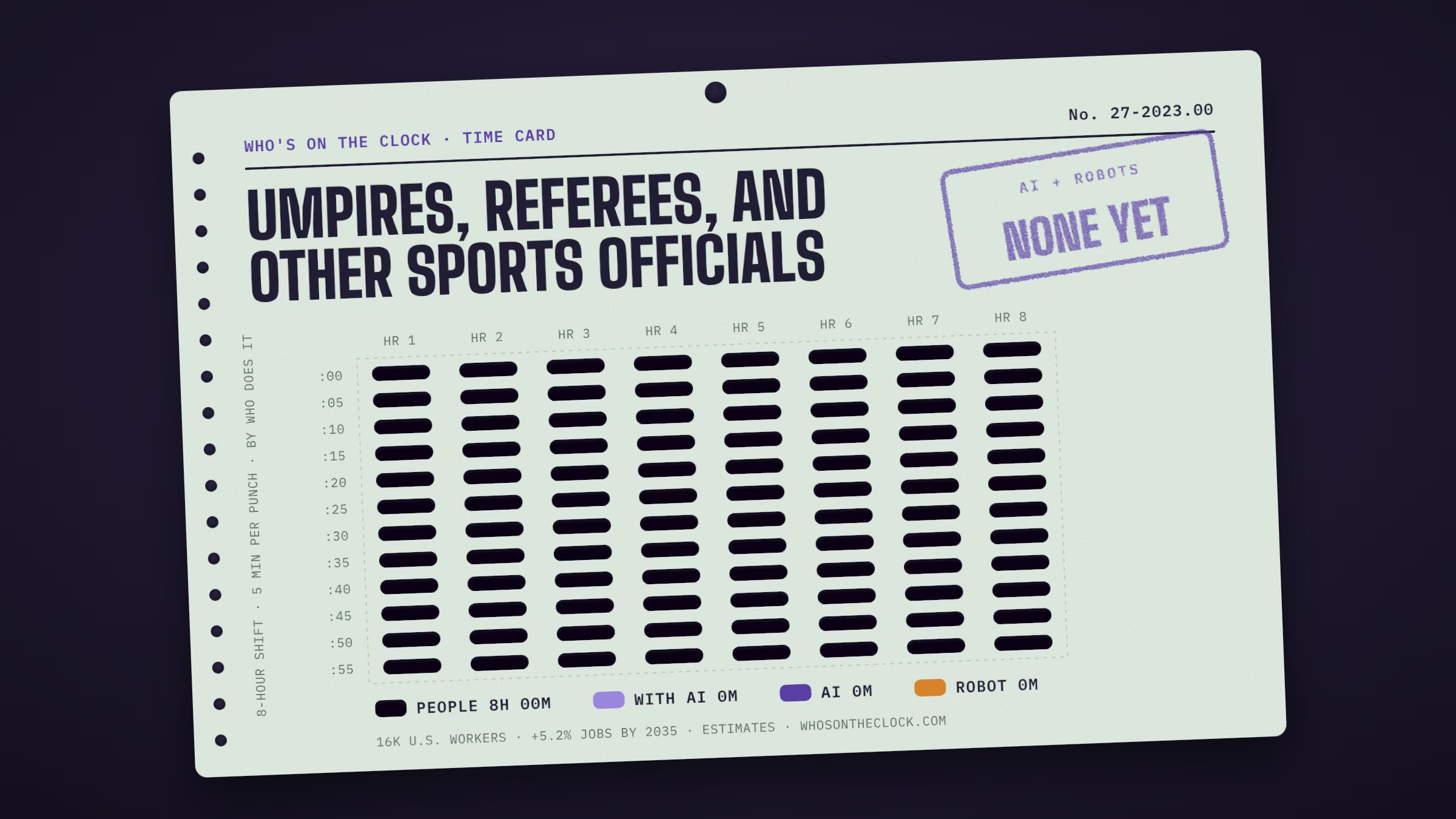
Most of the shift goes to “Officiate at sporting events, games, or competitions”, which remains people's work. So far the record shows no AI use or robot deployment for any of this job's tasks. That reflects today's evidence and could change. BLS expects about 5.2% more of these jobs by 2035.

Time card for umpires, referees, and other sports officials showing a typical 8-hour shift: 8h done by people.
Each mark is 5 minutes of a typical shift for umpires, referees, and other sports officials, colored by who does that task today. Estimates from O*NET tasks and Anthropic Economic Index data. How it's made

Home / Arts, media & sports / Umpires, Referees, and Other Sports Officials

Officiate at competitive athletic or sporting events. Detect infractions of rules and decide penalties according to established regulations. Includes all sporting officials, referees, and competition judges.

Time card

Untick tasks you don't do, or set your own times.
MineTask, by time spentHumanWith AIAIRobot
Officiate at sporting events, games, or competitions, to maintain standards of play and to ensure that game rules are observed.2h 58m a shift · No AI or robot evidence found
Why this label?This is physical work, and no robot has been shown doing it yet. How labels work
Signal participants or other officials to make them aware of infractions or to otherwise regulate play or competition.41m a shift · No AI or robot evidence found
Why this label?No AI use or robot deployment showed up for this task in our data. That isn't proof it's safe; it may just be rare in the data. How labels work
Resolve claims of rule infractions or complaints by participants and assess any necessary penalties, according to regulations.27m a shift · No AI or robot evidence found
Why this label?No AI use or robot deployment showed up for this task in our data. That isn't proof it's safe; it may just be rare in the data. How labels work
Teach and explain the rules and regulations governing a specific sport.27m a shift · No AI or robot evidence found
Why this label?No AI use or robot deployment showed up for this task in our data. That isn't proof it's safe; it may just be rare in the data. How labels work
Confer with other sporting officials, coaches, players, and facility managers to provide information, coordinate activities, and discuss problems.27m a shift · No AI or robot evidence found
Why this label?No AI use or robot deployment showed up for this task in our data. That isn't proof it's safe; it may just be rare in the data. How labels work
Judge performances in sporting competitions to award points, impose scoring penalties, and determine results.27m a shift · No AI or robot evidence found
Why this label?No AI use or robot deployment showed up for this task in our data. That isn't proof it's safe; it may just be rare in the data. How labels work
Keep track of event times, including race times and elapsed time during game segments, starting or stopping play when necessary.27m a shift · No AI or robot evidence found
Why this label?No AI use or robot deployment showed up for this task in our data. That isn't proof it's safe; it may just be rare in the data. How labels work
Inspect game sites for compliance with regulations or safety requirements.14m a shift · Robots only in factory cells
Why this label?Robots have done this only in factory setups built around the machine, so it stays Human for umpires, referees, and other sports officials. How labels work
Inspect sporting equipment or examine participants to ensure compliance with event and safety regulations.14m a shift · No AI or robot evidence found
Why this label?This is physical work, and no robot has been shown doing it yet. How labels work
Report to regulating organizations regarding sporting activities, complaints made, and actions taken or needed, such as fines or other disciplinary actions.14m a shift · No AI or robot evidence found
Why this label?No AI use or robot deployment showed up for this task in our data. That isn't proof it's safe; it may just be rare in the data. How labels work
Verify scoring calculations before competition winners are announced.14m a shift · No AI or robot evidence found
Why this label?No AI use or robot deployment showed up for this task in our data. That isn't proof it's safe; it may just be rare in the data. How labels work
Start races and competitions.14m a shift · Robots only in factory cells
Why this label?Robots have done this only in factory setups built around the machine, so it stays Human for umpires, referees, and other sports officials. How labels work
Compile scores and other athletic records.14m a shift · No AI or robot evidence found
Why this label?No AI use or robot deployment showed up for this task in our data. That isn't proof it's safe; it may just be rare in the data. How labels work
Verify credentials of participants in sporting events, and make other qualifying determinations, such as starting order or handicap number.14m a shift · No AI or robot evidence found
Why this label?No AI use or robot deployment showed up for this task in our data. That isn't proof it's safe; it may just be rare in the data. How labels work
Direct participants to assigned areas, such as starting blocks or penalty areas.14m a shift · No AI or robot evidence found
Why this label?No AI use or robot deployment showed up for this task in our data. That isn't proof it's safe; it may just be rare in the data. How labels work
Research and study players and teams to anticipate issues that might arise in future engagements.14m a shift · No AI or robot evidence found
Why this label?No AI use or robot deployment showed up for this task in our data. That isn't proof it's safe; it may just be rare in the data. How labels work

Clock history

  1. 0m touchedFirst published: O*NET 30.1, Anthropic Economic Index (2025 usage and September 2026 robot study), BLS May 2025

When new data changes this clock, the date, the new numbers and the reason are logged here. Company news alone never moves the clock.

On the floor

No company news tracked for this job yet. New stories are added as they happen.

Ask the clock

Will AI replace umpires, referees, and other sports officials?

Not on current evidence. Less than 30 minutes of a typical shift goes to tasks that AI or robots are doing today. The other 8h (100%) stays with people. Separately, BLS expects about 5.2% more of these jobs by 2035 (all jobs: +3.5%).

What can AI already do for umpires, referees, and other sports officials?

None of this job's tasks show regular AI use yet. That can mean the work is hands-on or in person, or simply that it rarely comes up in AI usage data.

Where do robots fit in?

Not in workplaces like this one, based on a 2026 review of robot deployments. 2 more tasks have only been done in factory setups built around the machine, so they stay with people here. For 2 physical tasks, no robot has shown it can do the work yet.

What still needs a person?

8h of a typical shift, or 100%, goes to tasks with no AI or robot evidence yet. No AI usage or robot deployment has shown up for these so far. The biggest:

  • Officiate at sporting events, games, or competitions, to maintain standards of play and to ensure that game rules are observed. (2h 58m a shift)
  • Signal participants or other officials to make them aware of infractions or to otherwise regulate play or competition. (41m a shift)
  • Resolve claims of rule infractions or complaints by participants and assess any necessary penalties, according to regulations. (27m a shift)
  • Teach and explain the rules and regulations governing a specific sport. (27m a shift)
  • Confer with other sporting officials, coaches, players, and facility managers to provide information, coordinate activities, and discuss problems. (27m a shift)
Why is that work hard to automate?

Much of it comes down to where and how the work happens. In-person, hands-on and high-stakes work is where AI and robots have made the least headway so far. In the official O*NET survey of people in this job:

  • 75% work at arm's length or closer to other people
  • 71% spend more than half the day on their feet
  • 52% handle conflict at least once a week
Are employers still hiring umpires, referees, and other sports officials?

On Indeed, job postings in the Arts & Entertainment sector are at 87% of their February 2020 level (all U.S. postings: 104%), up 12.4% from a year earlier, as of Oct 9, 2026. BLS separately expects about 4,300 openings a year in this job through 2035. Across all U.S. postings, 7.3% now mention AI skills. Sector postings cover more than this one job and move for many reasons besides AI.

How much do umpires, referees, and other sports officials make?

The median pay is about $40,710 a year, 20% below the median for all U.S. jobs ($50,980). Most people in this job earn between $26,540 and $82,960 a year; that range covers the middle 80%. Pay figures are from BLS, May 2025, and vary a lot by state and employer. Pick a state to compare:

Is this job growing or shrinking?

BLS projects growth of 5.2% from 2025 to 2035, compared with 3.5% growth for all jobs. That's about 19,000 jobs in 2035. It expects about 4,300 openings a year, mostly from people retiring or changing careers. These projections don't single out AI as a cause.

How many umpires, referees, and other sports officials are there in the U.S.?

About 16,000 people in the U.S., roughly 0.01% of all workers (BLS, May 2025). That makes it the 585th largest of the 796 jobs on this site. BLS expects about 19,000 in 2035.

What training do umpires, referees, and other sports officials need?

The most common requirement is a high school diploma: about 43% of people in the job said so in the official O*NET survey. O*NET rates the job at level 2 of 5 for preparation, which usually means: high school diploma, some training. Requirements vary by state and employer, especially for licensed work.

What should I learn to stay ahead of AI?

These come from the job's official skill ratings and from the tasks that AI and robots touch least today. Building them keeps you strong in the parts of the work that still need a person:

  • Skills that matter more here than in most jobs: Learning Strategies, Speaking, Judgment and Decision Making, Active Learning
  • Get strong at the parts of the job that stay with people (listed above), which take 8h of a typical shift
  • Tools employers list: Adobe Acrobat, Microsoft Excel, Microsoft Office software, Microsoft Outlook, Microsoft PowerPoint
What other jobs could umpires, referees, and other sports officials move into?

These use similar skills. Matches come from 109 official ratings of skills, knowledge and work activities, and each needs the same or less preparation unless the official list relates the jobs directly:

  • Coaches and Scouts (0m touched, $47k median pay)
  • Athletes and Sports Competitors (0m touched, $67k median pay)
  • Amusement and Recreation Attendants (2h 40m touched, $32k median pay)
  • First-Line Supervisors of Entertainment and Recreation Workers (59m touched, $49k median pay)
  • Exercise Trainers and Group Fitness Instructors (0m touched, $47k median pay)
How solid are these numbers?

Each task carries its own evidence label. For this job: 16 with no AI or robot evidence found. The minutes per task are estimates, not measured hours, and "no evidence" doesn't prove a task is safe.

Tools in demand

  • Adobe Acrobat

Plus everyday office tools: Microsoft Excel, Microsoft Office software, Microsoft Outlook, Microsoft PowerPoint, Microsoft Word.

Also called

Athletic Events Scorer, Baseball Umpire, Basketball Manager, Basketball Referee, Basketball Scorekeeper, Clerk of Scales, Clocker, Dance Critic, Diving Judge, Dressage Judge, Equestrian Events Judge, Flag Football Referee, Football Referee, Handicapper