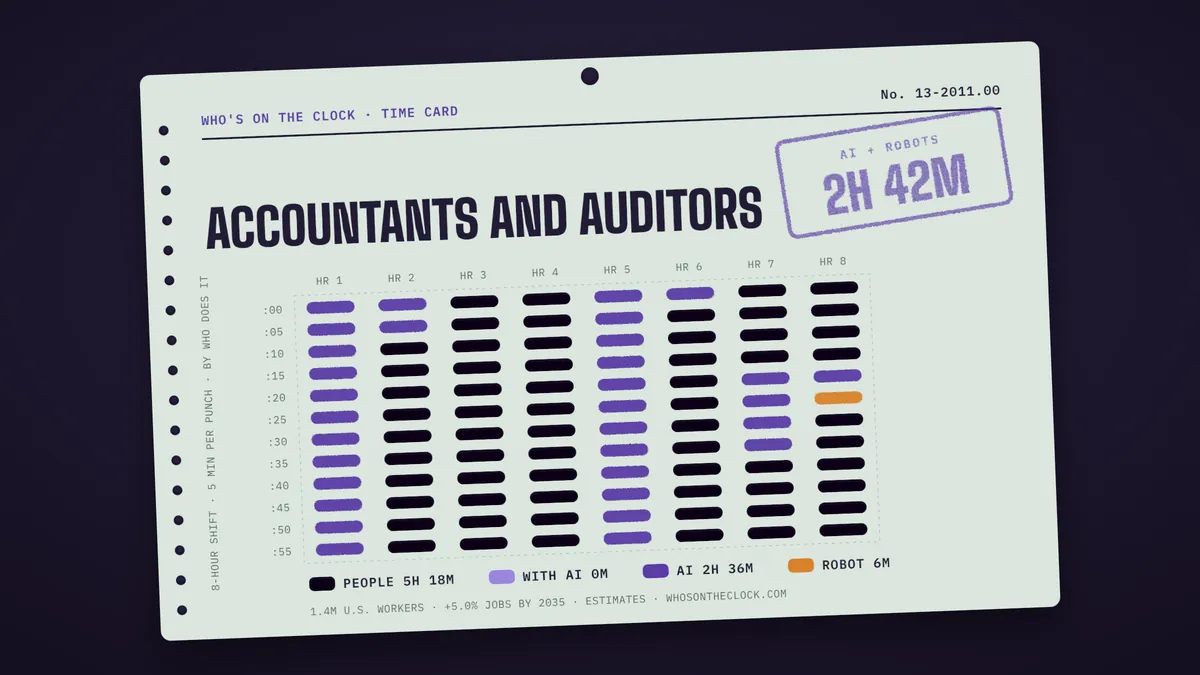
What does this mean for workers? KPMG's moves touch 3 jobs, which together employ about 2.9 million people in the U.S. Across them, AI and robots already touch between 1h 28m (tax preparers) and 2h 42m (accountants and auditors) of a typical 8-hour shift. A single company's move is an early signal for these jobs, and the time cards show how far the change has spread nationally.
Rolling out means it is in use and spreading to more locations or teams.
On the floor
- KPMG Australia uses AI agent to draft tax advice for clients
KPMG Australia built AI bots that review client documents and tax law and produce a 25-page first draft of tax advice. Its chief digital officer said it does in a day what the team used to do in about two weeks.
- KPMG builds AI agents into its global audit platform
KPMG is adding AI agents to its global audit platform for more than 95,000 auditors. The agents target routine tasks such as expense reviews and searching for unrecorded liabilities.
Bloomberg Tax · Accountants and Auditors, Bookkeeping, Accounting, and Auditing Clerks
Jobs affected
- Accountants and Auditors2h 42m of 8h touched · 1.4 million workers · $84k · +5% by 2035Where AI or robots show up most: Prepare, examine, or analyze accounting records, financial statements, or other financial reports to assess accuracy, completeness, and conformance to reporting and procedural standards (1h 9m a shift, AI on its own)
- Tax Preparers1h 28m of 8h touched · 76,000 workers · $55k · +4.7% by 2035Where AI or robots show up most: Furnish taxpayers with sufficient information and advice to ensure correct tax form completion (32m a shift, people with AI)
- Bookkeeping, Accounting, and Auditing Clerks1h 58m of 8h touched · 1.4 million workers · $51k · -5.6% by 2035Where AI or robots show up most: Operate computers programmed with accounting software to record, store, and analyze information (53m a shift, AI on its own)