Energy Engineers vs Water/Wastewater Engineers

Side by side: how much of the shift AI and robots touch, pay, outlook and training.

Home / Compare

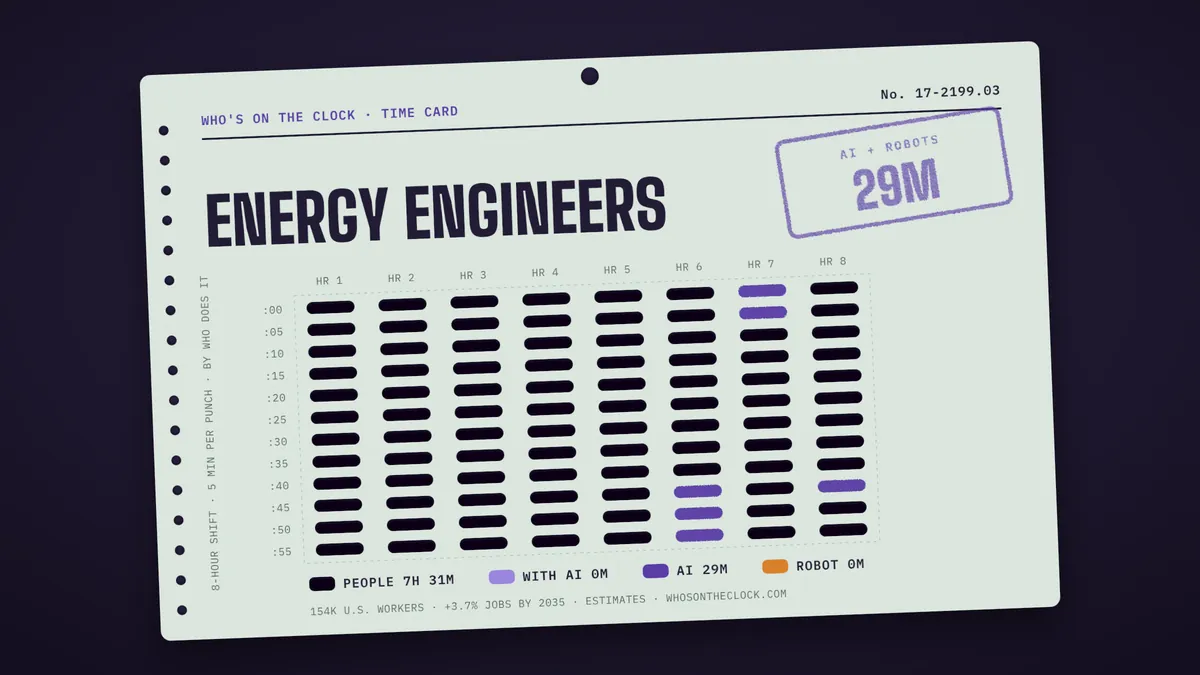
Energy engineers or water/wastewater engineers: which will AI change more? AI and robots touch more of the day for energy engineers: 29m of an 8-hour shift, against 0m for water/wastewater engineers. Energy engineers earn more, a median of $122,930 against $100,840.

The two jobs share very close skills, including systems analysis, mathematics, operations analysis, so moving between them is realistic for many people.

Energy Engineers
29mof an 8-hour shift touched by AI or robots
  • 7h 31mDone by people
  • 0mPeople do it with AI's help
  • 29mAI mostly does it alone
  • 0mRobots have done it somewhere
Median pay
$122,930
U.S. workers
154,000
Outlook to 2035
+3.7%
Openings a year
8,800
Typical preparation
Bachelor's degree
See the full time card →
Water/Wastewater Engineers
0mof an 8-hour shift touched by AI or robotsLess AI time
  • 8hDone by people
  • 0mPeople do it with AI's help
  • 0mAI mostly does it alone
  • 0mRobots have done it somewhere
Median pay
$100,840
U.S. workers
368,000
Outlook to 2035
+6.4%
Openings a year
23,000
Typical preparation
Bachelor's degree
See the full time card →

Energy Engineers

Where AI or robots show up most

  • Analyze, interpret, or create graphical representations of energy data, using engineering software. 24m
  • Promote awareness or use of alternative or renewable energy sources. 6m

Biggest tasks still done by people

  • Identify and recommend energy savings strategies to achieve more energy-efficient operation. 41m
  • Conduct energy audits to evaluate energy use and to identify conservation and cost reduction measures. 41m
  • Perform energy modeling, measurement, verification, commissioning, or retro-commissioning. 41m

Water/Wastewater Engineers

Where AI or robots show up most

No AI or robot use documented for any task yet.

Biggest tasks still done by people

  • Provide technical direction or supervision to junior engineers, engineering or computer-aided design (CAD) technicians, or other technical personnel. 46m
  • Review and critique proposals, plans, or designs related to water or wastewater treatment systems. 33m
  • Design domestic or industrial water or wastewater treatment plants, including advanced facilities with sequencing batch reactors (SBR), membranes, lift stations, headworks, surge overflow basins, ultraviolet disinfection systems, aerobic digesters, sludge lagoons, or control buildings. 33m

Swap in a different job Highlighted numbers are the higher of the two. Hours are estimates from each job's time card.