Will AI replace energy engineers?

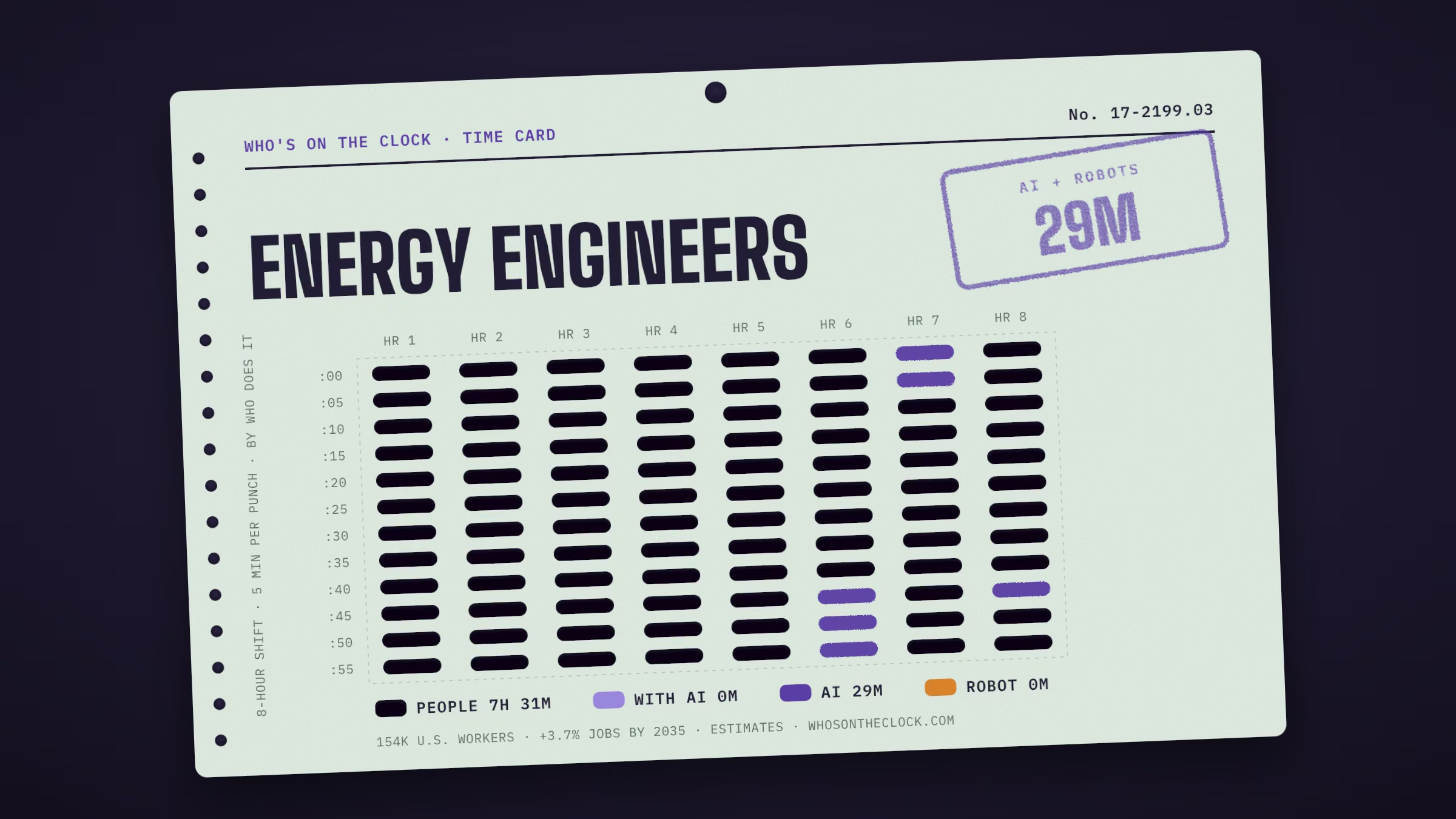
AI already handles some of this work on its own in real use, for tasks like “Analyze”. That's 29m of a typical shift; 7h 31m still has no AI or robot evidence. BLS expects about 3.7% more of these jobs by 2035.

Time card for energy engineers showing a typical 8-hour shift: 7h 31m done by people, 29m by AI.
Each mark is 5 minutes of a typical shift for energy engineers, colored by who does that task today. Estimates from O*NET tasks and Anthropic Economic Index data. How it's made

Home / Engineering & architecture / Energy Engineers

Design, develop, or evaluate energy-related projects or programs to reduce energy costs or improve energy efficiency during the designing, building, or remodeling stages of construction. May specialize in electrical systems; heating, ventilation, and air-conditioning (HVAC) systems; green buildings; lighting; air quality; or energy procurement.

Time card

Untick tasks you don't do, or set your own times.
MineTask, by time spentHumanWith AIAIRobot
Identify and recommend energy savings strategies to achieve more energy-efficient operation.41m a shift · No AI or robot evidence found
Why this label?No AI use or robot deployment showed up for this task in our data. That isn't proof it's safe; it may just be rare in the data. How labels work
Conduct energy audits to evaluate energy use and to identify conservation and cost reduction measures.41m a shift · No AI or robot evidence found
Why this label?This is physical work, and no robot has been shown doing it yet. How labels work
Perform energy modeling, measurement, verification, commissioning, or retro-commissioning.41m a shift · No AI or robot evidence found
Why this label?This is physical work, and no robot has been shown doing it yet. How labels work
Prepare energy-related project reports or related documentation.41m a shift · No AI or robot evidence found
Why this label?No AI use or robot deployment showed up for this task in our data. That isn't proof it's safe; it may just be rare in the data. How labels work
Monitor and analyze energy consumption.36m a shift · No AI or robot evidence found
Why this label?No AI use or robot deployment showed up for this task in our data. That isn't proof it's safe; it may just be rare in the data. How labels work
Advise clients or colleagues on topics such as climate control systems, energy modeling, data logging, sustainable design, or energy auditing.36m a shift · No AI or robot evidence found
Why this label?No AI use or robot deployment showed up for this task in our data. That isn't proof it's safe; it may just be rare in the data. How labels work
Inspect or monitor energy systems, including heating, ventilating, and air conditioning (HVAC) or daylighting systems to determine energy use or potential energy savings.30m a shift · No AI or robot evidence found
Why this label?This is physical work, and no robot has been shown doing it yet. How labels work
Collect data for energy conservation analyses, using jobsite observation, field inspections, or sub-metering.30m a shift · No AI or robot evidence found
Why this label?This is physical work, and no robot has been shown doing it yet. How labels work
Manage the development, design, or construction of energy conservation projects to ensure acceptability of budgets and time lines, conformance to federal and state laws, or adherence to approved specifications.30m a shift · No AI or robot evidence found
Why this label?No AI use or robot deployment showed up for this task in our data. That isn't proof it's safe; it may just be rare in the data. How labels work
Monitor energy related design or construction issues, such as energy engineering, energy management, or sustainable design.24m a shift · No AI or robot evidence found
Why this label?No AI use or robot deployment showed up for this task in our data. That isn't proof it's safe; it may just be rare in the data. How labels work
Analyze, interpret, or create graphical representations of energy data, using engineering software.24m a shift · Observed in AI use
Why this label?Marked AI because this task shows up regularly in real AI conversations (Anthropic Economic Index, 2025 usage), and in most of them AI does the task on its own rather than helping a person. Many workplaces may not use AI for it at all. How labels work
Review architectural, mechanical, or electrical plans or specifications to evaluate energy efficiency.24m a shift · No AI or robot evidence found
Why this label?No AI use or robot deployment showed up for this task in our data. That isn't proof it's safe; it may just be rare in the data. How labels work
Direct the implementation of energy management projects.18m a shift · No AI or robot evidence found
Why this label?No AI use or robot deployment showed up for this task in our data. That isn't proof it's safe; it may just be rare in the data. How labels work
Verify energy bills and meter readings.12m a shift · No AI or robot evidence found
Why this label?No AI use or robot deployment showed up for this task in our data. That isn't proof it's safe; it may just be rare in the data. How labels work
Research renewable or alternative energy systems or technologies, such as solar thermal or photovoltaic energy.12m a shift · No AI or robot evidence found
Why this label?No AI use or robot deployment showed up for this task in our data. That isn't proof it's safe; it may just be rare in the data. How labels work
Consult with construction or renovation clients or other engineers on topics such as Leadership in Energy and Environmental Design (LEED) or Green Buildings.12m a shift · No AI or robot evidence found
Why this label?No AI use or robot deployment showed up for this task in our data. That isn't proof it's safe; it may just be rare in the data. How labels work
Review or negotiate energy purchase agreements.6m a shift · No AI or robot evidence found
Why this label?No AI use or robot deployment showed up for this task in our data. That isn't proof it's safe; it may just be rare in the data. How labels work
Train personnel or clients on topics such as energy management.6m a shift · No AI or robot evidence found
Why this label?No AI use or robot deployment showed up for this task in our data. That isn't proof it's safe; it may just be rare in the data. How labels work
Promote awareness or use of alternative or renewable energy sources.6m a shift · Observed in AI use
Why this label?Marked AI because this task shows up regularly in real AI conversations (Anthropic Economic Index, 2025 usage), and in most of them AI does the task on its own rather than helping a person. Many workplaces may not use AI for it at all. How labels work
Write or install energy management routines for building automation systems.6m a shift · No AI or robot evidence found
Why this label?No AI use or robot deployment showed up for this task in our data. That isn't proof it's safe; it may just be rare in the data. How labels work
Recommend best fuel for specific sites or circumstances.6m a shift · No AI or robot evidence found
Why this label?No AI use or robot deployment showed up for this task in our data. That isn't proof it's safe; it may just be rare in the data. How labels work

Clock history

  1. 29m touchedFirst published: O*NET 30.1, Anthropic Economic Index (2025 usage and September 2026 robot study), BLS May 2025

When new data changes this clock, the date, the new numbers and the reason are logged here. Company news alone never moves the clock.

On the floor

  1. AnnouncedFervo Energy
    Fervo, Nvidia and PNNL build AI twin for geothermal drilling

    Fervo, Nvidia and the Pacific Northwest National Laboratory are building EGS-Twin, which combines live field data, simulations and AI forecasting. The goal is to help geothermal operators drill more efficiently.

    Invezz

Ask the clock

Will AI replace energy engineers?

Not on current evidence. Less than 30 minutes of a typical shift goes to tasks that AI or robots are doing today. The other 7h 31m (94%) stays with people. Separately, BLS expects about 3.7% more of these jobs by 2035 (all jobs: +3.5%).

What can AI already do for energy engineers?

AI shows up regularly in 2 of 21 tasks, about 29m of a typical shift. The biggest ones:

  • Analyze, interpret, or create graphical representations of energy data, using engineering software. (24m a shift, AI mostly does it alone)
  • Promote awareness or use of alternative or renewable energy sources. (6m a shift, AI mostly does it alone)
Where do robots fit in?

Not in workplaces like this one, based on a 2026 review of robot deployments. For 4 physical tasks, no robot has shown it can do the work yet.

What still needs a person?

7h 31m of a typical shift, or 94%, goes to tasks with no AI or robot evidence yet. No AI usage or robot deployment has shown up for these so far. The biggest:

  • Identify and recommend energy savings strategies to achieve more energy-efficient operation. (41m a shift)
  • Conduct energy audits to evaluate energy use and to identify conservation and cost reduction measures. (41m a shift)
  • Perform energy modeling, measurement, verification, commissioning, or retro-commissioning. (41m a shift)
  • Prepare energy-related project reports or related documentation. (41m a shift)
  • Monitor and analyze energy consumption. (36m a shift)
Why is that work hard to automate?

Much of it comes down to where and how the work happens. In-person, hands-on and high-stakes work is where AI and robots have made the least headway so far. In the official O*NET survey of people in this job:

  • 59% say dealing with the public is very or extremely important
  • 55% talk face to face with others every day
  • 52% carry high or very high responsibility for other workers' safety
What are companies actually doing?

We track 1 sourced company move that affects this job. Most recent:

  • Jun 22, 2026: Fervo, Nvidia and PNNL build AI twin for geothermal drilling (Announced)
Are employers still hiring energy engineers?

On Indeed, job postings in the Mechanical Engineering sector are at 168% of their February 2020 level (all U.S. postings: 104%), up 43.4% from a year earlier, as of Oct 9, 2026. BLS separately expects about 8,800 openings a year in this job through 2035. Across all U.S. postings, 7.3% now mention AI skills. Sector postings cover more than this one job and move for many reasons besides AI.

How much do energy engineers make?

The median pay is about $122,930 a year ($59.10 an hour), 141% above the median for all U.S. jobs ($50,980). Most people in this job earn between $66,810 and $189,950 a year; that range covers the middle 80%. Pay figures are from BLS, May 2025, and vary a lot by state and employer. Pick a state to compare:

Is this job growing or shrinking?

BLS projects growth of 3.7% from 2025 to 2035, compared with 3.5% growth for all jobs. That's about 173,000 jobs in 2035. It expects about 8,800 openings a year, mostly from people retiring or changing careers. These projections don't single out AI as a cause.

How many energy engineers are there in the U.S.?

About 154,000 people in the U.S., roughly 0.10% of all workers (BLS, May 2025). That makes it the 211th largest of the 796 jobs on this site. BLS expects about 173,000 in 2035.

What training do energy engineers need?

The most common requirement is a bachelor's degree: about 50% of people in the job said so in the official O*NET survey. O*NET rates the job at level 4 of 5 for preparation, which usually means: bachelor's degree. Requirements vary by state and employer, especially for licensed work.

What should I learn to stay ahead of AI?

These come from the job's official skill ratings and from the tasks that AI and robots touch least today. Building them keeps you strong in the parts of the work that still need a person:

  • Skills that matter more here than in most jobs: Operations Analysis, Systems Analysis, Mathematics, Science
  • Get strong at the parts of the job that stay with people (listed above), which take 7h 31m of a typical shift
  • Tools employers list: The MathWorks MATLAB, Python, Microsoft PowerPoint, Microsoft Office software, Microsoft Excel
  • Learn to use AI well on the tasks where it already shows up in this job (listed above)
What other jobs could energy engineers move into?

These use similar skills. Matches come from 109 official ratings of skills, knowledge and work activities, and each needs the same or less preparation unless the official list relates the jobs directly:

  • Water/Wastewater Engineers (0m touched, $101k median pay)
  • Environmental Engineers (17m touched, $107k median pay)
  • Fire-Prevention and Protection Engineers (0m touched, $115k median pay)
  • Civil Engineers (46m touched, $101k median pay)
  • Mining and Geological Engineers, Including Mining Safety Engineers (56m touched, $106k median pay)
How solid are these numbers?

Each task carries its own evidence label. For this job: 2 observed in real AI use, 19 with no AI or robot evidence found. The minutes per task are estimates, not measured hours, and "no evidence" doesn't prove a task is safe.

Tools in demand

  • The MathWorks MATLAB
  • Python
  • C++
  • Autodesk AutoCAD
  • Microsoft Access

Plus everyday office tools: Microsoft PowerPoint, Microsoft Office software, Microsoft Excel.

Also called

Alternative Energy Engineer, Carbon Analyst, Carbon Specialist, Certified Green Building Engineer, Energy Conservation Engineer, Energy Efficiency Engineer, Energy Engineer, Energy Infrastructure Engineer, Energy Market Analyst, Energy Modeler, Energy Project Engineer, Energy Systems Engineer, Engineer, Green Building Energy Engineer