Financial and Investment Analysts vs Personal Financial Advisors

Side by side: how much of the shift AI and robots touch, pay, outlook and training.

Home / Compare

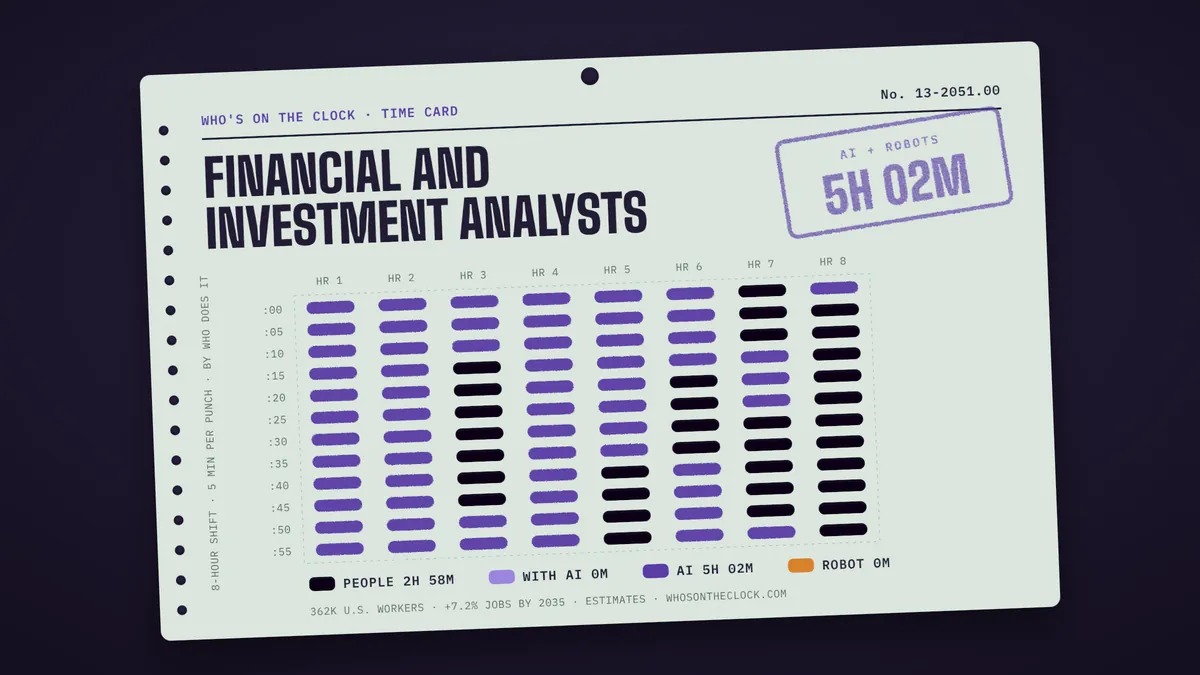
Financial and investment analysts or personal financial advisors: which will AI change more? AI and robots touch more of the day for financial and investment analysts: 5h 2m of an 8-hour shift, against 3h 4m for personal financial advisors. Median pay is about the same: $102,740 and $105,070.

Financial and Investment Analysts
5h 2mof an 8-hour shift touched by AI or robots
  • 2h 58mDone by people
  • 0mPeople do it with AI's help
  • 5h 2mAI mostly does it alone
  • 0mRobots have done it somewhere
Median pay
$102,740
U.S. workers
362,000
Outlook to 2035
+7.2%
Openings a year
25,000
Typical preparation
Bachelor's degree
See the full time card →
Personal Financial Advisors
3h 4mof an 8-hour shift touched by AI or robotsLess AI time
  • 4h 56mDone by people
  • 0mPeople do it with AI's help
  • 3h 4mAI mostly does it alone
  • 0mRobots have done it somewhere
Median pay
$105,070
U.S. workers
267,000
Outlook to 2035
+1.4%
Openings a year
17,000
Typical preparation
Bachelor's degree
See the full time card →

Financial and Investment Analysts

Where AI or robots show up most

  • Employ financial models to develop solutions to financial problems or to assess the financial or capital impact of transactions. 59m
  • Inform investment decisions by analyzing financial information to forecast business, industry, or economic conditions. 38m
  • Monitor fundamental economic, industrial, and corporate developments by analyzing information from financial publications and services, investment banking firms, government agencies, trade publications, company sources, or personal interviews. 32m

Biggest tasks still done by people

  • Perform securities valuation or pricing. 32m
  • Develop and maintain client relationships. 22m
  • Monitor developments in the fields of industrial technology, business, finance, and economic theory. 22m

Personal Financial Advisors

Where AI or robots show up most

  • Analyze financial information obtained from clients to determine strategies for meeting clients' financial objectives. 45m
  • Manage client portfolios, keeping client plans up-to-date. 39m
  • Answer clients' questions about the purposes and details of financial plans and strategies. 34m

Biggest tasks still done by people

  • Interview clients to determine their current income, expenses, insurance coverage, tax status, financial objectives, risk tolerance, or other information needed to develop a financial plan. 45m
  • Recruit and maintain client bases. 39m
  • Review clients' accounts and plans regularly to determine whether life changes, economic changes, environmental concerns, or financial performance indicate a need for plan reassessment. 34m

Swap in a different job Highlighted numbers are the higher of the two. Hours are estimates from each job's time card.