Helpers for Production Workers vs Molders, Shapers, and Casters

Side by side: how much of the shift AI and robots touch, pay, outlook and training.

Home / Compare

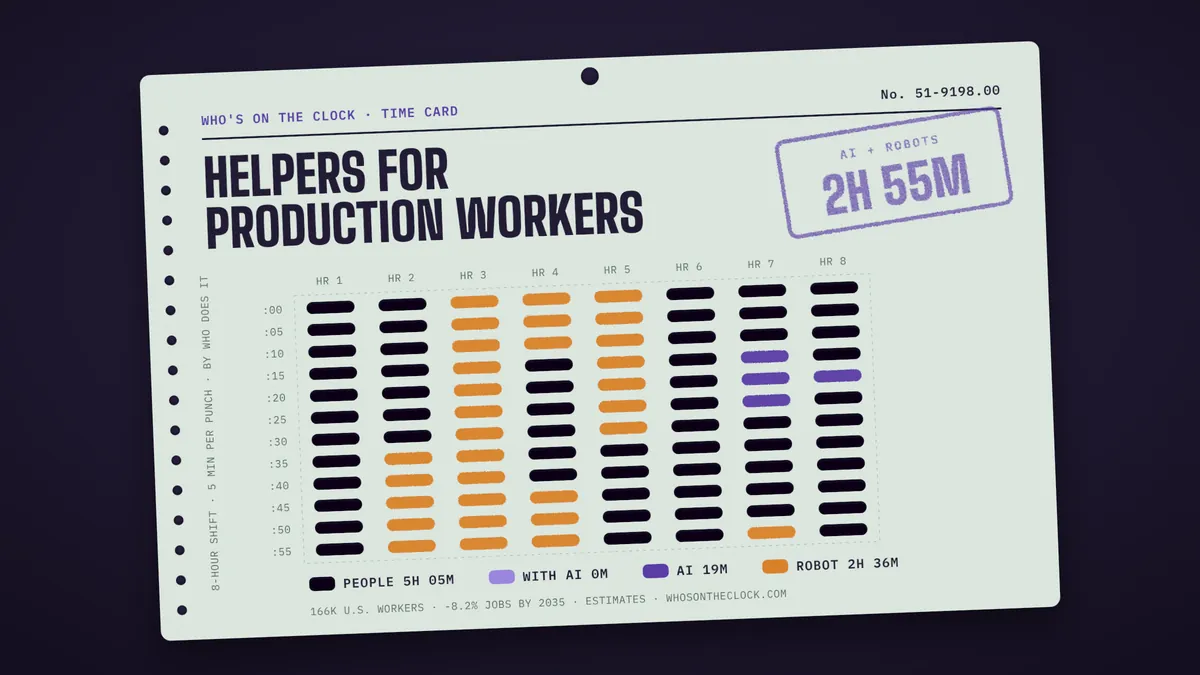
Helpers for production workers or molders, shapers, and casters: which will AI change more? AI and robots touch more of the day for helpers for production workers: 2h 55m of an 8-hour shift, against 6m for molders, shapers, and casters. Molders, shapers, and casters earn more, a median of $46,170 against $39,070.

The two jobs share very close skills, including repairing, equipment maintenance, operation and control, so moving between them is realistic for many people.

Helpers for Production Workers
2h 55mof an 8-hour shift touched by AI or robots
  • 5h 5mDone by people
  • 0mPeople do it with AI's help
  • 19mAI mostly does it alone
  • 2h 36mRobots have done it somewhere
Median pay
$39,070
U.S. workers
166,000
Outlook to 2035
-8.2%
Openings a year
21,000
Typical preparation
High school diploma, some training
See the full time card →
Molders, Shapers, and Casters
6mof an 8-hour shift touched by AI or robotsLess AI time
  • 7h 54mDone by people
  • 0mPeople do it with AI's help
  • 0mAI mostly does it alone
  • 6mRobots have done it somewhere
Median pay
$46,170
U.S. workers
33,000
Outlook to 2035
+5.8%
Openings a year
5,100
Typical preparation
High school diploma, some training
See the full time card →

Helpers for Production Workers

Where AI or robots show up most

  • Help production workers by performing duties of lesser skill, such as supplying or holding materials or tools, or cleaning work areas and equipment. 37m
  • Place products in equipment or on work surfaces for further processing, inspecting, or wrapping. 31m
  • Transfer finished products, raw materials, tools, or equipment between storage and work areas of plants and warehouses, by hand or using hand trucks or powered lift trucks. 31m

Biggest tasks still done by people

  • Load and unload items from machines, conveyors, and conveyances. 56m
  • Operate machinery used in the production process, or assist machine operators. 37m
  • Pack and store materials and products. 31m

Molders, Shapers, and Casters

Where AI or robots show up most

  • Set the proper operating temperature for each casting. 6m

Biggest tasks still done by people

  • Pour, pack, spread, or press plaster, concrete, or other materials into or around models or molds. 1h 13m
  • Trim or remove excess material, using scrapers, knives, or band saws. 36m
  • Measure ingredients and mix molding, casting material, or sealing compounds to prescribed consistencies, according to formulas. 36m

Swap in a different job Highlighted numbers are the higher of the two. Hours are estimates from each job's time card.