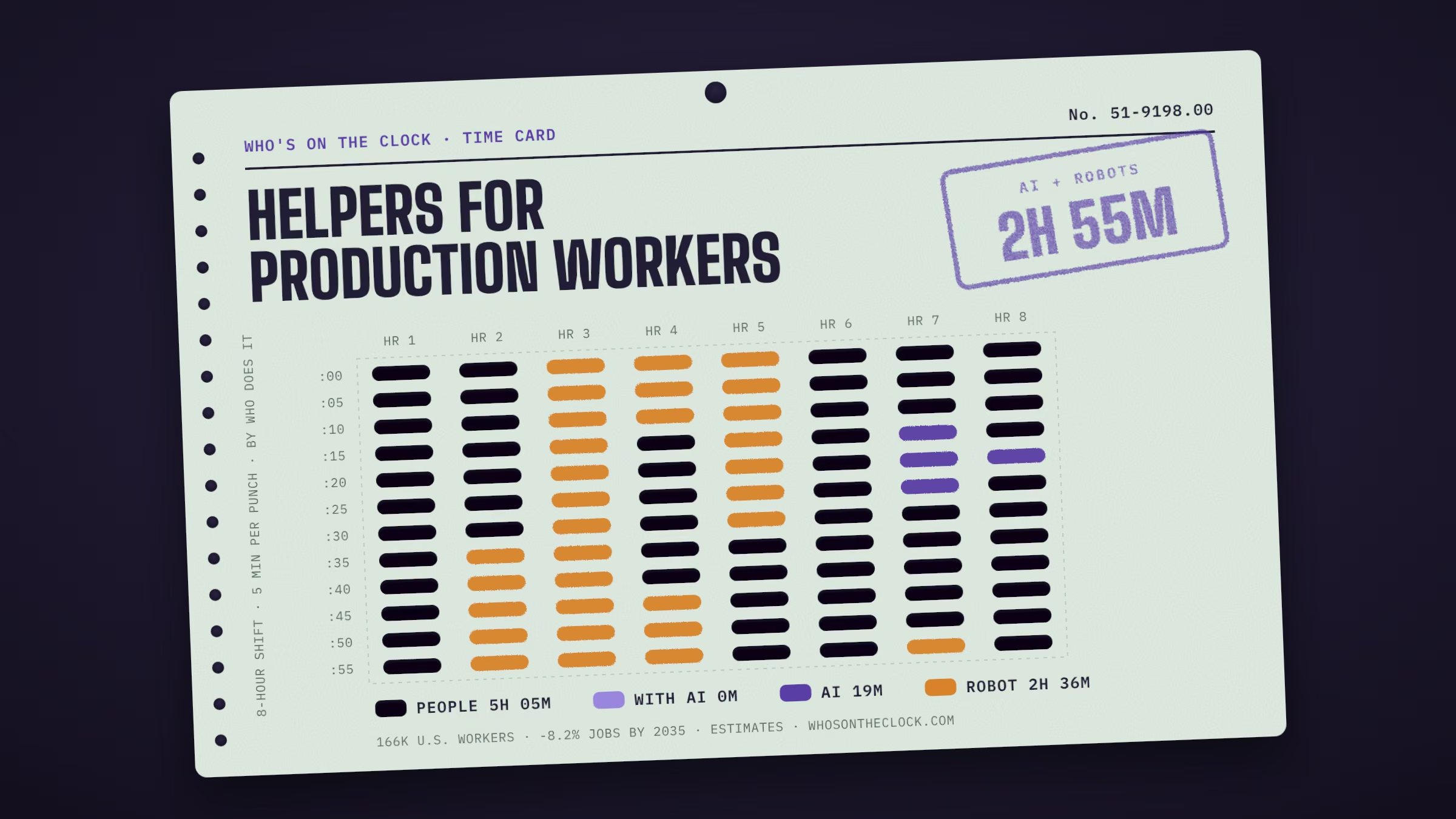
Help production workers by performing duties requiring less skill. Duties include supplying or holding materials or tools, and cleaning work area and equipment.
Time card
Untick tasks you don't do, or set your own times.
| Mine | Task, by time spent | Human | With AI | AI | Robot |
|---|---|---|---|---|---|
Load and unload items from machines, conveyors, and conveyances.56m a shift · Robots only in factory cellsWhy this label?Robots have done this only in factory setups built around the machine, so it stays Human for helpers for production workers. How labels work | |||||
Operate machinery used in the production process, or assist machine operators.37m a shift · Robots only in factory cellsWhy this label?Robots have done this only in factory setups built around the machine, so it stays Human for helpers for production workers. How labels work | |||||
Help production workers by performing duties of lesser skill, such as supplying or holding materials or tools, or cleaning work areas and equipment.37m a shift · Robots deployed · e.g. OTTO Motors AMRs (OTTO 100/1500)Why this label?Marked Robot because OTTO Motors AMRs (OTTO 100/1500) (in real use) has done this task in a real workplace. It shows a robot can do it somewhere, not that most helpers for production workers work alongside one. How labels work | |||||
Place products in equipment or on work surfaces for further processing, inspecting, or wrapping.31m a shift · Robots deployed · e.g. UR10e cobot + Keyence 3D bin picking machine-tending cell (integrated by GCG/AFS)Why this label?Marked Robot because UR10e cobot + Keyence 3D bin picking machine-tending cell (integrated by GCG/AFS) (in real use) has done this task in a real workplace. It shows a robot can do it somewhere, not that most helpers for production workers work alongside one. How labels work | |||||
Transfer finished products, raw materials, tools, or equipment between storage and work areas of plants and warehouses, by hand or using hand trucks or powered lift trucks.31m a shift · Robots deployed · e.g. MiR500 autonomous mobile robot (Mobile Industrial Robots)Why this label?Marked Robot because MiR500 autonomous mobile robot (Mobile Industrial Robots) (in real use) has done this task in a real workplace. It shows a robot can do it somewhere, not that most helpers for production workers work alongside one. How labels work | |||||
Pack and store materials and products.31m a shift · Robots only in factory cellsWhy this label?Robots have done this only in factory setups built around the machine, so it stays Human for helpers for production workers. How labels work | |||||
Remove products, machine attachments, or waste material from machines.25m a shift · Robots deployed · e.g. Universal Robots UR5 (CNC machine tending)Why this label?Marked Robot because Universal Robots UR5 (CNC machine tending) (in real use) has done this task in a real workplace. It shows a robot can do it somewhere, not that most helpers for production workers work alongside one. How labels work | |||||
Lift raw materials, finished products, and packed items, manually or using hoists.25m a shift · Robots deployed · e.g. Stretch (Boston Dynamics)Why this label?Marked Robot because Stretch (Boston Dynamics) (in real use) has done this task in a real workplace. It shows a robot can do it somewhere, not that most helpers for production workers work alongside one. How labels work | |||||
Examine products to verify conformance to quality standards.19m a shift · Robots only in factory cellsWhy this label?Robots have done this only in factory setups built around the machine, so it stays Human for helpers for production workers. How labels work | |||||
Observe equipment operations so that malfunctions can be detected, and notify operators of any malfunctions.19m a shift · No AI or robot evidence foundWhy this label?No AI use or robot deployment showed up for this task in our data. That isn't proof it's safe; it may just be rare in the data. How labels work | |||||
Clean and lubricate equipment.19m a shift · Robots only in factory cellsWhy this label?Robots have done this only in factory setups built around the machine, so it stays Human for helpers for production workers. How labels work | |||||
Prepare raw materials for processing.19m a shift · Robots only in factory cellsWhy this label?Robots have done this only in factory setups built around the machine, so it stays Human for helpers for production workers. How labels work | |||||
Wash work areas, machines, equipment, vehicles, or products.19m a shift · Robots only in factory cellsWhy this label?Robots have done this only in factory setups built around the machine, so it stays Human for helpers for production workers. How labels work | |||||
Record information, such as the number of products tested, meter readings, or dates and times of product production.12m a shift · Observed in AI useWhy this label?Marked AI because this task shows up regularly in real AI conversations (Anthropic Economic Index, 2025 usage), and in most of them AI does the task on its own rather than helping a person. Many workplaces may not use AI for it at all. How labels work | |||||
Start machines or equipment to begin production processes.6m a shift · Robots only in factory cellsWhy this label?Robots have done this only in factory setups built around the machine, so it stays Human for helpers for production workers. How labels work | |||||
Count finished products to determine if product orders are complete.6m a shift · Robots only in factory cellsWhy this label?Robots have done this only in factory setups built around the machine, so it stays Human for helpers for production workers. How labels work | |||||
Measure amounts of products, lengths of extruded articles, or weights of filled containers to ensure conformance to specifications.6m a shift · Robots only in factory cellsWhy this label?Robots have done this only in factory setups built around the machine, so it stays Human for helpers for production workers. How labels work | |||||
Separate products according to weight, grade, size, or composition of materials used to produce them.6m a shift · Robots deployed · e.g. TOMRA fresh-pack potato optical sorters (5A/5S/Sentinel II)Why this label?Marked Robot because TOMRA fresh-pack potato optical sorters (5A/5S/Sentinel II) (in real use) has done this task in a real workplace. It shows a robot can do it somewhere, not that most helpers for production workers work alongside one. How labels work | |||||
Turn valves to regulate flow of liquids or air, to reverse machines, to start pumps, or to regulate equipment.6m a shift · Robots only in factory cellsWhy this label?Robots have done this only in factory setups built around the machine, so it stays Human for helpers for production workers. How labels work | |||||
Mark or tag identification on parts.6m a shift · Robots only in factory cellsWhy this label?Robots have done this only in factory setups built around the machine, so it stays Human for helpers for production workers. How labels work | |||||
Mix ingredients according to specified procedures or formulas.6m a shift · Robots only in factory cellsWhy this label?Robots have done this only in factory setups built around the machine, so it stays Human for helpers for production workers. How labels work | |||||
Tie products in bundles for further processing or shipment, following prescribed procedures.6m a shift · Robots only in factory cellsWhy this label?Robots have done this only in factory setups built around the machine, so it stays Human for helpers for production workers. How labels work | |||||
Read gauges or charts, and record data obtained.6m a shift · Observed in AI useWhy this label?Marked AI because this task shows up regularly in real AI conversations (Anthropic Economic Index, 2025 usage), and in most of them AI does the task on its own rather than helping a person. Many workplaces may not use AI for it at all. How labels work | |||||
Unclamp and hoist full reels from braiding, winding, or other fabricating machines, using power hoists.6m a shift · Robots only in factory cellsWhy this label?Robots have done this only in factory setups built around the machine, so it stays Human for helpers for production workers. How labels work | |||||
Signal coworkers to direct them to move products during the production process.6m a shift · No AI or robot evidence foundWhy this label?No AI use or robot deployment showed up for this task in our data. That isn't proof it's safe; it may just be rare in the data. How labels work | |||||
Perform minor repairs to machines, such as replacing damaged or worn parts.6m a shift · Robots only in factory cellsWhy this label?Robots have done this only in factory setups built around the machine, so it stays Human for helpers for production workers. How labels work | |||||
Attach slings, ropes, or cables to objects such as pipes, hoses, or bundles.6m a shift · Robots only in factory cellsWhy this label?Robots have done this only in factory setups built around the machine, so it stays Human for helpers for production workers. How labels work | |||||
Position spouts or chutes of storage bins so that containers can be filled.6m a shift · Robots only in factory cellsWhy this label?Robots have done this only in factory setups built around the machine, so it stays Human for helpers for production workers. How labels work | |||||
Break up defective products for reprocessing.6m a shift · Robots only in factory cellsWhy this label?Robots have done this only in factory setups built around the machine, so it stays Human for helpers for production workers. How labels work | |||||
Cut or break flashing from materials or products.6m a shift · Robots only in factory cellsWhy this label?Robots have done this only in factory setups built around the machine, so it stays Human for helpers for production workers. How labels work |