Will AI replace actuaries?

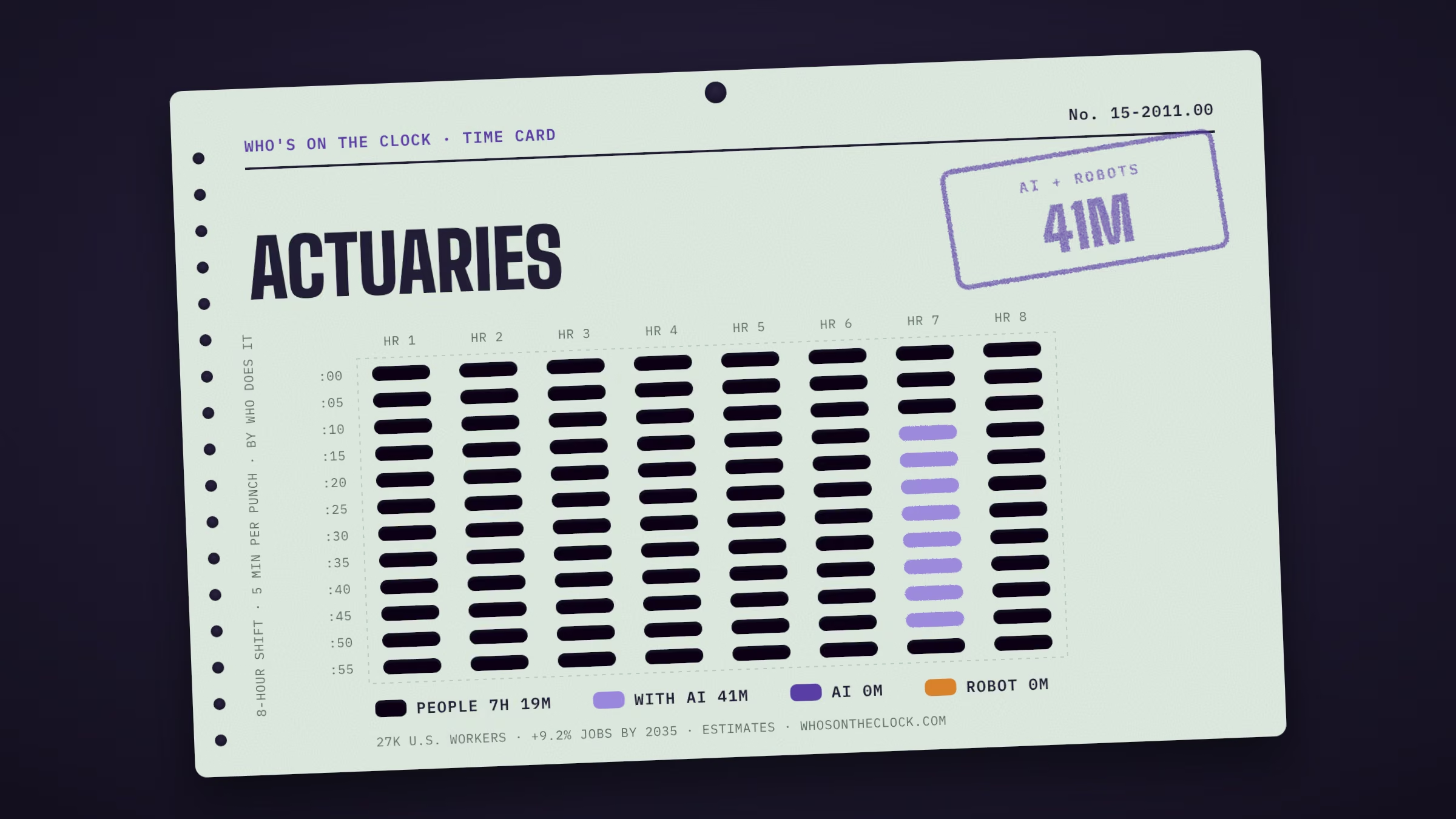
Here AI mostly shows up as a helper: people regularly use it for tasks like “Provide advice to clients on a contract basis, working as a consultant”. Tasks with AI help add up to 41m of a typical shift, while 7h 19m has no AI or robot evidence. BLS expects about 9.2% more of these jobs by 2035.

Time card for actuaries showing a typical 8-hour shift: 7h 19m done by people, 41m done by people with AI.
Each mark is 5 minutes of a typical shift for actuaries, colored by who does that task today. Estimates from O*NET tasks and Anthropic Economic Index data. How it's made

Home / Computers & math / Actuaries

Analyze statistical data, such as mortality, accident, sickness, disability, and retirement rates and construct probability tables to forecast risk and liability for payment of future benefits. May ascertain insurance rates required and cash reserves necessary to ensure payment of future benefits.

Time card

Untick tasks you don't do, or set your own times.
MineTask, by time spentHumanWith AIAIRobot
Ascertain premium rates required and cash reserves and liabilities necessary to ensure payment of future benefits.1h 40m a shift · No AI or robot evidence found
Why this label?No AI use or robot deployment showed up for this task in our data. That isn't proof it's safe; it may just be rare in the data. How labels work
Analyze statistical information to estimate mortality, accident, sickness, disability, and retirement rates.1h 28m a shift · No AI or robot evidence found
Why this label?No AI use or robot deployment showed up for this task in our data. That isn't proof it's safe; it may just be rare in the data. How labels work
Design, review, and help administer insurance, annuity and pension plans, determining financial soundness and calculating premiums.1h 10m a shift · No AI or robot evidence found
Why this label?No AI use or robot deployment showed up for this task in our data. That isn't proof it's safe; it may just be rare in the data. How labels work
Collaborate with programmers, underwriters, accounts, claims experts, and senior management to help companies develop plans for new lines of business or improvements to existing business.1h 4m a shift · No AI or robot evidence found
Why this label?No AI use or robot deployment showed up for this task in our data. That isn't proof it's safe; it may just be rare in the data. How labels work
Determine, or help determine, company policy, and explain complex technical matters to company executives, government officials, shareholders, policyholders, or the public.47m a shift · No AI or robot evidence found
Why this label?No AI use or robot deployment showed up for this task in our data. That isn't proof it's safe; it may just be rare in the data. How labels work
Provide advice to clients on a contract basis, working as a consultant.41m a shift · Observed in AI useTypical AI request: about 4h 32m alone, 54m with AI
Why this label?Marked With AI because people regularly use AI to help with this task in real conversations (Anthropic Economic Index, 2025 usage), but AI doesn't usually finish it alone. How labels work
Construct probability tables for events such as fires, natural disasters, and unemployment, based on analysis of statistical data and other pertinent information.23m a shift · No AI or robot evidence found
Why this label?No AI use or robot deployment showed up for this task in our data. That isn't proof it's safe; it may just be rare in the data. How labels work
Provide expertise to help financial institutions manage risks and maximize returns associated with investment products or credit offerings.12m a shift · No AI or robot evidence found
Why this label?No AI use or robot deployment showed up for this task in our data. That isn't proof it's safe; it may just be rare in the data. How labels work
Determine policy contract provisions for each type of insurance.12m a shift · No AI or robot evidence found
Why this label?No AI use or robot deployment showed up for this task in our data. That isn't proof it's safe; it may just be rare in the data. How labels work
Determine equitable basis for distributing surplus earnings under participating insurance and annuity contracts in mutual companies.6m a shift · No AI or robot evidence found
Why this label?No AI use or robot deployment showed up for this task in our data. That isn't proof it's safe; it may just be rare in the data. How labels work
Negotiate terms and conditions of reinsurance with other companies.6m a shift · No AI or robot evidence found
Why this label?No AI use or robot deployment showed up for this task in our data. That isn't proof it's safe; it may just be rare in the data. How labels work
Testify before public agencies on proposed legislation affecting businesses.6m a shift · No AI or robot evidence found
Why this label?No AI use or robot deployment showed up for this task in our data. That isn't proof it's safe; it may just be rare in the data. How labels work
Explain changes in contract provisions to customers.6m a shift · No AI or robot evidence found
Why this label?No AI use or robot deployment showed up for this task in our data. That isn't proof it's safe; it may just be rare in the data. How labels work
Testify in court as expert witness or to provide legal evidence on matters such as the value of potential lifetime earnings of a person disabled or killed in an accident.time not estimated · No AI or robot evidence found
Why this label?No AI use or robot deployment showed up for this task in our data. That isn't proof it's safe; it may just be rare in the data. How labels work
Manage credit and help price corporate security offerings.time not estimated · No AI or robot evidence found
Why this label?No AI use or robot deployment showed up for this task in our data. That isn't proof it's safe; it may just be rare in the data. How labels work

Clock history

  1. 41m touchedFirst published: O*NET 30.1, Anthropic Economic Index (2025 usage and September 2026 robot study), BLS May 2025

When new data changes this clock, the date, the new numbers and the reason are logged here. Company news alone never moves the clock.

On the floor

No company news tracked for this job yet. New stories are added as they happen.

Ask the clock

Will AI replace actuaries?

Unlikely, though parts of the work are changing. About 41m of an 8-hour shift goes to tasks touched by AI that people use as a helper. The other 7h 19m (91%) stays with people. Separately, BLS expects about 9.2% more of these jobs by 2035 (all jobs: +3.5%).

What can AI already do for actuaries?

AI shows up regularly in 1 of 15 tasks, about 41m of a typical shift. The biggest ones:

  • Provide advice to clients on a contract basis, working as a consultant. (41m a shift, people use AI to help)
What still needs a person?

7h 19m of a typical shift, or 91%, goes to tasks with no AI or robot evidence yet. No AI usage or robot deployment has shown up for these so far. The biggest:

  • Ascertain premium rates required and cash reserves and liabilities necessary to ensure payment of future benefits. (1h 40m a shift)
  • Analyze statistical information to estimate mortality, accident, sickness, disability, and retirement rates. (1h 28m a shift)
  • Design, review, and help administer insurance, annuity and pension plans, determining financial soundness and calculating premiums. (1h 10m a shift)
  • Collaborate with programmers, underwriters, accounts, claims experts, and senior management to help companies develop plans for new lines of business or improvements to existing business. (1h 4m a shift)
  • Determine, or help determine, company policy, and explain complex technical matters to company executives, government officials, shareholders, policyholders, or the public. (47m a shift)
Why is that work hard to automate?

Much of it comes down to where and how the work happens. In-person, hands-on and high-stakes work is where AI and robots have made the least headway so far. In the official O*NET survey of people in this job:

  • 64% talk face to face with others every day
How much time does AI save on these tasks?

For the 1 task in this job where AI shows up and timing data exists, a typical request takes about 4h 32m for a person alone and about 54m with AI. These are Claude's own estimates from real conversations in April and May 2026 (Anthropic Economic Index). They describe single requests, not whole workdays, and time saved on a task doesn't mean jobs are cut. The biggest gaps:

  • Provide advice to clients on a contract basis, working as a consultant (about 4h 32m alone, 54m with AI)
Are employers still hiring actuaries?

On Indeed, job postings in the Insurance sector are at 127% of their February 2020 level (all U.S. postings: 104%), up 5.1% from a year earlier, as of Oct 9, 2026. BLS separately expects about 1,500 openings a year in this job through 2035. Across all U.S. postings, 7.3% now mention AI skills. Sector postings cover more than this one job and move for many reasons besides AI.

How much do actuaries make?

The median pay is about $130,000 a year ($62.50 an hour), 155% above the median for all U.S. jobs ($50,980). Most people in this job earn between $78,570 and $215,100 a year; that range covers the middle 80%. Pay figures are from BLS, May 2025, and vary a lot by state and employer. Pick a state to compare:

Is this job growing or shrinking?

BLS projects growth of 9.2% from 2025 to 2035, compared with 3.5% growth for all jobs. That's about 34,000 jobs in 2035. It expects about 1,500 openings a year, mostly from people retiring or changing careers. These projections don't single out AI as a cause.

How many actuaries are there in the U.S.?

About 27,000 people in the U.S., roughly 0.02% of all workers (BLS, May 2025). That makes it the 498th largest of the 796 jobs on this site. BLS expects about 34,000 in 2035.

What training do actuaries need?

The most common requirement is a bachelor's degree: about 79% of people in the job said so in the official O*NET survey. O*NET rates the job at level 4 of 5 for preparation, which usually means: bachelor's degree. Requirements vary by state and employer, especially for licensed work.

What should I learn to stay ahead of AI?

These come from the job's official skill ratings and from the tasks that AI and robots touch least today. Building them keeps you strong in the parts of the work that still need a person:

  • Skills that matter more here than in most jobs: Mathematics, Systems Evaluation, Judgment and Decision Making, Systems Analysis
  • Get strong at the parts of the job that stay with people (listed above), which take 7h 19m of a typical shift
  • Tools employers list: Tableau, Structured query language SQL, SAS, R, Python
  • Learn to use AI well on the tasks where it already shows up in this job (listed above)
What other jobs could actuaries move into?

These use similar skills. Matches come from 109 official ratings of skills, knowledge and work activities, and each needs the same or less preparation unless the official list relates the jobs directly:

  • Economists (3h 39m touched, $125k median pay)
  • Business Intelligence Analysts (6h 5m touched, $120k median pay)
  • Personal Financial Advisors (3h 4m touched, $105k median pay)
  • Accountants and Auditors (2h 42m touched, $84k median pay)
How solid are these numbers?

Each task carries its own evidence label. For this job: 1 observed in real AI use, 14 with no AI or robot evidence found. The minutes per task are estimates, not measured hours, and "no evidence" doesn't prove a task is safe.

Tools in demand

  • Tableau
  • Structured query language SQL
  • SAS
  • R
  • Python
  • Microsoft Visual Basic for Applications VBA
  • Microsoft Power BI

Plus everyday office tools: Microsoft PowerPoint.

Also called

Actuarial Analyst, Actuarial Associate, Actuarial Consultant, Actuarial Intern, Actuarial Mathematician, Actuarial Specialist, Actuary, Annuity Analyst, Consulting Actuary, Corporate Actuary, Enrolled Actuary, Forecast Analyst, Health Actuary, Insurance Actuary