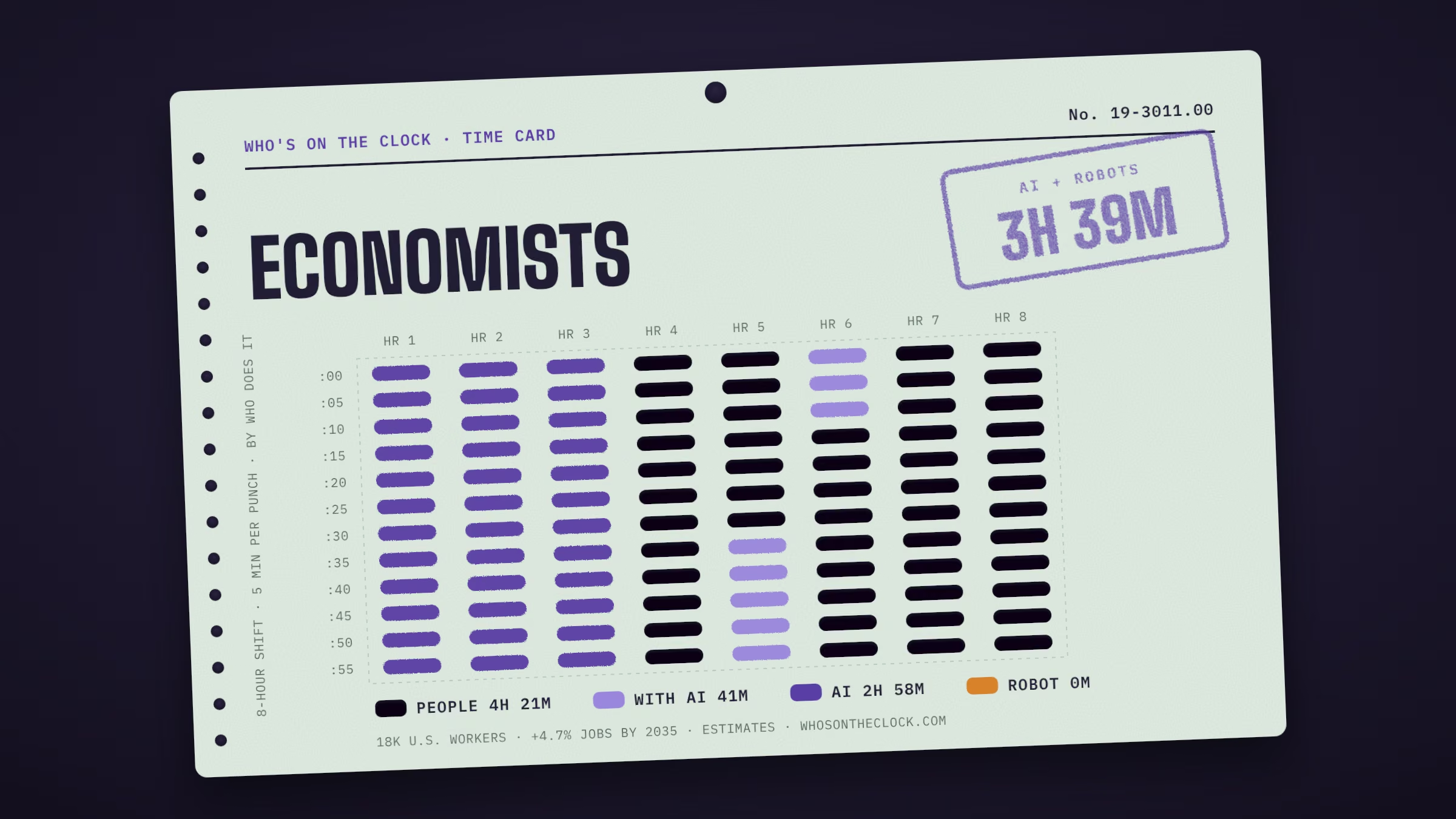
Some tasks are already handled by AI or machines; the rest still needs a person. About 2h 58m of an 8-hour shift goes to tasks that AI or robots largely take over. The breakdown: 41m done by people with AI help, 2h 58m that AI mostly does alone. The other 4h 20m (54%) stays with people. Separately, BLS expects about 4.7% more of these jobs by 2035 (all jobs: +3.5%).
⤢ Full sizeEach mark is 5 minutes of a typical shift for economists, colored by who does that task today. Estimates from O*NET tasks and Anthropic Economic Index data. How it's made
Conduct research, prepare reports, or formulate plans to address economic problems related to the production and distribution of goods and services or monetary and fiscal policy. May collect and process economic and statistical data using sampling techniques and econometric methods.
Time card
Untick tasks you don't do, or set your own times.
Mine
Task, by time spent
Human
With AI
AI
Robot
Compile, analyze, and report data to explain economic phenomena and forecast market trends, applying mathematical models and statistical techniques.1h 41m a shift · Observed in AI useTypical AI request: about 6h 17m alone, 22m with AI
Study economic and statistical data in area of specialization, such as finance, labor, or agriculture.1h 17m a shift · Observed in AI use
Conduct research on economic issues, and disseminate research findings through technical reports or scientific articles in journals.53m a shift · No AI or robot evidence found
Study the socioeconomic impacts of new public policies, such as proposed legislation, taxes, services, and regulations.41m a shift · No AI or robot evidence found
Provide advice and consultation on economic relationships to businesses, public and private agencies, and other employers.41m a shift · Observed in AI useTypical AI request: about 3h 20m alone, 27m with AI
Formulate recommendations, policies, or plans to solve economic problems or to interpret markets.41m a shift · No AI or robot evidence found
Review documents written by others.30m a shift · No AI or robot evidence found
Supervise research projects and students' study projects.24m a shift · No AI or robot evidence found
Explain economic impact of policies to the public.18m a shift · No AI or robot evidence found
Develop economic guidelines and standards, and prepare points of view used in forecasting trends and formulating economic policy.18m a shift · No AI or robot evidence found
Teach theories, principles, and methods of economics.12m a shift · No AI or robot evidence found
Provide litigation support, such as writing reports for expert testimony or testifying as an expert witness.12m a shift · No AI or robot evidence found
Testify at regulatory or legislative hearings concerning the estimated effects of changes in legislation or public policy, and present recommendations based on cost-benefit analyses.6m a shift · No AI or robot evidence found
Forecast production and consumption of renewable resources and supply, consumption, and depletion of non-renewable resources.6m a shift · No AI or robot evidence found
On the floor
No company news tracked for this job yet. New stories are added as they happen.
Ask the clock
Will AI replace economists?
Some tasks are already handled by AI or machines; the rest still needs a person. About 2h 58m of an 8-hour shift goes to tasks that AI or robots largely take over. The breakdown: 41m done by people with AI help, 2h 58m that AI mostly does alone. The other 4h 20m (54%) stays with people. Separately, BLS expects about 4.7% more of these jobs by 2035 (all jobs: +3.5%).
What can AI already do for economists?
AI shows up regularly in 3 of 14 tasks, about 3h 39m of a typical shift. The biggest ones:
Compile, analyze, and report data to explain economic phenomena and forecast market trends, applying mathematical models and statistical techniques. (1h 41m a shift, AI mostly does it alone)
Study economic and statistical data in area of specialization, such as finance, labor, or agriculture. (1h 17m a shift, AI mostly does it alone)
Provide advice and consultation on economic relationships to businesses, public and private agencies, and other employers. (41m a shift, people use AI to help)
What still needs a person?
4h 20m of a typical shift, or 54%, goes to tasks with no AI or robot evidence yet. No AI usage or robot deployment has shown up for these so far. The biggest:
Conduct research on economic issues, and disseminate research findings through technical reports or scientific articles in journals. (53m a shift)
Study the socioeconomic impacts of new public policies, such as proposed legislation, taxes, services, and regulations. (41m a shift)
Formulate recommendations, policies, or plans to solve economic problems or to interpret markets. (41m a shift)
Review documents written by others. (30m a shift)
Supervise research projects and students' study projects. (24m a shift)
Why is that work hard to automate?
Much of it comes down to where and how the work happens. In-person, hands-on and high-stakes work is where AI and robots have made the least headway so far. In the official O*NET survey of people in this job:
57% talk face to face with others every day
How much time does AI save on these tasks?
For the 2 tasks in this job where AI shows up and timing data exists, a typical request takes about 4h 48m for a person alone and about 24m with AI. These are Claude's own estimates from real conversations in April and May 2026 (Anthropic Economic Index). They describe single requests, not whole workdays, and time saved on a task doesn't mean jobs are cut. The biggest gaps:
Compile, analyze, and report data to explain economic phenomena and forecast market trends, applying mathematical models and statistical techniques (about 6h 17m alone, 22m with AI)
Provide advice and consultation on economic relationships to businesses, public and private agencies, and other employers (about 3h 20m alone, 27m with AI)
Are employers still hiring economists?
On Indeed, job postings in the Social Science sector are at 126% of their February 2020 level (all U.S. postings: 104%), down 6.7% from a year earlier, as of Oct 9, 2026. BLS separately expects about 1,100 openings a year in this job through 2035. Across all U.S. postings, 7.3% now mention AI skills. Sector postings cover more than this one job and move for many reasons besides AI.
How much do economists make?
The median pay is about $124,720 a year ($59.96 an hour), 145% above the median for all U.S. jobs ($50,980). Most people in this job earn between $67,360 and $238,060 a year; that range covers the middle 80%. Pay figures are from BLS, May 2025, and vary a lot by state and employer. Pick a state to compare:
Is this job growing or shrinking?
BLS projects growth of 4.7% from 2025 to 2035, compared with 3.5% growth for all jobs. That's about 20,000 jobs in 2035. It expects about 1,100 openings a year, mostly from people retiring or changing careers. These projections don't single out AI as a cause.
How many economists are there in the U.S.?
About 18,000 people in the U.S., roughly 0.01% of all workers (BLS, May 2025). That makes it the 571st largest of the 796 jobs on this site. BLS expects about 20,000 in 2035.
What training do economists need?
The most common requirement is a master's degree: about 50% of people in the job said so in the official O*NET survey. O*NET rates the job at level 5 of 5 for preparation, which usually means: graduate degree. Requirements vary by state and employer, especially for licensed work.
What should I learn to stay ahead of AI?
These come from the job's official skill ratings and from the tasks that AI and robots touch least today. Building them keeps you strong in the parts of the work that still need a person:
Skills that matter more here than in most jobs: Mathematics, Judgment and Decision Making, Critical Thinking, Writing
Get strong at the parts of the job that stay with people (listed above), which take 4h 20m of a typical shift
Learn to use AI well on the tasks where it already shows up in this job (listed above)
What new tasks are economists taking on?
Yes. Occupational experts recently added these to the official task list, a sign of how the work itself is shifting. New tasks aren't rated for AI or robots yet:
Construct and manage economic datasets.
Present research at seminars and conferences.
What other jobs could economists move into?
These use similar skills, with less of a typical shift touched by AI or robots. Matches come from 109 official ratings of skills, knowledge and work activities, and each needs the same or less preparation unless the official list relates the jobs directly:
Environmental Economists (1h 47m touched, $125k median pay)
Climate Change Policy Analysts (0m touched, $82k median pay)
How solid are these numbers?
Each task carries its own evidence label. For this job: 3 observed in real AI use, 11 with no AI or robot evidence found. The minutes per task are estimates, not measured hours, and "no evidence" doesn't prove a task is safe.
Tools in demand
Tableau
Structured query language SQL
SAS
R
Python
Microsoft PowerPoint
Microsoft Power BI
Microsoft Office software
Also called
Agricultural Economist, Business Economist, Consultant Economist, Econometrician, Economic Advisor, Economic Analyst, Economic Consultant, Economic Developer, Economic Development Manager, Economic Development Specialist, Economic Research Analyst, Economic Specialist, Economist, Environmental Economist